
Wolfgang Amadeus Mozart - Violin Sonata No. 22 in A major, K. 305
In Mo Yang (Violin)
Renana Gutman (Piano)
Brahms, Four Ballades op. 10
April 11, 2016. Four Ballades op. 10 by Brahms. Today we’re publishing Joseph DuBose’s article on one of Johannes Brahms’s youthful compositions, Four Ballades op. 10. We’ll illustrate them with performances by Sevgi Giles. ♫
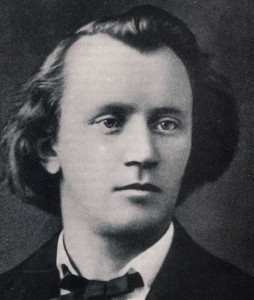 The four Ballades of Brahms’s opus 10 were the first foreshadowing of the eventual direction his output for piano would take. Composed in 1854, they followed the completion of his third and last piano sonata by roughly a year, and were his first foray into the newfound realm of miniatures. Perhaps it was mere curiosity that led the young composer—Brahms was only in his early twenties at the time—from his Classically inspired sonatas to the miniatures born of the Romantic period, yet it would be the latter pieces that would largely come to define his output as composer for the piano. Although nearly a quarter of a century would pass, in which time Brahms championed the large-scale variation form with such works as the Paganini and Haydn Variations, and the Variations and Fugue on a Theme of G.F. Handel, he returned to the miniature in his 8 Klavierstücke, op. 76. This work would, in turn, prove to be only the foundation for the ethereal and introspective pieces to come during the 1890s.
As a musical form, the ballade takes its name from the literary tradition of ballad poetry, which often employed grand themes of heroism or mythology. The ballade became established primarily at the hands of Chopin, who composed four examples between 1831 and 1842. Though it is suggested Chopin’s compositions were inspired by the poetry of Adam Mickiewicz, there is no direct evidence of this from the composer himself. Instead, the term ballade for Chopin seemed to have a similar connotation as the fantasia, a rather free development of ideas with little or no expectation as to formal arrangement, yet also unified with a greater sense of coherence—the development of a musical “narrative,” so to speak. It is natural, then, that Chopin’s ballades borrowed from the established conventions of sonata form, and thereby furthered the weighty discourses found within them.
Perhaps the most significant set of the ballades to follow Chopin’s was that of Brahms, though other notable composers, such as Franz Liszt, would compose their own ballades. Brahms approached the ballade in the same manner as he would many of the piano pieces of his last years—i.e., the three-fold division of the ternary form. Brahms’s ballades in this regard are less expansive as Chopin’s. All four embody some variation of a tripartite form. The first, perhaps, has the closest connection to Chopin. While in ternary form, its middle section, instead of presenting new material, develops upon that of the principal theme. Yet, its monothematicism and abbreviated reprise hardly qualify it as a bona-fide sonata form. The second employs a modified ternary, or, perhaps more appropriately, arch form, while the fourth nearly presents a complete rondo. Only the third is composed in a blatant ternary design. (Continue reading here).
Read more...Robert Schumann - Widmung
Ling-Ju Lai (Piano)
Johann Sebastian Bach - Partita No. 4 in D Major, BWV 828
Ling-Ju Lai (Piano)
Frédéric Chopin - Nocturne in D-flat Major Op. 27 No. 2
Ling-Ju Lai (Piano)
P. Kellach Waddle - Four Offertories for Piano
Nikki Birdsong (Piano)
P. Kellach Waddle - The Reflections and Secrets In July's Darkest Espresso -- Sonata in 4 mvmts. for Solo Bass
P. Kellach Waddle (Double Bass)
P. Kellach Waddle - The Midnight Laundry; The Midnight Candy for Vla/Cello/Contrabasn/Bass Flute
Rose Holden ( BASS flute) (Flute)
Samuel Nordlund (Viola)
Michael Fernandez (Cello)
Dylan Ingram ( CONTRAbassoon) (Bassoon)
Johann Kuhnau - Gideon the Savior of the People of Israel
John Butt (Harpsichord)
Robert Schumann - Violin Sonata No. 3 in A minor, WoO 2
In Mo Yang (Violin)
Renana Gutman (Piano)