
Anna Khanina, Piano
07/16/2014 12:15, Preston Bradley Hall
Prelude and Fugue No. 4 in E minor -- Dmitri Shostakovich
Piano Sonata in A Major, D. 664 -- Franz Schubert
From Préludes, Book 1 -- Claude Debussy
Les sons et les parfums tournent dans l'air du soir
Minstrels: Modéré
Alon Goldstein, Piano
07/09/2014 12:15, Preston Bradley Hall
Dame Myra Hess Memorial Concert
Al Booth Memorial Concert
Impromptu in E-flat Major, Op. 90 No. 2 -- Franz Schubert
Une Barque sur L’Ocean, from Miroirs -- Maurice Ravel
Three Etudes -- Avner Dorman (b. 1975)
I. Snakes and Ladders
II. Funeral March
III. Sundrops Over Windy Water
Sonata No. 26 in E-flat Major, Op. 81a, "Les Adieux" -- Ludwig van Beethoven
Stella Chen, Violin and Renana Gutman, Piano
07/02/2014 12:15, Preston Bradley Hall
Caprice No. 23 -- Niccolò Paganini
Chaconne from Partita No. 2, BWV 1004 -- Johann Sebastian Bach
Violin Sonata No. 22 in A Major, K. 305 -- Wolfgang Amadeus Mozart
Nocturne in C-Sharp minor, B.49 -- Frédéric Chopin (arr. Nathan Milstein)
Christoph Willibald Gluck at 300
June 30, 2014. Christoph Willibald Gluck at 300. We’ve never written about Gluck before, even though he was one of the most important composers of the 18th century: he composed mostly operas, and this genre is not well represented on Classical Connect. That’s why it’s a special pleasure to do so on his 300th birthday 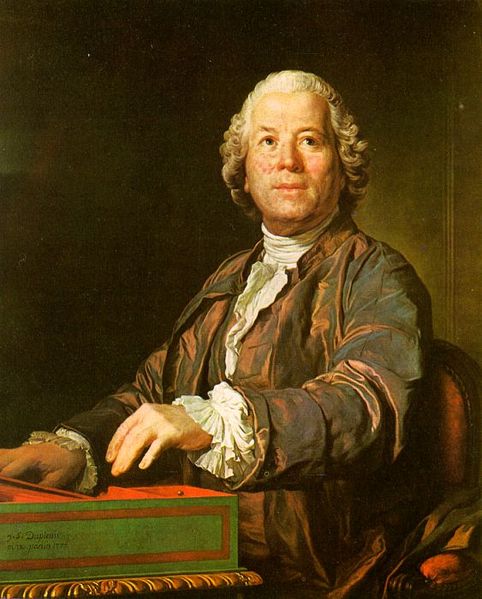 anniversary. Gluck was born on July 2nd of 1714 in Erasbach, now part of the town of Berching in Bavaria into a family of a forester. When Christoph was three, they moved to Bohemia where his father found a job as the head forester to Prince Lobkowicz (Lobkowiczes were an old noble family and patrons of art: two generations later Prince Joseph Franz Maximilian Lobkowicz would become a patron first of Haydn and then Beethoven; Haydn’s “Lobkowicz” quartet and several of Beethoven’s symphonies and quartets are dedicated to him). Christoph fell in love with music early and learned to play several instruments. As a teenager he left home and went to Prague to study music; he also enrolled in the university there but never finished his studies. In 1736 he went to Vienna. There his talents were noticed by an Italian nobleman who brought Christoph to Milan. He took musical lessons from Giovanni Battista Sammartini and wrote his first opera, Artaserse, which was premiered in 1741 at Teatro Ducal. The libretto of the opera was by Metastasio, probably the greatest and most prolific librettist of the time. Gluck stayed in Italy till 1745, writing several more operas, all to the texts of Metastasio. In 1745, already a well-known opera composer, he went to London to challenge Handel’s dominance of the opera scene; he wasn’t very successful. He left London a year later and for the next several years moved from one town to another, writing operas for theaters in Dresden, Vienna and Prague along the way. One of them was the very successful La clemenza di Tito on the libretto of Metastasio; it was performed in the famous Teatro di San Carlo in Naples (Mozart’s opera of the same title, his last one, used the libretto that was a reworking of Metastasio’s original).
Gluck settled in Vienna in 1754, supporting himself as a Kapellmeister at the court of a wealthy patron. Italian operas, seria (serious) and buffa (comic), were dominating the Viennese scene, and they were getting stale. Many opera productions were turning into vehicles for singers who more interested in demonstrating their virtuosity than in music or drama. Gluck attempted to reform the opera, putting the emphasis on the story and musical development, rather than the coloratura (Richard Wagner had a similar impulse a century later). The first significant composition in this new style was Orfeo ed Euridice, which premiered in 1762. Till this day, it remains his most popular creation. The original Orfeo was the famous castrato Gaetano Guadagni; today this role is sometimes performed by mezzo-sopranos, high tenors (Juan Diego Flórez is a good example) or counter-tenors. Here’s Marilyn Horn as Orfeo in the famous aria Che farò senza Euridice? (What will I do without Euridice?). Georg Solti conducts the Covent Garden Orchestra.
One of Gluck’s pupils in Vienna was Princess Maria Antonia, who as Marie Antoinette would marry the future King of France Louis XVI in 1770. Gluck moved to Paris in 1773 and Marie Antoinette became his patron, helping him to secure a contract for six operas with the Paris Opera company. Gluck’s Iphigénie en Aulide, premiered in 1774, and the French remake of Orfeo were very successful. Unfortunately, several other operas failed to impress the public. Gluck was deeply hurt and left Paris for Vienna in May of 1776. In Paris the opera world was split between two camps: the supporters of Gluck and those who preferred operas of Niccolò Piccinni, a practically forgotten Italian who in the 1770s was probably the most popular opera composer in Europe. In Vienna Gluck was made a Court composer, but he would return to Paris on two more occasions, in 1777 and 1778. On the last trip he brought with him two of his latest operas, Iphigénie en Tauride and Echo et Narcisse. The former was a big success but the latter failed. To make things worse, during the rehearsals of Echo Gluck suffered a stroke. He left Paris for the last time in October of 1779. In Vienna he continued revising his older creations but never wrote anything major. He suffered two more strokes, the last of which killed him on November 15th, 1787. Let’s listen to the overture to Iphigénie en Aulide; it’s played in its original form, how Gluck wrote it rather that the popular Wagner revision. John Eliot Gardiner conducts the Lyon Opera Orchestra.
Read more...Christoph Gluck - Iphigénie en Aulide overture
Lyon Opera Orchestra (Orchestra)
John Eliot Gardiner (Conductor)
Christoph Gluck - Che farò senza Euridice?, from Orfeo ed Euridice
Marilyn Horne (Mezzo-soprano)
Covent Garden Orchestra (Orchestra)
Georg Solti (Conductor)
James Woodward - Variations on Adeste Fideles
Gaudete Brass (Quintet)
Giaches De Wert - Dica chi vuol
Gaudete Brass (Quintet)
Giaches De Wert - Io non son però morto
Gaudete Brass (Quintet)
Sergei Rachmaninov - Polichinelle, from Morceaux de fantaisie Op. 3
David-Michael Dunbar (Piano)