
Keith Pound - sunrise flute
keith pound (Ensemble)
Bowlin-Li-Myer Trio
12/18/2013 10:59, Preston Bradley Hall
David Bowlin, Violin
Si-Yan Darren Li, Cello
Spencer Myer, Piano
Primavera Porteña for Violin, Cello and Piano -- Ástor Piazzolla
Piano Trio No. 2 in C Major, Op. 87 -- Johannes Brahms
I. Allegro
II. Andante con moto
III. Scherzo. Presto – Poco meno presto
IV. Finale. Allegro giocoso
Dame Myra Hess Memorial Concert Gaudete Brass Quintet
12/11/2013 12:15, Preston Bradley Hall
Trumpets - Bill Baxtresser and Ryan Berndt; Horn - Julia Filson; Trombone - Paul Von Hoff; Tuba - Scott Tegge
Entrance -- David Sampson (b. 1951)
Christ Lag in Todesbanden -- Michael Praetorius
Prayers of Steel -- Jonathan Newman (b.1972)
I. Limited
II. Foxtrot
III. Prayers of Steel
IV. City of Big Shoulders
Still -- David Sampson
16th c. Italian Madrigals -- Giaches de Wert (c.1535 – 1596)
I. Questi odorate fiori - These fragrant flowers
II. Misera, che faro - Unhappy wretch
III. Io non son però morto - I am, however, not dead
IV. Dica chi vuol - Let them say whatever, I will be happy
Variations on Adeste Fideles -- James Woodward (b. 1987)
Rachel Schutz, Soprano and Jonathan Korth, Piano
12/04/2013 12:15, Preston Bradley Hall
William Shakespeare
It was a lover and his lass from Let us garlands bring - Gerald Finzi
Come away, death, Op. 6, No. 1 - Roger Quilter (1877 – 1953)
Winter from Six Elizabethan Songs - Dominick Argento (b. 1927)
Johann Wolfgang von Goethe - Hugo Wolf
Die Spröde
Die Bekehrte
Frühling übers Jahr
Alexander Pushkin - Sergei Rachmaninoff
Muza, Op. 34, No. 1
Ne poy krasavitsa pri mne, Op. 4, No. 4
Excerpts from Twelve Poems of Emily Dickinson - Aaron Copland
Why do they shut me out of heaven?
Heart, we will forget him
Dear March, come in!
Sleep is supposed to be
Paul Verlaine - Claude Debussy
Fantoches from Fêtes Gallantes I
Pantomime from Quatre chansons de jeunesse
Mandoline
Soler, Geminiani, Sibelius 2013
December 2, 2013. Soler, Geminiani and Sibelius. Francesco Geminiani was born in Lucca on December 5th, 1687. He studied music with Alessandro Scarlatti and later with Arcangelo Corelli. In 1711 he became the leader of the Opera orchestra of Naples, 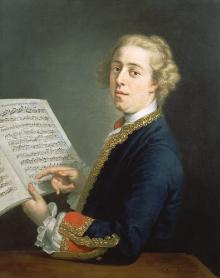 where he was also the concertmaster. His teacher Scarlatti was living (and writing operas) in Naples during that time, so they resumed their contacts. In 1714 Geminiani moved to London. By then he had a reputation as a violin virtuoso. George Frideric Handel, who also studied with Corelli, was the king of the London music scene. All things Italian were very popular in London in those days (the tradition of a young gentleman’s Grand Tour with its obligatory stops in Florence, Rome, and also Venice and Naples, was established at the end of the 17th century), and Geminiani was invited to the court of George I. There he played the violin accompanied by Handel himself. Geminiani lived in England and Ireland for the rest of his life (he died in Dublin on September 17th, 1762). He had many students and in 1751 published an influential book on violin playing, Art of Playing the Violin. Among his best-known compositions are concerti grossi, some of them based on the music of his teacher Corelli. Here, for example is Geminiani’s Concerto Grosso no. 12 in D minor "La Follia," which was based on Corelli’s Violin sonata op.5 no. 12, which in turn was based on the famous tune, La Folia. It’s performed by The English Concert, Trevor Pinnock conducting. And here is his Concerto Grosso op. 7 no. 3. It’s performed by Capella Istropolitana, Jaroslav Krcek conducting.
Antonio Soler was born on December 3rd, 1729 in a small Catalan town of Olot. There is a connection between Soler and Geminiani: the former studied with Domenico Scarlatti, while the latter – with Domenico’s father Alessandro. Soler went to the choir school of the monastery of Monserrat and soon after was made chapel master at the Lerida Cathedral. In 1752 he joined the Order of St. Jerome (therefore “Padre” or “Father” Soler, as he’s commonly called) and became the organist at the royal Monastery of El Escorial. While there he wrote more than 500 compositions, among them 150 keyboard sonatas, many of them highly original, with unexpected harmonic developments (it’s rumored, though, that some of the sonatas were actually written by his pupil, Infante Gabrile, son of the king Carlos III). Soler also wrote church music and music for plays, but it’s his keyboard sonatas that he’s famous for. Here are three sonatas by Soler, performer by the great Spanish pianist Alicia de Larrocha: F-sharp minor R 85; in D Major R86, and F-sharp major R 90.
Jean Sibelius is another composer who has his birthday this week. He was born on December 8th, 1865 in Hämeenlinna, not far from Helsinki in what was then part of the Russian Empire. The first thing that comes to mind when one compares the work of Sibelius with the baroque composers like Geminiani and Soler is not the difference in style, which of course is enormous, – it’s the intensity and seriousness of purpose. For Sibelius, a Finnish nationalist whose first language was Swedish, Finland’s independence was paramount, and while he couldn’t do much about it politically, he attempted to create it in his music; his Symphony no. 2 was dubbed “The Symphony of Independence.” As a composer he was a master, building his work as a progression of different elements and fragments. In this respect, his recollection of a conversation with Gustav Mahler, whom he met in 1907 while Mahler was touring Finland, is very telling for our understanding of both composers. “I said that I admired [the symphony's] severity of style and the profound logic that created an inner connection between all the motifs... Mahler's opinion was just the reverse. 'No, a symphony must be like the world. It must embrace everything.’” It couldn’t be said better: Mahler’s symphonies are like the world, and Sibelius’s are logical. Sibelius composed his Symphony no. 5 in 1915; the symphony was commissioned by the Finnish Government to commemorate Sibelius’s 50th birthday, and it was premiered on that date, December 8th, 1915 in Helsinki. In this recording Herbert von Karajan conducts the Berlin Philharmonic (here).
Read more...Antonio Soler - Sonata in F-sharp Major, R 90
Alicia de Larrocha (Piano)
Antonio Soler - Sonata in D Major, R86
Alicia de Larrocha (Piano)
Antonio Soler - Sonata in F-sharp minor, R 85
Alicia de Larrocha (Piano)
Francesco Geminiani - Concerto Grosso no. 12 in D minor "La Folia"
The English Concert (Ensemble)
Trevor Pinnock (Conductor)
Sergei Prokofiev - Sonata for Cello and Piano in C Major
Adriana La Rosa Ransom (Cello)
Jason Alfred (Piano)