
Dukas and Charpentier, 2013
September 30, 2013. Paul Dukas and Marc-Antoine Charpentier. The French composer Paul Dukas is know mostly for his orchestral poem The Sorcerer's Apprentice, but it’s such a lovely piece that it alone places Dukas’ name alongside the best 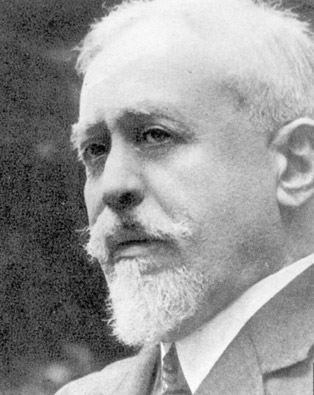 French composers of the late 19th century. Paul Dukas was born in Paris on October 1, 1865 into a well to do Jewish family; his father was a banker. Apparently Dukas didn’t show any special musical talents till the age of 14, when, while recovering from an illness, he started composing. Two years later he entered the Paris Conservatory, where he met Claude Debussy; the two became close friends. In 1888, Dukas failed to win the prestigious Prix du Rome (Debussy had won it four years earlier) and disappointed, left the Conservatory. After a stint in the army he started his second career as a music critic. As a composer, Dukas was very self-conscious and, if dissatisfied, would destroy his own music: the list of pieces he rejected is almost as long as those that he published. His first big composition, Symphony in C Major, was premiered in1896 to mixed reviews. Then, a year later, he wrote The Sorcerer's Apprentice, a symphonic piece inspired by Goethe’s poem by the same name. The poem describes an apprentice of an old sorcerer, who, when left alone, performs small magic, making a broom fetch water for him. Unfortunately, he doesn’t know how to break the spell and almost drowns, but the old sorcerer arrives just in time to restore order. The work is programmatic and almost literally descriptive in the way it follows the development of Goethe’s poem (in this it reminds one of Richard Strauss’s Till Eulenspiegel's Merry Pranks, with it’s Till’s theme and the representation of people and events). The music immediately became very popular, eclipsing everything else Dukas wrote either before or after. In 1899 he composed a rather successful opera Ariane et Barbe-bleue. He continued writing music till 1912, after which he turned to teaching. Maurice Duruflé, Olivier Messiaen, Manuel Ponce, Joaquín Rodrigo were among his students. Dukas died in 1935 aged 69. You can hear The Sorcerer's Apprentice in the recording by the Cincinnati Symphony Orchestra, Jesús López-Cobos conducting.
We’ll stay in France for a little longer to salute another composer who lived two centuries earlier: Marc-Antoine Charpentier (who should not be confused with another Charpentier, Gustave, a contemporary of Dukas and the author of the opera Louise). We don’t know his date of birth, except that it was in 1643. Marc-Antoine was probably born in Paris, got a good education and spent some time in Rome, studying with the then-famous Roman composer Giacomo Carissimi. Upon returning to Paris he found employment at the court of Mademoiselle Guise, the daughter of Charles, Duke of Guise and a cousin of King Louis XIV. Charpentier lived and worked in Hôtel de Guise for the next 17 years. He wrote music to the plays of Molière and Corneille and had his operas staged, even though Jean Baptiste Lully had a virtual monopoly over theatrical music. In 1679 Charpentier became the court composer for Grand Dauphin, the eldest son of the King and in 1698 he was appointed maître de musique for the Royal choir of Sainte-Chapelle. Charpentier died on February 24, 1704 in Sainte-Chapelle and was buried in the cemetery behind the choir. Here is one of the most famous of Charpentier’s compositions, the motet Te Deum. Charpentier wrote several settings, all between 1688 and 1698. This performance is by the Orchestra and the chorus of Accademia Nazionale Di Santa Cecilia, Myung-Whun Chung conducting.
Read more...Paul Dukas - The Sorcerer's Apprentice
Cincinnati Symphony (Orchestra)
Jesús López-Cobos (Conductor)
Olivier Greif - Second Hommage à Raymond Roussel op. 37
Nicolas Horvath (Piano)
Claude Debussy - Claire de lune, from Suite Bergamasque
David-Michael Dunbar (Piano)
Alexander von Zemlinsky - Die Seejungfrau
Berlin Radio Symphony (Orchestra)
Ricardo Chailly (Conductor)
Franz Schubert - Twelve German Dances, Op. 171, D. 790
Inesa Sinkevych (Piano)
Claude Debussy - Etude No. 7, Pour les degrés chromatiques
Inesa Sinkevych (Piano)
Claude Debussy - Ondine, from Préludes Book II
Inesa Sinkevych (Piano)
Rameau and Shostakovich 2013
September 23, 2013. Jean-Philippe Rameau and Dmitry Shostakovich. Two composers, both major figures during their lifetime, were born this week. One dominated the music scene during the reign of French King Louis XV, another was considered, officially (if not always), the greatest composer of the Soviet Union. That’s where the parallel ends however; it’s not just that two and a half centuries separate them: Rameau lived during the most brilliant period of French history; Shostakovich’s time was one of the most oppressive in all of the history of Russia. Jean-Philippe Rameau was born on September 25, 1683, when Louis XIV the Sun King ruled France, but he didn’t come to age as a composer till the 1720s; by then Louis XIV’s son was king. Rameau was approaching 50 when he wrote his first opera, but once he started, he wouldn’t write anything else. He wrote more than 30, and in toto they represent a major development in music history of the 18th century. His very first opera Hippolyte et Aricie, written in 1733, was premiered at the Palais-Royal, his second, Samson, had none other than Voltaire as the librettist. (Unfortunately, it was never performed, even though it went into rehearsals, and its score has been lost). The third opera, Les Indes galantes, was a big success. A curious historical anecdote relates to this opera. In 1725 the French settlers convinced several Indian chiefs, Agapit Chicagou among them, to go to Paris. Many Indian chiefs decided to travel to France, but as they were about to board the ship, it sunk; after the accident, most of the chiefs returned home. Apparently the ones who went had a good time in Paris and eventually were brought to Fontainebleau, were they met with the King. The chiefs pledged allegiance to the French crown, and later performed ritual dances at the Theatre Italien. Rameau was inspired by this event; the fourth act (entrées) of Les Indes galantes is called Les Sauvages and tells the story of a daughter of an Indian chief being pursued by a Spaniard and a Frenchmen.
Rameau wrote his 13th opera, Zaïs, in 1748. The highly imaginative Overture to the opera depicts the emergence of the four elements,Earth, Water, Air, and Fire, out of chaos. You can hear it in the performance by Les Musiciens Du Louvre under the direction of Marc Minkowski.
Dmitry Shostakovich, who was also born on September 25, 1906 in St.-Petersburg, Russia, is known mostly as a symphonist. This reputation is totally deserved: Shostakovich wrote 15 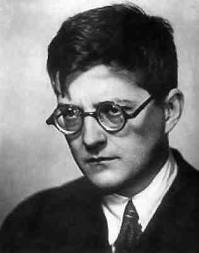 symphonies, many of them are among the most important music of the 20th century. He also wrote 15 string quartets, and often these were much more personal, less affected by the events of the day. In 1936 his opera Lady Macbeth of the Mtsensk District, which initially was hailed by the Soviet propaganda machine as a “result of the correct policy of the Party,” fell out of favor. The opera was denounced in Pravda. The same year, in a frightening episode, Shostakovich went to the Bolshoi Theater for a performance of Lady Macbeth only to find Stalin and members of the Politburo in the main box. To his horror they cringed as the music got loud and laughed during the love scenes. Shostakovich was “white as a sheet” when he took bows at the end of the opera. The Great Terror was gaining speed; many of Shostakovich’s friends, including his major patron, Marshal Tukhachevsky, were arrested and shot. His Fourth symphony was banned (officially, Shostakovich withdrew it voluntarily). Scared for his life, he wrote the Fifth Symphony in a much more conservative manner, and it was a great success, both with the public and the officials. This restored Shostakovich’s reputation: the official line was that he learned from his mistakes. That was when Shostakovich composed his first string quartet: the more chamber setting allowed him to experiment with the musical ideas he would not dare to expose in a symphony. You can hear the Quartet no. 1 in C Major op. 49 in the performance by the Borodin Quartet, a great ensemble with which Shostakovich collaborated for many years. This recording was made in 1978.
Marc-Antoine Charpentier - Te Deum
Accademia Nazionale Di Santa Cecilia (Orchestra)
Accademia Nazionale Di Santa Cecilia (Chorale)
Myung-Whun Chung (Conductor)