
Olivier Messiaen - Action de grâces, from Poèmes pour Mi
Ju Hyeon Han (Soprano)
Renate Rohlfing (Piano)
Claude Debussy - Green, from Ariettes oubliées
Liesbeth Devos (Soprano)
Lucas Blondeel (Piano)
5th Moscow International David Oistrakh Violin Competition
09/21/2013 19:00, Great Hall of Moscow Concervatory
The 5th Moscow International David Oistrakh Violin Competition is going to be held in Moscow, from 21st to 30th September, 2013. The competition is dedicated to the memory of the Great Russian violinist David Oistrakh.
The purpose of the competition is popularization and development the best traditions of Russian violin performing art, discovering young talent musicians supporting them in their professional potential.
The Competition has 2 age groups: Junior (10-16 y.o.), Senior (17-28 y.o.) Most of the participants are already winners of prestigious violin competitions and they perform in famous concerts halls of the world. The applications for participation in the 5th Moscow International David Oistrakh Violin Competition should be sent before 31st May, 2013.
Besides the special prizes and prize amounts (the highest prize of the Senior group is 15000 Euro), winners will get the invitation to perform on the best stages of Russia and Europe.
Rossini, Chopin, Smetana 2013
February 25, 2013. Rossini, Chopin, Smetana. Three composers were born this week, Gioachino Rossini, Frédéric Chopin and Bedřich Smetana, Rossini on February 29, 1792, Chopin on March 1, 1810 (there is some confusion regarding the date: the record in the parish register says February 22, but it was entered a couple months after Chopin’s birth, and the family always celebrated his birthday on March 1), and Smetana on March 2, 1824. We’ve written about Rossini before, and Chopin doesn’t need any introductions: he remains one of the most popular composers both with performers (we have more than 300 recordings of his works) and listeners. So in lieu of commemorations, here’s Rossini’s overture to the opera La Gazza Ladra (The Thieving Magpie). According to Rossini himself, it was written on the day of the performance, on May 31, 1817 in Milan, with Rossini locked in a room, throwing pages of completed music through the window for the copyists. If true, we have to acknowledge the professionalism of the musicians of La Scala orchestra, who were able to perform the Overture later that evening site unseen. In this recording it is performed by the Vienna Philharmonic, Claudio Abbado conducting. As for Chopin, here’s Bolero Op 19 from 1833, one of his less frequently performed pieces. Lara Downes is at the piano.
Bedřich Smetana, the "father of Czech music," was born in a small picturesque town of Litomyšl not far from Prague, in Bohemia, then part of the Austro-Hungarian Empire. German was the official language of Bohemia, 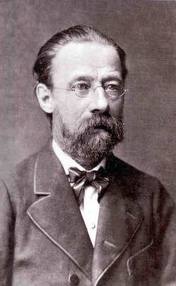 and Czech music, as such, practically didn’t exist (Josef Mysliveček, 1737 – 1781, was born in Prague but wrote Italian opera seria and classical symphonies and spent most of his productive years in Italy. Anton Reicha, 1770 – 1836, was also born in Prague, but lived mostly in Vienna, eventually settling in Paris and becoming a French citizen). At the age of 15, Bedřich was sent to Pague, to the Academic Grammar school. He didn’t fit in there, disliked the school and skipped many classes; instead he attended concerts, operas and even joined an amateur string quartet for which he composed several pieces. He heard Franz Liszt, then at the height of his pianist career, play recitals, and decided that he should become a professional musician (later he and Liszt became close). When his father learned about Bedřich’s truancy, he removed him from the city and placed him in the care of his uncle. Four years later, 19-year old Smetana won his father's approval of his career choice and once again departed for Prague. He recognized the need for formal musical training and took theory and composition lessons with Josef Proksch, then the head of the Prague Music Institute. In the meantime, he earned some money teaching music to the children of a local nobleman. In 1848, the year revolutions swept over Europe, Smetana took part in the uprising aimed to end the rule of the Hapsburgs and afford more autonomy for the Czech lands. The rebellion was put down, but luckily Smetana avoided imprisonment.
While Smetana’s earliest compositions were written in 1840, his most accomplished music dates from the 1860s. In 1861, the Habsburg administrations, in an attempt to address the rising nationalism, laid out plans for the Provisional Theater dedicated to Czech opera. Smetana saw it as a chance to create a new genre, following the example of the Russian composer Mikhail Glinka. For that he had to learn the Czech language: the first language of the majority of educated Czechs of the time, and Smetana’s, was German. He composed the first opera, The Brandenburgers in Bohemia, in 1862-63, and based the story in 13th century Prague. It was premiered at the Provisional Theatre in 1866. What then followed was Smetana’s most successful opera, The Bartered Bride. It premiered also 1866, and also at the Provisional Theatre. By then Smetana was appointed the principal conductor of the Theatre. Smetana wrote seven more operas, a large number of piano compositions, some wonderful songs, and several orchestral pieces. Of these Má vlast, a set of six symphonic poems, is the best known. The cycle was written between 1874 and 1879. Here is the second poem, Vltava, sometimes labeled by the German name of the river, Die Moldau, in the performance by the Vienna Philharmonic, Herbert von Karajan conducting (courtesy of YouTube.). According to the composer, the music describes the flow of this beautiful river from its spring in the hills of northern Bohemia, through Prague and other towns, and to the point where it joins the Elbe.
In his late years Smetana suffered from deafness (he losthis hearing completely in 1874) and generally poor health, which didn’t stop him from composing some of his best music. At the end of his life, his mental health deteriorated as well. Smetana died in Prague on May 12, 1884 in a lunatic asylum. His funeral became a national event.
Read more...Bedřich Smetana - Vltava, from Má vlast
Vienna Philharmonic (Orchestra)
Herbert von Karajan (Conductor)
Gioachino Rossini - La Gazza Ladra (Overture)
Vienna Philharmonic (Orchestra)
Claudio Abbado (Conductor)
Frédéric Chopin - Waltz in C sharp minor op 64 no 2
Michel Mananes (Piano)
Claude Debussy - Pelléas et Mélisande
Royal Opera House (Orchestra)
Pierre Boulez (Conductor)
Donald McIntyre (Bass)
Elisabeth Söderström (Soprano)
George Shirley (Tenor)
Claude Debussy - Les sons et les parfums tournent dans l’air du soir, from Préludes Book I
Jorge Federico Osorio (Piano)
Olivier Messiaen - Paysage, from Poèmes pour Mi
Ju Hyeon Han (Soprano)
Renate Rohlfing (Piano)