
Susan Merdinger performs in Carnegie's Weill Recital Hall
05/20/2012 18:30, Weill Recital Hall at Carnegie Hall
TBA
Mostly Music of Chicago presents Charlie Pikler and Susan Merdinger
06/15/2012 05:30, Arts Club of Chicago
Mozart Sonata for Violin and Piano , K. 454
Brahms Sonatas No. 1 and No. 2 for Viola and Piano, Op. 120
Wanderer
April 30, 2012. The word “Wanderer” is close to our hearts these days. It connotes so many states and emotions: nostalgia, wistful retrospection, but also the optimistic sense of beginnings, of new possibilities. Franz Schubert, who didn’t travel much in his life, used the word Wanderer in the title of 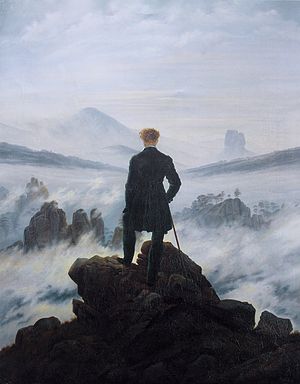 several very different pieces, and each time to denote a state of mind, not the body. In 1816, when he was just 19 but already entering his mature compositional period, he wrote a Lied Der Wanderer (D. 493) on the text by Georg Philipp Schmidt, a minor German poet. In the song, the protagonist, a "stranger everywhere," is searching for “his land,” his friends, a place he could call his own. This beautiful Lied is sung here by the incomparable German baritone Dietrich Fischer-Dieskau, with Gerald Moore on the piano (courtesy of YouTube).
Six years later Schubert wrote a piano Fantasy, so technically demanding that he himself couldn’t play it at all. Schubert used the theme from Der Wanderer in the second movement of the Fantasy, the Adagio (Theme and Variations). That led it to be called Wanderer. You can listen to it here in performance by the Israeli-American pianist Alon Goldstein.
In 1826, only two years before his death and the year preceding the composition of the great Winterreise song cycle, Schubert wrote a Lied to the text of Johann Gabriel Seidl’s poem Der Wanderer an den Mond ("The Wanderer Speaks to the Moon"). It has a simple, almost folk-like tune, with the accompaniment imitating the chords of a guitar. "Happy is he, who wherever he goes, stands on his native soil" is the concluding line of the poem. This little gem (the songs is just a bit longer than two minutes) is sung by the baritone Thomas Meglioranza. Reiko Uchida is on the piano (here).
The illustration, Wanderer above the Sea of Fog, is by the German Romantic painter Caspar David Friedrich. It was made in 1818, just two years after Schubert wrote his first Wanderer.
April 30, 2012. The word “Wanderer” is close to our hearts these days. It connotes so many states and emotions: nostalgia, wistful retrospection, but also the optimistic sense of beginnings, of new possibilities. Franz Schubert, who didn’t travel much in his life, used the word Wanderer in the title of several very different pieces, and each time to denote a state of mind, not the body. In 1816, when he was just 19 but already entering his mature compositional period, he wrote a Lied Der Wanderer (D. 493) on the text by Georg Philipp Schmidt, a minor German poet. In the song, the protagonist, a "stranger everywhere," is searching for “his land,” his friends, a place he could call his own. This beautiful Lied is sung here by the incomparable German baritone Dietrich Fischer-Dieskau, with Gerald Moore on the piano (courtesy of YouTube).
Six years later Schubert wrote a piano Fantasy, so technically demanding that he himself couldn’t play it at all. Schubert used the theme from Der Wanderer in the second movement of the Fantasy, the Adagio (Theme and Variations). That led it to be called Wanderer. You can listen to it here in performance by the Israeli-American pianist Alon Goldstein.
In 1826, only two years before his death and the year preceding the composition of the great Winterreise song cycle, Schubert wrote a Lied to the text of Johann Gabriel Seidl’s poem Der Wanderer an den Mond ("The Wanderer Speaks to the Moon"). It has a simple, almost folk-like tune, with the accompaniment imitating the chords of a guitar. "Happy is he, who wherever he goes, stands on his native soil" is the concluding line of the poem. This little gem (the songs is just a bit longer than two minutes) is sung by the baritone Thomas Meglioranza. Reiko Uchida is on the piano (here).
The illustration, Wanderer above the Sea of Fog, is by the German Romantic painter Caspar David Friedrich. It was made in 1818, just two years after Schubert wrote his first Wanderer.
Read more...Franz Schubert - Der Wanderer
Dietrich Fischer-Dieskau (Baritone)
Gerald Moore (Piano)
Ivan Benedetti - Воздушная сонata
Ivan Benedetti (Piano)
Stephan Dusault - miniature no.2
stephan dusault (Ensemble)
Stephan Dusault - miniature no.1
stephan dusault (Ensemble)
Andrea Falconieri - O bellissimi capelli
Gyula Szabo (Baritone)
Gyula M Szabo (Piano)
Amanda Röntgen-Maier - From Six Pieces for Violin and Piano
Gregory Maytan (Violin)
Nicole Lee (Piano)
Frédéric Chopin - Fantaisie-Impromptu in C-sharp Minor, Op. 66
Denis Evstuhin (Piano)