This Week in Classical Music: June 16, 2025. Vicenza. On our latest trip, we visited two musically famous cities, Cremona and Mantua, which we’ve written about in our previous posts. There was one more city, Vicenza, not as renowned, but worth a visit for a music lover, if just for one building, its Teatro Olimpico. Vicenza boasts more buildings designed by the great Renaissance architect, Andrea Palladio, than any other city, and Teatro Olimpico is one of them. The theater was Palladio’s last project; he started it in 1580 but died before the work on it had even begun. After Palladio’s death, the construction was supervised by another architect, Vincenzo Scamozzi, who also designed the stage scenery. The theater is majestic in its proportions, but it’s Scamozzi’s trompe l'oeil stage set that makes it all work. What you see is a fanciful cityscape, with a wall decorated by columns, pilasters, and Roman-looking statues, and several gates opening into streets that seem to go back for hundreds of yards. In reality, they are only 2-3 yards deep. There are columns and statues all over the theater, not only on the wall at the back of the stage, but also on the proscenium and the loggia that surrounds the seating area. The combination of the real statuary and the one on the trompe l'oeil creates a visual effect that is as strong now as it was 500 years ago, when the theater was built. The amphitheater of the seating area has no chairs: there are only cushions to make the public somewhat comfortable, but the absence of chairs eliminates the distraction to the architectural marvel of the theater.
It’s not by chance that Scamozzi did such a spectacular job in following Palladio’s design and creating the stage scenery: he was a talented architect. If you are in Venice, you can’t miss his most visible job, Procuratie Nuove, a row of buildings framing the Piazza San Marco on the right, as you face the cathedral.
Teatro Olimpico, completed in 1585, was one of the first permanent covered theaters in European history since the Greeks and the Romans built their open theaters millennia earlier. Of course, plays were staged and music played long before that, but usually it was in the palazzos of the princes and the cardinals. Olimpico was a “real,” permanent theater and it’s used today: in the Fall, classical plays are staged, and, in the Spring, a musical festival takes place. This year, for example, the theater hosted productions of Mozart’s Le nozze di Figaro and Don Giovanni, Verdi’s Falstaff, and a performance of Brahms’ Ein deutsches Requiem. Few people can experience these masterpieces in such a setting: the theater is small and seats only 400 lucky ones. Maybe one day…

Vicenza, 2025
This Week in Classical Music: June 16, 2025. Vicenza. On our latest trip, we visited two musically famous cities, Cremona and Mantua, which we’ve written about in our previous posts.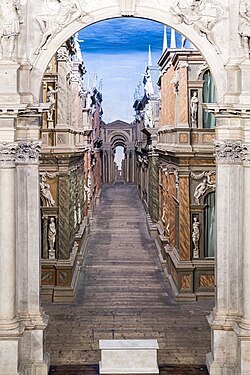 There was one more city, Vicenza, not as renowned, but worth a visit for a music lover, if just for one building, its Teatro Olimpico. Vicenza boasts more buildings designed by the great Renaissance architect, Andrea Palladio, than any other city, and Teatro Olimpico is one of them. The theater was Palladio’s last project; he started it in 1580 but died before the work on it had even begun. After Palladio’s death, the construction was supervised by another architect, Vincenzo Scamozzi, who also designed the stage scenery. The theater is majestic in its proportions, but it’s Scamozzi’s trompe l'oeil stage set that makes it all work. What you see is a fanciful cityscape, with a wall decorated by columns, pilasters, and Roman-looking statues, and several gates opening into streets that seem to go back for hundreds of yards. In reality, they are only 2-3 yards deep. There are columns and statues all over the theater, not only on the wall at the back of the stage, but also on the proscenium and the loggia that surrounds the seating area. The combination of the real statuary and the one on the trompe l'oeil creates a visual effect that is as strong now as it was 500 years ago, when the theater was built. The amphitheater of the seating area has no chairs: there are only cushions to make the public somewhat comfortable, but the absence of chairs eliminates the distraction to the architectural marvel of the theater.
It’s not by chance that Scamozzi did such a spectacular job in following Palladio’s design and creating the stage scenery: he was a talented architect. If you are in Venice, you can’t miss his most visible job, Procuratie Nuove, a row of buildings framing the Piazza San Marco on the right, as you face the cathedral.
Teatro Olimpico, completed in 1585, was one of the first permanent covered theaters in European history since the Greeks and the Romans built their open theaters millennia earlier. Of course, plays were staged and music played long before that, but usually it was in the palazzos of the princes and the cardinals. Olimpico was a “real,” permanent theater and it’s used today: in the Fall, classical plays are staged, and, in the Spring, a musical festival takes place. This year, for example, the theater hosted productions of Mozart’s Le nozze di Figaro and Don Giovanni, Verdi’s Falstaff, and a performance of Brahms’ Ein deutsches Requiem. Few people can experience these masterpieces in such a setting: the theater is small and seats only 400 lucky ones. Maybe one day…