This Week in Classical Music: September 15, 2025. Ghent incident and other things. Last week, instead of our usual fare, we wrote an entry about a music critic, Eduard Hanslick. While doing that, we missed some interesting anniversaries, so we’ll try to catch up on some of them this week. But first, another item that caught our eye. The Flanders Festival in Ghent has decided to cancel a concert featuring the Munich Philharmonic with Lisa Batiashvili. The reason? The orchestra was to be conducted by Lahav Shani, the current music director of the Israel Philharmonic and the next chief conductor of the Munich Philharmonic. As the organizer of the festival explained, “Lahav Shani has spoken out in favor of peace and reconciliation several times in the past, but in the light of his role as the chief conductor of the Israel Philharmonic Orchestra, we are unable to provide sufficient clarity about his attitude to the genocidal regime in Tel Aviv.” [Emphasis is ours]. The organizers prefaced this statement by saying: “The decision has been made on the basis of our deepest conviction that music should be a source of connection and reconciliation. First and foremost, Flanders Festival Ghent aspires to be a place where artists, audiences and staff can experience music in a context of respect and safety.” We find this malignant combination of antisemitism and wokeness appalling. It’s especially awful coming from a presumably nonpolitical arts organization. Fortunately, even the Prime Minister of Belgium, a country extremely critical of Israel, was shocked and condemned the action of the festival in a written statement. He then flew to Essen, Germany, to attend the same concert that was organized on very short notice. He met Shani and apologized to him in person. The German reaction in general was very strong: the Berlin Philharmonic extended an invitation to Shani, the culture minister called the action of the Ghent Festival “pure antisemitism,” and the German Commissioner for Antisemitism said that it was “a completely unspeakable and deeply antisemitic act." We applaud Bart de Wever, the Prime Minister of Belgium, and the German musical and political establishments for their strong condemnation of the Ghent Festival and their support of music. And we’re sorry that this unfortunate event had to happen in Ghent, a gem of a city that treasures one of the greatest masterpieces of visual art, the Adoration of the Mystic Lamb altarpiece by Huber and Jan van Eyck.
And now, briefly, back to music. Arvo Pärt, an Estonian composer, turned 90 on September 11th. He left for Vienna and then Germany in 1980, lived there for 30 years, returned to Estonia in 2010, and has resided in his motherland since then. In the year 2000, he wrote Cecilia, vergine romana, a piece for mixed choir and orchestra, commissioned by the Vatican as part of the celebration of the Great Jubilee. Santa Cecilia is a patron saint of music, and, appropriately, the premiere was held by the Accademia Nazionale di Santa Cecilia orchestra. Hereit is, but in this case it’s played by the Orchestre National de France under the direction of Kristjan Järvi, Pärt’s compatriot.
Arnold Schoenberg’s birthday was also last week; he was born on September 13th of 1874. Last year, as we observed Schoenberg’s 150th anniversary (here), we found celebrations in the US muted. While things were already changing in 2024, compared to 2020-2021, since then, they seem to have improved a bit further. We think that had it been celebrated this year, the Schoenberg anniversary would’ve been more interesting and festive.
Last week was exceptional with birthdays, and here are some other names: Antonín Dvořák, Henry Purcell, Girolamo Frescobaldi, William Boyce, and Clara Schumann. And this week it’s the Swiss composer Frank Martin, the Russian Aleksandr Lokshin, and the Brit Gustav Holst.

Ghent incident, catching up 2025
This Week in Classical Music: September 15, 2025. Ghent incident and other things. Last week, instead of our usual fare, we wrote an entry about a music critic, Eduard Hanslick. While doing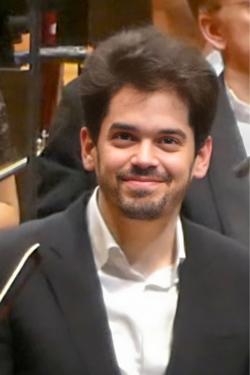 that, we missed some interesting anniversaries, so we’ll try to catch up on some of them this week. But first, another item that caught our eye. The Flanders Festival in Ghent has decided to cancel a concert featuring the Munich Philharmonic with Lisa Batiashvili. The reason? The orchestra was to be conducted by Lahav Shani, the current music director of the Israel Philharmonic and the next chief conductor of the Munich Philharmonic. As the organizer of the festival explained, “Lahav Shani has spoken out in favor of peace and reconciliation several times in the past, but in the light of his role as the chief conductor of the Israel Philharmonic Orchestra, we are unable to provide sufficient clarity about his attitude to the genocidal regime in Tel Aviv.” [Emphasis is ours]. The organizers prefaced this statement by saying: “The decision has been made on the basis of our deepest conviction that music should be a source of connection and reconciliation. First and foremost, Flanders Festival Ghent aspires to be a place where artists, audiences and staff can experience music in a context of respect and safety.” We find this malignant combination of antisemitism and wokeness appalling. It’s especially awful coming from a presumably nonpolitical arts organization. Fortunately, even the Prime Minister of Belgium, a country extremely critical of Israel, was shocked and condemned the action of the festival in a written statement. He then flew to Essen, Germany, to attend the same concert that was organized on very short notice. He met Shani and apologized to him in person. The German reaction in general was very strong: the Berlin Philharmonic extended an invitation to Shani, the culture minister called the action of the Ghent Festival “pure antisemitism,” and the German Commissioner for Antisemitism said that it was “a completely unspeakable and deeply antisemitic act." We applaud Bart de Wever, the Prime Minister of Belgium, and the German musical and political establishments for their strong condemnation of the Ghent Festival and their support of music. And we’re sorry that this unfortunate event had to happen in Ghent, a gem of a city that treasures one of the greatest masterpieces of visual art, the Adoration of the Mystic Lamb altarpiece by Huber and Jan van Eyck.
And now, briefly, back to music. Arvo Pärt, an Estonian composer, turned 90 on September 11th. He left for Vienna and then Germany in 1980, lived there for 30 years, returned to Estonia in 2010, and has resided in his motherland since then. In the year 2000, he wrote Cecilia, vergine romana, a piece for mixed choir and orchestra, commissioned by the Vatican as part of the celebration of the Great Jubilee. Santa Cecilia is a patron saint of music, and, appropriately, the premiere was held by the Accademia Nazionale di Santa Cecilia orchestra. Here it is, but in this case it’s played by the Orchestre National de France under the direction of Kristjan Järvi, Pärt’s compatriot.
Arnold Schoenberg’s birthday was also last week; he was born on September 13th of 1874. Last year, as we observed Schoenberg’s 150th anniversary (here), we found celebrations in the US muted. While things were already changing in 2024, compared to 2020-2021, since then, they seem to have improved a bit further. We think that had it been celebrated this year, the Schoenberg anniversary would’ve been more interesting and festive.
Last week was exceptional with birthdays, and here are some other names: Antonín Dvořák, Henry Purcell, Girolamo Frescobaldi, William Boyce, and Clara Schumann. And this week it’s the Swiss composer Frank Martin, the Russian Aleksandr Lokshin, and the Brit Gustav Holst.