This Week in Classical Music: October 13, 2025. Power, Marenzio, Galuppi. We’ve never written about Leonel Power, the English composer of the early 15th century.He was a contemporary of John Dunstaple, and it was the two of them who produced Contenance Angloise, the English manner, a distinct style of polyphony.Contenance Angloise was influential at the Burgundian courts, then the most important musical center in Europe.We should confess that the music of Power and Dunstaple is the earliest that we can really enjoy.What has been reconstructed of the writing of Léonin and Pérotin, two composers of the Notre-Dame School who worked at the end of the 12th – early 13th centuries, sounds to us rather foreign, almost “mathematical,” created for the eye, not the ear.Even the music of Guillaume de Machaut (and we should write about him, too), as interesting as it is, is difficult to enjoy.It’s what the poet Martin Le Franc called the “sweet harmonies” of the English manner that makes the music of Power and Dunstaple so much more approachable for the modern ear.
We know little about Power’s life, which is not surprising considering the era; musicologists cannot even determine the decade he was born in: guesses range from 1370 to 1385.From contemporary documents, we know that he served as an instructor of choristers in the household chapel of Thomas, Duke of Clarence (Thomas died in 1421).In 1423, he was admitted to the fraternity of Christ Church, Canterbury (we know it as the Canterbury Cathedral).Later, he served as the choirmaster of the cathedral.In the cathedral’s documents, he was called by an honorific, Esquire.The date of his death is documented as June 5th of 1445.Here’s a motet Ibo michi ad montem (I will go to the mountain).It is performed by the Hilliard Ensemble.
Two other composers of the past were also born this week, Luca Marenzio and Baldassare Galuppi.Marenzio, one of the most important madrigalists of the late Renaissance, was born on October 18th, the question being whether in 1553 or 1554.The Marenzios, a poor family, lived in Lombardy in a small town near Brescia.Luca was probably educated at the Brescia Cathedral.In 1568, he went to Mantua, where he served at the court of the Gonzagas.After moving to Rome, Marenzio served, for about 10 years, at the court of Cardinal Luigi d'Este.He later went to Florence and worked at the court of Ferdinando I de' Medici.His madrigals became known across Italy and in Europe.Here, from 1580, is one of them, Dolorosi martir.Concerto Italiano is led by Rinaldo Alessandrini.
Baldassare Galuppi was also born on October 18th, 1706, on the island of Burano, near Venice.A popular composer, he traveled widely, visiting London and St. Petersburg.You can read more about him here.Galuppi wrote more than 100 operas, many to the librettos of Metastasio and the playwright Carlo Goldoni.Here’s an aria from Galuppi’s opera La diavolessa.The mezzo Kremena Dilcheva is supported by the Lautten Compagney orchestra under the direction of Wolfgang Katschner.

Power, Marenzio, Galuppi, 2025
This Week in Classical Music: October 13, 2025. Power, Marenzio, Galuppi. We’ve never written about Leonel Power, the English composer of the early 15th century. He was a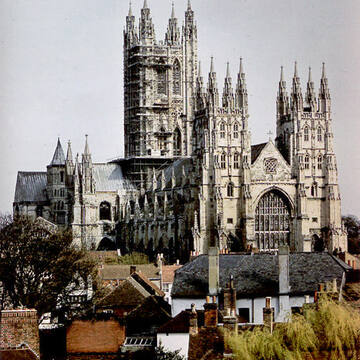 contemporary of John Dunstaple, and it was the two of them who produced Contenance Angloise, the English manner, a distinct style of polyphony. Contenance Angloise was influential at the Burgundian courts, then the most important musical center in Europe. We should confess that the music of Power and Dunstaple is the earliest that we can really enjoy. What has been reconstructed of the writing of Léonin and Pérotin, two composers of the Notre-Dame School who worked at the end of the 12th – early 13th centuries, sounds to us rather foreign, almost “mathematical,” created for the eye, not the ear. Even the music of Guillaume de Machaut (and we should write about him, too), as interesting as it is, is difficult to enjoy. It’s what the poet Martin Le Franc called the “sweet harmonies” of the English manner that makes the music of Power and Dunstaple so much more approachable for the modern ear.
We know little about Power’s life, which is not surprising considering the era; musicologists cannot even determine the decade he was born in: guesses range from 1370 to 1385. From contemporary documents, we know that he served as an instructor of choristers in the household chapel of Thomas, Duke of Clarence (Thomas died in 1421). In 1423, he was admitted to the fraternity of Christ Church, Canterbury (we know it as the Canterbury Cathedral). Later, he served as the choirmaster of the cathedral. In the cathedral’s documents, he was called by an honorific, Esquire. The date of his death is documented as June 5th of 1445. Here’s a motet Ibo michi ad montem (I will go to the mountain). It is performed by the Hilliard Ensemble.
Two other composers of the past were also born this week, Luca Marenzio and Baldassare Galuppi. Marenzio, one of the most important madrigalists of the late Renaissance, was born on October 18th, the question being whether in 1553 or 1554. The Marenzios, a poor family, lived in Lombardy in a small town near Brescia. Luca was probably educated at the Brescia Cathedral. In 1568, he went to Mantua, where he served at the court of the Gonzagas. After moving to Rome, Marenzio served, for about 10 years, at the court of Cardinal Luigi d'Este. He later went to Florence and worked at the court of Ferdinando I de' Medici. His madrigals became known across Italy and in Europe. Here, from 1580, is one of them, Dolorosi martir. Concerto Italiano is led by Rinaldo Alessandrini.
Baldassare Galuppi was also born on October 18th, 1706, on the island of Burano, near Venice. A popular composer, he traveled widely, visiting London and St. Petersburg. You can read more about him here. Galuppi wrote more than 100 operas, many to the librettos of Metastasio and the playwright Carlo Goldoni. Here’s an aria from Galuppi’s opera La diavolessa. The mezzo Kremena Dilcheva is supported by the Lautten Compagney orchestra under the direction of Wolfgang Katschner.