This Week in Classical Music: June 29, 2026. Henze at 100. July 1 will mark the 100th birthday anniversary of Hans Werner Henze, a prolific and talented German composer. He was born in Gütersloh, Westphalia, the eldest of the six children of a schoolteacher. And here we’ll digress. Several prominent 20th-century composers were active politically, and most invariably, on the left: for example, just three weeks ago, we wrote about Erwin Schulhoff, an Austrian-Czech composer who turned radically left late in his career and accepted Stalin’s Socialist Realism as his credo. He’s remembered, and rightfully so, as a victim of Nazism, but that doesn’t negate his objectionable politics. Hanns Eisler was part of the Left from an early age in Germany. The Nazi takeover brought him to the US, the Red Scare sent him back to Europe, and he ended up as an official composer of communist East Germany. Henze belonged to the same group of hard-left acolytes, and his politics affected much of what he wrote during his life.
The young Henze grew up under the Nazis, with his father indoctrinated by Nazi propaganda. Like many German kids of his age, Henze enrolled in the Hitler Youth group. Hans was sent to a music school in 1942, but eventually both he and his father ended up in the army: the father volunteered, Hans was conscripted. His father was killed on the Eastern Front. Hans served as a radio operator, was captured by the British, and placed in a camp for a year until the end of the war. After the war, Henze, by then a budding composer, attended the Darmstadt school and festival, the major center for new music in Europe, and became involved with post-classicism (in the Hindemith style) first, and then with the twelve-tone technique and serialism.
For the next several years, Henze composed for the stage, creating several operas and ballets; he also served as ballet conductor in Wiesbaden. In 1953, Henze, who was gay, decided to move to Italy, partly because of the perceived (or real) homophobic atmosphere in Germany, partly because of the country's more conservative culture in general. In Italy, he continued writing for voice, operas and songs, and some instrumental music as well. He also became much more active politically, joining the Italian Communist Party. In Italy, he met Ingeborg Bachmann, an Austrian poet and radical philosopher. She wrote librettos to several of Henze’s operas, including Der Prinz von Homburg (The Prince of Homburg), probably Henze’s most popular opera; he also set her poems to music. In 1957, he created a piece for soprano and orchestra based on Bachmann’s poem, called Nachtstücke und Arien. Here is Nachtstücke I, the first movement of the piece.
In 1967, he wrote the oratorio Das Floß der Medusa (The Raft of the Medusa), and dedicated it as a requiem to the Cuban revolutionary Che Guevara. The premier, in Hamburg in December of 1968, turned into a political scandal. Before the performance even started, radical students hung a large poster of Che and a red flag. Then the anarchists added a black flag. The choir refused to sing under these flags and left the stage; the police were called to remove the students, and in this chaos, the performance was canceled. Here’s a four-minute fragment from the Floß, with Dietrich Fischer-Dieskau singing and Henze himself conducting. The recording was made in the same revolutionary year of 1968.
We’ll finish the story of this fascinating composer next week.

Henze at 100, 2026
This Week in Classical Music: June 29, 2026. Henze at 100. July 1 will mark the 100th birthday anniversary of Hans Werner Henze, a prolific and talented German composer. He was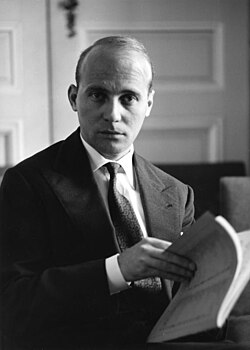 born in Gütersloh, Westphalia, the eldest of the six children of a schoolteacher. And here we’ll digress. Several prominent 20th-century composers were active politically, and most invariably, on the left: for example, just three weeks ago, we wrote about Erwin Schulhoff, an Austrian-Czech composer who turned radically left late in his career and accepted Stalin’s Socialist Realism as his credo. He’s remembered, and rightfully so, as a victim of Nazism, but that doesn’t negate his objectionable politics. Hanns Eisler was part of the Left from an early age in Germany. The Nazi takeover brought him to the US, the Red Scare sent him back to Europe, and he ended up as an official composer of communist East Germany. Henze belonged to the same group of hard-left acolytes, and his politics affected much of what he wrote during his life.
The young Henze grew up under the Nazis, with his father indoctrinated by Nazi propaganda. Like many German kids of his age, Henze enrolled in the Hitler Youth group. Hans was sent to a music school in 1942, but eventually both he and his father ended up in the army: the father volunteered, Hans was conscripted. His father was killed on the Eastern Front. Hans served as a radio operator, was captured by the British, and placed in a camp for a year until the end of the war. After the war, Henze, by then a budding composer, attended the Darmstadt school and festival, the major center for new music in Europe, and became involved with post-classicism (in the Hindemith style) first, and then with the twelve-tone technique and serialism.
For the next several years, Henze composed for the stage, creating several operas and ballets; he also served as ballet conductor in Wiesbaden. In 1953, Henze, who was gay, decided to move to Italy, partly because of the perceived (or real) homophobic atmosphere in Germany, partly because of the country's more conservative culture in general. In Italy, he continued writing for voice, operas and songs, and some instrumental music as well. He also became much more active politically, joining the Italian Communist Party. In Italy, he met Ingeborg Bachmann, an Austrian poet and radical philosopher. She wrote librettos to several of Henze’s operas, including Der Prinz von Homburg (The Prince of Homburg), probably Henze’s most popular opera; he also set her poems to music. In 1957, he created a piece for soprano and orchestra based on Bachmann’s poem, called Nachtstücke und Arien. Here is Nachtstücke I, the first movement of the piece.
In 1967, he wrote the oratorio Das Floß der Medusa (The Raft of the Medusa), and dedicated it as a requiem to the Cuban revolutionary Che Guevara. The premier, in Hamburg in December of 1968, turned into a political scandal. Before the performance even started, radical students hung a large poster of Che and a red flag. Then the anarchists added a black flag. The choir refused to sing under these flags and left the stage; the police were called to remove the students, and in this chaos, the performance was canceled. Here’s a four-minute fragment from the Floß, with Dietrich Fischer-Dieskau singing and Henze himself conducting. The recording was made in the same revolutionary year of 1968.
We’ll finish the story of this fascinating composer next week.