
Gustav Mahler - Symphony No. 5, Part III, Adagietto. Sehr langsam
Vienna Philharmonic (Orchestra)
Pierre Boulez (Conductor)
Gustav Mahler - Symphony No. 5, Part II, Scherzo
Vienna Philharmonic (Orchestra)
Pierre Boulez (Conductor)
Gustav Mahler - Symphony No. 5, Part I, Stürmisch bewegt, mit größter Vehemenz
Vienna Philharmonic (Orchestra)
Pierre Boulez (Conductor)
Gustav Mahler - Symphony No. 5, Part I, Trauermarsch
Vienna Philharmonic (Orchestra)
Pierre Boulez (Conductor)
David Carlson - Tuba Concerto I
David Carlson (Tuba)
David Carlson - Tuba Concerto II
David Carlson (Tuba)
Beethoven, Symphony no. 7
June 26, 2017. Beethoven, Symphony No. 7. Below is the article by Joseph DuBose on Beethoven’s Symphony no.7. As always with Beethoven’s symphonies, our problem was in selecting a recording to illustrate it: there are myriads in existence, many of superb quality. We 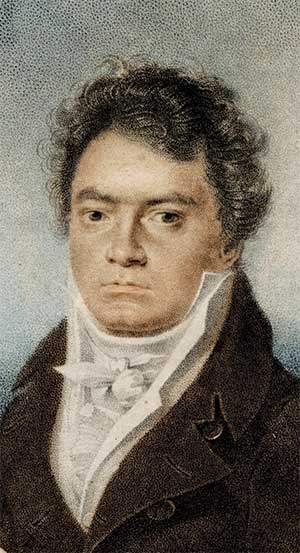 chose a remastered live recording made by Carlos Kleiber with the Vienna Philharmonic orchestra in 1976. You can listen to it here. ♫
Symphony No. 7 in A major
Beethoven completed the Symphony No. 7 in 1812. Four years separated it from the “Pastoral”—the longest span between any of the symphonies thus far. Yet, that interval does not mark a period of lesser creativity in Beethoven’s career. Many important works appeared during that time, including two string quartets (opp. 74 and 95), the music for “Egmont,” “King Stephen,” and the “Ruins of Athens,” the Choral Fantasia, and the F-sharp minor and “Les Adieux” piano sonatas.
Beethoven’s style continued to advance during this period. With each decisive step he brought music closer to embodying the deepest expressions of the human soul. Thus far, his music had embodied the grand, the lofty, the profound, and, quite remarkably, was largely uninfluenced by the day-to-day events of the composer's life. What Beethoven had not yet explored, at least in his symphonies, was humor. Beethoven had always indulged in coarse jokes, puns, and nicknames, but in his later years, his humor became even more pronounced. He even had a special word for his unique, off-putting behavior: aufgeknöptf, or “unbuttoned.” In one such instance of this behavior, Beethoven, when visiting his friend Breuning, would, if having just come in from the rain, take off his hat and dash water off it in all possible directions, without the slightest regard for what furniture or people may have been nearby. Another example involved his brother. When Johann left a card for Beethoven that read, “Johann van Beethoven, Landed proprietor,” Beethoven quickly responded with his own: “Ludwig van Beethoven, Brain proprietor.” Though brief glimpses of this rough humor can be found as early as the Second Symphony, Beethoven had not yet allowed it an outlet in his music until the composition of the A major Symphony.
Besides allowing his “unbuttoned” humor a musical outlet, Beethoven composed the Seventh Symphony during a particularly happy time for the composer. As was his habit, the composer left Vienna during the summer months for the countryside, where he sketched out his compositions that would later be put into their final form once he returned to Vienna for the winter. In the summer of 1811, he ventured farther from the Austrian capital than usual, to Teplitz, roughly fifty miles from Prague. There, he enjoyed a vibrant confluence of intellectuals and musicians, among them the Sebald family; the actor Ludwig Lowe; Johann Fichte, a founding figure of German idealism; and the poet Christoph Tiedge. Afternoons and evenings were spent with great fellowship, and Beethoven, against his usual manner, even obliged to extemporize at the piano.
Once completed, the Seventh Symphony was premiered on December 8, 1813 at a concert in Vienna given to benefit the soldiers wounded at the battle of Hanau, where Austrian and Bavarian troops attempted to cut off Napoleon’s retreat from Leipzig. The program also included Beethoven’s “Battle Symphony” in honor of the British victory over Napeleon at Vittoria. Among the orchestra were some of the most prominent musicians of the day—Schuppanzigh, Romberg, Spohr, Dagonetti, Meyerbeer, Hummel, and Salieri. Beethoven himself conducted the concert, though probably more to the performance’s detriment than advantage due to the advanced stage of his deafness by this time. Yet, the Symphony No. 7 was received with great praise; the Allegretto even was encored. A repeat performance on the 12th of the same month met with equal success. The work, however, did not fare as well in North Germany. When it was premiered in Leipzig, Friedrich Wieck, father of Clara Wieck, criticized the symphony, remarking that it could have only been composed in a “drunken state.” Regardless, the Seventh now is staple of the symphonic repertoire, and, along with the Eroica and the Fifth, one of the most oft-performed of Beethoven’s symphonies. Beethoven himself was particularly fond of the work, and twice referred to it as one of his best works. (To continue reading, please click here)
Read more...A Stamitz and a Bach, 2017
June 19, 2017. A Stamitz and a Bach. Johann Stamitz was born on this day in 1717 in a small town of Německý Brod (German Ford in the Czech) in Moravia, then part of the Austrian Empire. He studied in the Jesuit Gymnasium in Jihlava known across Europe for its high 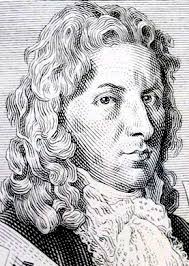 quality of musical education. He then studied at Prague University and then, it’s assumed, embarked on a career of a violin virtuoso. Sometime around 1741 Stamitz was hired by the Mannheim court of the Elector of Palatinate. At the time, the court had an excellent orchestra. In June of 1742 he played at a concert and, according to the advertisement, was to perform on the violin, viola d’amore, cello and double bass. His rise was very quick: a year later he became the first violinist of the court orchestra, in 1745 – the Konzertmeister and in 1750 – director of instrumental music. As such he was responsible for both composing and performing music for the court. Under the leadership of Stamitz the orchestra improved even further, both technically and musically, becoming the most renowned orchestra in Europe. In 1754, Stamiz went to Paris and stayed there for a year. He performed, to great acclaim, in private residences of the nobility and also at the Concert Spirituel at the Tuileries Palace, the first ever public concert series. Stamiz returned to Mannheim in the fall of 1755. Two years later, on March 27th of 1757, he died at the age of 39. Johann Stamitz, had two composer sons who became as well known as their father, and is mostly famous for his symphonies (he wrote 58 of them) and his orchestral trios. Here is his Pastorale Symphony. Virtuosi di Praga are conducted by Oldřich Vlček.
Johann Stamitz was three years younger than Carl Philipp Emanuel Bach and 15 years older than another son of J.S. Bach, Johann Christoph Friedrich Bach. Johann Christoph was born this week, on June 21st of 1732 in Leipzig, where his famous father was the Thomaskantor. Johann Sebastian was his son’s first music teacher, and, as many of Johann Sebastian’s sons, Johann Christoph attended the Thomasschule (St. Thomas School). Not as famous as his brothers Wilhelm Friedemann, Carl Philipp Emanuel, or Johann Christian, he was a fine composer and a virtuoso keyboard player. Johann Christoph is sometimes called the "Bückeburg Bach" as he spent many years in Bückeburg, the capital of the County of Schaumburg-Lippe. Here is Johann Christoph’s virtuosic Piano Concerto E Major. It’s performed by the wonderful Cyprien Katsaris. Orchestre de Chambre du Festival d`Echternach is conducted by Yoon Lee.
Read more...Dmitry Shostakovich - Sonata for Cello and Piano in d minor, Op. 40
Tomoko Fujita (Cello)
Luba Poliak (Piano)
Gustav Mahler - Symphony No. 5, Part III, Rondo-Finale
Vienna Philharmonic (Orchestra)
Pierre Boulez (Conductor)