
Antonin Dvořák - Silent Woods, Op. 68, No. 5
Artu Duo (Duo)
Christoph Willibald Gluck, 2017
July 10, 2017. Recent anniversaries: Gluck and more. We missed several significant anniversaries and will make up for at least some of them. The great reformer of the opera, Christoph Willibald Gluck was born in a small town of Erasbach in Bavaria on July 2nd of 1714. He was four when his family moved to Bohemia (Antonio 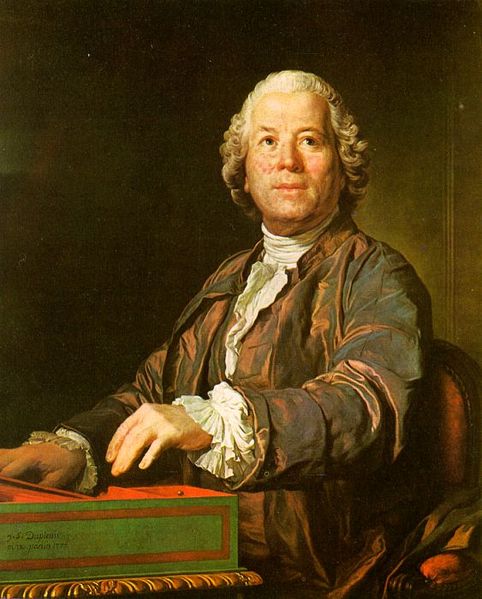 Salieri, his pupil, wrote in his memoir that Czech was Gluck’s native language and that he expressed himself in German with difficulty). Gluck studied mathematics at the university of Prague but probably never graduated. In 1737 he went to Milan to study music with Giuseppe Sammartini. Gluck’s first opera was Artaserse, on the libretto of the famous Metastasio, composed for the Carnival of 1742 and performed in the Teatro Regio Ducal (the theater, one of the largest in Milan, burned down in 1776 and as his replacement Nuovo Regio Ducal Teatro alla Scala was built; we now know it as La Scala). In 1745 Gluck traveled to London. There he composed an opera, but more importantly, became familiar with the operas of George Frideric Handel. Handel was not terribly impressed with Gluck’s compositions: the music historian Charles Burney wrote in his “Life of Handel” that the great master said of Gluck “he knows no more of contrapunto, as mein cook, Waltz” (an interesting mixture of three languages that is). Gluck didn’t stay in London for too long; in 1747 he was back in Vienna, writing an opera to celebrate the Empress Maria Theresa's birthday. The opera was La Semiramide riconosciuta, again on Metastasio's libretto, and the assignment was very prestigious: Gluck got it ahead of the much more established Johann Adolph Hasse. The opera was a popular success but Metastasio called it “archvandalian music, which is insupportable’” and Gluck left Vienna shortly after.
For the next few years Gluck earned money as an “itinerant maestro di cappella,” moving around Europe, first with the troupe of the impresario Pietro Mingotti and later with the troupe of Giovanni Battista Locatelli. He directed different orchestras, composed, and staged productions of his own operas. One of them was La clemenza di Tito, written on Metastasio’s old libretto. The opera, composed to celebrate the name day of King Charles VII of Naples, was performed in Teatro di San Carlo, Naples’s most important theater, and featured the famous soprano castrato Cafarelli. One aria, the exceptionally difficult Se mai senti spirarti sul volto, became especially popular. Castratos disappeared from opera stages by the end of the 19th century; fortunately, we have the incomparable Cecilia Bartoli, who brought to life so many arias from the castrato repertoire. Here she is in Se mai senti recorded live in 2001; the ensemble Akademie für Alte Musik Berlin is conducted by Bernhard Forck. As for La Clemenza, it proved to be a very popular libretto. Gluck’s 1752 rendition wasn’t the first one: Antonio Caldara wrote an opera in 1734, and before Gluck there were 17 more operas written on the same text, Hasse using it not once but three times, creating different version in 1735, 1738 and then in 1759. Of the famous composers, Baldassare Galuppi and Josef Myslivecek used the libretto. Altogether, 45 operas were written to Metastasio’s piece. But the most famous one was, without a doubt, the one written by Mozart in 1791, his last one.
By 1751 Gluck settled in Vienna. The most productive, but also the most disappointing period of his life was still ahead of him. We’ll write about it another time.
Two more names we’d like to mention: another Czech-speaker, the composer Leoš Janáček was born on July 3rd of 1854. And the Italian composer Ottorino Respighi was born on this day, July 9th of 1879.
Read more...Christoph Gluck - Se mai senti spirarti sul volto, from La clemenza di Tito
Cecilia Bartoli (Mezzo-soprano)
Akademie für Alte Musik Berlin (Ensemble)
Bernhard Forck (Conductor)
P. Kellach Waddle - At The Snowy Bourbon Winter's Twilight : Impression-Satz for Chamber Orchestra Op. 439
P. Kellach Waddle (Conductor)
Orchestra Enigmatic (Orchestra)
Ludwig van Beethoven - Sonata No. 23 in F minor, Op. 57, "Appassionata"
Luca Buratto (Piano)
Thomas Adès - Darknesse Visible
Luca Buratto (Piano)
John Dowland - Flow My Tears (Lachrimae Pavan)
Luca Buratto (Piano)
Mahler 2017
July 3, 2017. Mahler, Symphony no. 5. Gustav Mahler was born on July 7th of 1860, and to celebrate his birthday we will again turn to one of his symphonies, this time the Fifth. The time of its composition, the years of 1901 and 1902, is closely linked to Mahler’s marriage to Alma Schindler. In 1897 Mahler 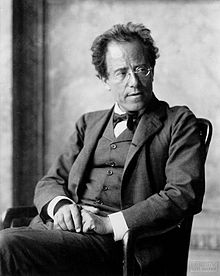 was appointed the music director of the Vienna Hofoper, one of the most important opera theaters in Europe, whose orchestra, the Vienna Philharmonic, was (and still is) one of the best. Mahler’s early years as the director were rather turbulent. As he was mounting new opera productions (the first two were Wagner’s Lohengrin and Mozart’s Zauberflöte), Mahler required utter discipline and precision. Very demanding, he was not too sensitive toward the singers and orchestra players, whose feelings he often hurt. The atmosphere within the opera house was difficult but results were of a very high quality. Problems of a different sort accompanied Mahler as the conductor of subscription concerts with the Vienna Philharmonic. To many conservative music critic, he appeared not sufficiently felicitous to the classical scores. And indeed, Mahler often altered the orchestration and was known to amplify musical dynamics beyond the generally accepted practices of the day. Things were exacerbated by the partisan, and often very hostile, critics. A large section of the society was deeply anti-Semitic (the Mayor of Vienna, Karl Lueger, was the leader of the anti-Semitic Austrian Christian Social Party), and even though Mahler converted to Christianity to take a position with the Hofoper, they never forgot his Jewish roots.
Nonetheless, by 1901 things were settling down. Mahler resigned as the conductor of the Philharmonic series (his re-orchestration of Beethoven’s Ninth symphony cause a real scandal), concentrating on opera. His own compositions were getting wider acceptance. He was financially secure, and could even afford a villa, in Maiernigg on the Wörthersee. The summer of 1901 was the first one of many that he spent there, composing. In November of 1901, at a dinner party given by Sofie Clemenceau (sister-in-law of George Clemenceau, the future Prime-minister of France) he met Alma Schindler. Alma, the daughter of an established landscape painter Emil Schindler, was then 22 (and 19 years younger than Mahler). She was known as a fine-looking society girl. At the time, Alma was having an affair with the composer Alexander von Zemlinsky, her music teacher. That didn’t prevent a brief but intense romance between her and Gustav, and on March 9th of 1902 they were married. One of the conditions of the marriage, imposed by Gustav, was that Alma would drop her own composition efforts (Mahler changed his attitude some years later, helping Alma to edit and publish several of her compositions). Both Mahler’s friends and his enemies were surprised: the friends, because they considered Alma to be too young for Gustav and too flirtatious, his enemies – because they considered her too pretty and too much a part of the society to marry a Jew. But by the time of the marriage Alma was already pregnant with their first daughter and happy to assume her conjugal responsibilities.
By then Mahler had already started working on his Fifth symphony. He and Alma spent the summer months of 1902 at their Maiernigg villa. Mahler built a separate small studio, where he spent the morning hours composing. By the end of the summer of 1902 the Fifth symphony was finished, although it would wait for the premier for another two years. Here it is, in the 1996 performance by the Vienna Philharmonic, Pierre Boulez conducting.
Read more...Gustav Mahler - Symphony No. 5
Vienna Philharmonic (Orchestra)
Pierre Boulez (Conductor)
Bohuslav Martinu - Sonata No. 2 for Cello and Piano
Artu Duo (Duo)