
Johannes Brahms - Sonata for cello and piano in F Major, Op. 99
Oliver Herbert (Cello)
Renana Gutman (Piano)
Brahms’s Klavierstücke, op. 76
September 26, 2016. Brahms’s Klavierstücke, op. 76. In the past we published a series of articles about Brahms’s late piano works: 7 Fantasien, op. 116 (here), 3 Intermezzi op. 117 (here), 6 Klavierstucke op. 118 (here), and 4 Klavierstucke op. 119 (here). Today we’ll publish an article on a piano set he created earlier, sometime between 1871 and 1878, titled 8 Klavierstücke, op. 76. 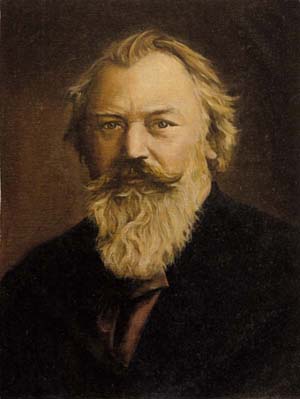 We have two sets of recordings, one made by the English pianist Sam Armstrong, another – by the American, Maya Hartman. ♫
The Eight Klavierstücke, op. 76 was a marked departure for Brahms in the realm of piano music—not since the composition of the Ballades in the mid-1850s had he composed a set of miniatures. The sonata had long since disappeared; the only three Brahms left to us were products of his youth. The piano music of his middle period was dominated by large-scale variation sets. The last of these sets, the Paganini Variations, was also his last work for solo piano before the composition of the 8 Klavierstücke in the late 1870s, a space of fifteen years. Viewed as a part of Brahms’s entire output for the piano, the Klavierstücke and the contemporaneous 2 Rhapsodies, op. 79 form the transition from those Classically-oriented pieces of his youth and middle period, to the deeply introspective Romanticism of his last works for piano, namely, opp. 116-19. With the Klavierstücke, lengthy discourses are abandoned in favor of a greater economy of means, a trend that pervaded most of Brahms’s late music, even in large-scale works, in which fewer and fewer notes were forced to bear an ever increasing portion of a piece’s emotional weight. Concomitantly, there is also a greater emphasis on motivic development, a feature really of all of Brahms’s music, but now driven to even more exacting and imaginative lengths.
The set begins with the fantasia-like F-sharp minor Capriccio. Ominous arpeggios reach up out of the bass register in the opening measures, intermixed with a distinctive stepwise descent through the interval of a third that becomes an important accompanimental figure to the principal melody which later emerges. The melody itself, which appears after a fortissimo close on the dominant, emphasizes two semitone movements within its initial measures—the first, moving upwards, and the latter, downwards. This motif becomes the focus of the Capriccio’s discourse. Initially, beginning on the dominant, its position within the scale and its key is later changed, yet its melodic pattern remains unchanged, as it is woven into the endless accompaniment of broken chords. A strict inversion of the melody even appears immediately before the reprise of the opening fantasia. This reprise, though structurally similar to the opening statement, is greatly changed. The left hand takes the burden of presenting the motivic material while the right now provides brilliant filigree in the upper register. The lengthy coda returns to working out the melody of the middle section, presenting it in octaves against repeated statements in augmentation of descending thirds. However, its final statements take place betwixt a firm tonic pedal in the bass and the return of the fanciful passagework in the treble, as the piece dies away into a conclusion in F-sharp major. (Read more here).
Read more...Girolamo Frescobaldi - Toccata Terza, from Primo Libro
Laura Alvini (Harpsichord)
Robert Schumann - Fantasy Pieces Op. 73
Haeji Kim (Violin)
Sahun Hong (Piano)
Sergei Prokofiev - Sonata for Cello and Piano in C Major
James Kim (Cello)
Ron Regev (Piano)
Gabriel Fauré - Piano Quartet in C minor, Op. 15
Benjamin Baker (Violin)
Maren Rothfritz (Viola)
Ari Evan (Cello)
Roope Gröndahl (Piano)
Johannes Brahms - Violin sonata No. 2 in A Major, Op. 100
Ania Filochowska (Violin)
Einav Yarden (Piano)
Girolamo Frescobaldi - Toccata Seconda, from Primo Libro
Laura Alvini (Harpsichord)
Claude Debussy - String Quartet in g minor, Op. 10
Omer Quartet (Quartet)
Claude Debussy - Doctor Gradus ad Parnassum, from Children's Corner
Roope Gröndahl (Piano)