
Domenico Scarlatti - Sonata in F Minor, K. 204b
Eylam Keshet (Piano)
Domenico Scarlatti - Sonata in B-flat Minor, K. 131
Eylam Keshet (Piano)
Rameau, Panufnik, Shostakovich
September 19, 2016. From the 18th century to the 20th. One of the most important French composers of the baroque era and two major composers of the 20th were born this week. 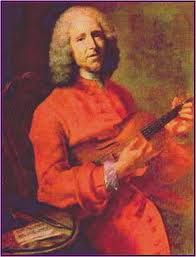 , who followed Lully to become the leading French opera composer, was born on September 25th of 1683 in Dijon, the capital of Burgundy. Little is known about Rameau’s early years: records are few, and he didn’t like to talk about it either. His father was an organist, and Jean-Philippe was taught music from an early age. When he was around 18, he was sent to Milan, to study music, but the visit was short. In 1706, after working as an organist in several churches in the provinces, Rameau went to Paris, where he found a similar position at the Collège (now Lycée) Louis-le-Grand, a very prestigious institution (one of the pupils there was Voltaire, who would later collaborate with Rameau on several operatic and theatrical productions). In 1709 he returned to Dijon to succeed his father as the organist at the church of Notre-Dame. He didn’t stay there long, though: in a couple of years he moved to Lyon, and then to Clermont. All this was transitory, until, in June of 1722, at the age of 38 but still practically unknown, he arrived in Paris, where he would live for the rest of his life. What made him famous was not his music but theoretical treaties on harmony, which were published that year. Four years later he wrote “New System of Music Theory” which established him as a major theorist not just in France, but in all of Europe. Even though he had already published a book of harpsichord music, he was still unknown as a composer. Rameau’s first composition that Parisians ever heard was an inconspicuous incidental music, written for a play staged at a temporary theater during the annual fair in Saint-Germain. The second book for the harpsichord appeared in 1725, and the third, Nouvelles suites de pieces de clavecin, two years later. Nouvelles suites, which included a piece called Les sauvages (here), became popular.
Even so, his career wasn’t going anywhere: he couldn’t secure a position of organist at any major Parisian church (even though he tried many times) and he was still better known as a theorist rather than a composer. What Rameau really wanted was to write an opera. He was 50 when he presented the first one, Hippolyte et Aricie; the premier became an event but also created a huge controversy. The opera, first staged on October 1 of 1733 in the Théâtre du Palais-Royal, immediately divided the listening public into two camps: those who liked it and those who felt that it flouts all the principals established by Rameau’s predecessor, Jean-Baptiste Lully, and therefore isn’t good. In any event, Rameau’s reputation as a major opera composer was established, and though 50, he had many productive years ahead of him. Here’s a short section from Act I, Rendons un éternel homage.
Andrzej Panufnik, one of the most important Polish composers of the last century, was born on September 24th of 1914. We wrote about this talented composer and great man here. As a youngster he resisted the Nazi occupation, and as an adult – the Soviet takeover of Poland. He defected to the West in 1954. Here’s Panufnik’s Symphony no. 3 (Sinfonia Sacra), from 1963, performed by the Chicago Symphony Orchestra conducted by Sir Georg Solti. It’s about 20 minutes long; even though it’s more traditional than much of his work, it’s very much worth listening to.
Dmitry Shostakovich was born on September 25th of 1906. Here’s his Quartet no. 2, composed in 1944. It’s performed by the Borodin Quartet, a preeminent interpreter of Shostakovich’s works. At the time of the recording, the members were: Rostislav Dubinsky and Yaroslav Alexandrov, violins; Dmitry Shebalin, viola and Valentin Berlinsky, cello. The Quartet was dedicated to Dmitry Shebalin’s father, the composer Vissarion Shebalin, Shostakovich’s close friend.
Read more...Dmitry Shostakovich - String Quartet no. 2
The Borodin Quartet (Quartet)
Andrzej Panufnik - Symphony No. 3 "Sinfonia Sacra"
Chicago Symphony Orchestra (Orchestra)
Georg Solti (Conductor)
Jean-Philippe Rameau - Rendons un éternel hommage, from Hippolyte et Aricie
Monique Simon (Mezzo-soprano)
Les Musiciens du Louvre (Ensemble)
Marc Minkowski (Conductor)
Frescobaldi, Cherubini and Schoenberg, 2016
September 12, 2016. Frescobaldi, Cherubini and Schoenberg. Girolamo Frescobaldi, one of the first great keyboard composers, was born on or around September 13th of 1583. We posted a rather 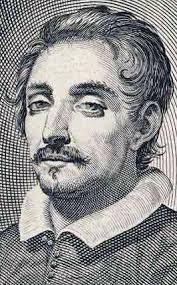 detailed entry about him two years ago, so this time we’ll present some of his compositions. As we mentioned, Frescobaldi, even though he wrote in different genres was best known for his works for the keyboard. At the beginning of the 17th century, the keyboard meant the organ or the harpsichord. One of the major collections of organ pieces Frescobaldi wrote late in his life is called Fiori musicali ("Musical Flowers"). It was published in 1635 in Rome; at the time Frescobaldi was working as the organist at St Peter’s Basilica, a prestigious position. Fiori musicali consists of three masses: Missa della Domenica (Sunday Mass), Missa degli Apostoli ("Mass of the Apostles") and Missa della Madonna ("Mass of the Virgin"). At that time, the organ mass was still in development: most masses were choral works. Frescobaldi’s organ setting became highly influential; Henry Purcell studied it, Johann Sebastian Bach copied the whole set by hand. None of the masses cover the complete service; all three start with a Toccata, to be played before the mass. A polyphonic Kyrie section follows, and then a rendition of Credo (written as a Ricercar) and another Toccata. Here’s the third Mass, Missa della Madonna, performed by the organist Roberto Loreggian. About 20 years earlier, in 1615, Frescobladi had published a book of keyboard pieces called “Primo libro di toccata” or the first book of toccatas. The toccatas (there are 12 of them) can be played on the organ or on a harpsichord. Here’s Toccata Prima, played on the harpsichord by Laura Alvini.
Another Italian, Luigi Cherubini lived and worked two centuries after Frescobaldi. He was born on September 14th of 1760 (although some sources state September 8th as his birthday) in Florence. A child prodigy, he studied counterpoint at an early age and also played the harpsichord. When he was thirteen, he composed sections of a Mass and a cantata. He received the Grand Duke’s scholarship to study in Milan and Bologna. During those years he composed several operas (throughout his career he wrote more than 30). In 1785 he traveled to London and then to Paris, where he was presented to Queen Marie Antoinette. The following year, he permanently moved to Paris, where he shared an apartment with his friend and great violinist Giovanni Battista Viotti. Viotti helped him to be appointed the director of Théâtre Feydeau, then called Théâtre de Monsieur, under whose patronage it was created (“Monsieur,” the Count of Provence, the grandson of Louis XV, would become Louis XVIII and reign after the fall of Napoleon, till 1824). Cherubini composed a number of successful operas, presented either at his theater or at the Opéra-Comique (the two theaters would eventually merge). The French Revolution affected Cherubini, as he was associated with the royal family, and at some point he even had to flee Paris, but eventually Napoleon extended him his patronage, however reluctantly (he didn’t like Cherubini’s music). Eventually Cherubini moved away from opera and toward liturgical music. He wrote several masses and a Requiem in C minor, to commemorate the execution of Louis XVI. The Requiem was highly praised by Beethoven and later by Schumann and Brahms (Beethoven held Cherubini in especially high regard, considering him his most talented contemporary). Twenty years later, Cherubini wrote another requiem, in D minor, to be performed at his funeral. Here’s the overture to one of Cherubini’s most successful operas, Les Deux Journées (Two days). Christoph Spering conducts the Neues Berliner Kammerorchester.
Arnold Schoenberg, one of the most influential composer of the first half of the 20th century, was also born this week, on September 13th of 1874. We’ll write about him another time.
Read more...Luigi Cherubini - Ouverture to Les Deux Journées
Neues Berliner Kammerorchester (Orchestra)
Christoph Spering (Conductor)
Girolamo Frescobaldi - Toccata prima, from Primo Libro
Laura Alvini (Harpsichord)
Domenico Scarlatti - Sonata in C Minor, K. 56
Eylam Keshet (Piano)