Bach 2016
March 21, 2016. Bach. Today is the birthday of Johann Sebastian Bach. He was born in 1685 in Eisenach, the city we mentioned last week while celebrating Bach’s friend, Georg Philipp Telemann. Last year we wrote about Bach’s life around 1723-1724, as he arrived in Leipzig, after spending 6 years in Köthen. Bach was going to assume the duties of the Kantor at Thomaskirche, the post that was left open with the death of Johann Kuhnau, the previous Kantor and Telemann’s nemesis, a year earlier. This was a prestigious position: the Kantor was 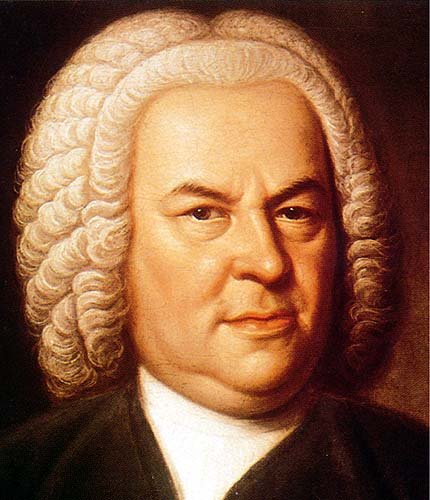 practically the director of church music for the whole city. During the previous years Bach had changed employers several times, moving from one place to another, but he would remain in Leipzig for the rest of his life. Last year we mentioned (and played) the St. John Passion, one of his early Leipzig masterpieces. Bach wrote it in 1723-1724; it was first performed during the Good Friday service on April 7th, 1724, at Nikolaikirche, one of the most important churches in Leipzig, second only to Thomaskirche. Bach’s workload was enormous. First of all, he was supposed to teach music to the students at Thomasschule, one of the oldest schools in Europe: it was founded in 1212, together with Thomaskirche. The school was located in the courtyard of the church and was extended during Bach’s tenure (the old building was demolished in 1903, a pity). There were 50 to 60 students, split into four choirs. Each choir performed in a different church, and each had its own musical curriculum. Bach was also supposed to teach Latin but was allowed to employ substitutes.
In addition to teaching, Bach was required to compose music for the services at the main churches of Leipzig: a cantata for each Sunday service and for every holiday. In Leipzig, Bach composed five annual cycles, about 60 cantatas each (altogether Bach wrote almost 300 cantatas; of these, 200 are extant and about 100 were lost). Most of the Leipzig cantatas were written during his first years as Thomaskantor, the last one – around 1745. Cantatas were written for vocal soloists (usually four of them- soprano, alto, tenor and bass, but sometimes just for one vocal solo), who were supported by the Thomanerchor (the choir of the St. Thomas School), and the orchestra. The choral part was usually written for four voices, and there were four singers per group – 16 choristers altogether. Bach himself lead the performances and played the organ. The soprano solo very often was Anna Magdalena, his young second wife.
With such an extraordinary workload, it’s not surprising that Bach reused some of the material from his previous work, as he would later use some of the cantata material in his Oratorios (Easter and Christmas). Out of the 300 cantatas it is impossible to find the “better” ones or even a favorite, so “Vergnügte Ruh, beliebte Seelenlust” BWV 170, as great as it is, is neither. “Delightful rest, beloved pleasure of the soul,” as it is translated from German, was composed in 1726 for the sixth Sunday after the Trinity. It was first performed on July 28th of that year. This is a rather unusual cantata as it’s composed for a solo voice, an alto. Sometimes it’s performed by a countertenor, sometimes by a mezzo-soprano. In this recording it’s the former, Andreas Scholl. Collegium Vocale is conducted by Philippe Herreweghe. And here’s a more mature (and more famous) cantata Wachet auf, ruft uns die Stimme, BWV 140 for four voices. The first line is usually translated as “Awake, calls the voice to us.” Bach later transcribed the fourth movement, chorale: "Zion hört die Wächter singen" for the organ (BWV 645). This chorale was further transcribed for the piano by Ferruccio Busoni and several other composers. The original cantata is performed by the soloists and Concentus musicus Wien and conducted by Nikolaus Harnoncourt. Harnoncour, one of the pioneers of “historically informed” performances, died earlier this month, on March 5th. He was 86.
Read more...Johann Sebastian Bach - Cantata "Wachet Auf, Ruft Uns Die Stimme," BWV 140
Alan Bergius (Soprano)
Kurt Equiluz (Tenor)
Thomas Hampson (Bass)
Concentus musicus Wien (Ensemble)
Nikolaus Harnoncourt (Soprano)
Johann Sebastian Bach - Cantata "Vergnügte Ruh, beliebte Seelenlust," BWV 170
Andreas Scholl (Tenor)
Collegium Vocale (Ensemble)
Philippe Herreweghe (Conductor)
Kevin Daniels - Beethoven by World Philharmonic Orchestra & Soul Cafe
Beethoven by World Philharmonic Orchestra & Soul Cafe (Orchestra)
Suites
04/10/2016 15:00, South Milwaukee Performing Arts Center
Whirr, Whirr, Whirr! - Hultgren
First Suite in Eb - Holst
Dali - Forte
-----
Scenes from Childhood - Turnbull
Gloriosa - Ito
For ticket information, go to www,knightwind,org
Mehdi Hosseini's Âbkenâri, will be performed in Mussorgsky Hall (Mariinsky II)
03/05/2016 19:00, Mariinsky
Âbkenâri for flute, clarinet, violin and cello will be performed by musicians of the Mariinsky Orchestra in Mussorgsky Hall (Mariinsky II).
Âbkenâri based on folk music material of Gilan. The original tune played when the bride is separated from her family. According to master musicians, it denotes final phase of sorna playing. A showpiece, with free meter, is sometimes accompanied by other instruments.
Performers:
Alexei Krasheninnikov, violin
Alexander Perecypkin, cello
Maria Arsenieva, flute
Andrei Bezruchko, clarinet
Conductor: Arseny Shuplyakov
Mehdi Hosseini - Inertia I.
Mehdi Hosseini (Ensemble)
Mehdi Hosseini (Violin)
Mehdi Hosseini (Clarinet)
Mehdi Hosseini (Piano)
Mehdi Hosseini (Cello)
Telemann 2016
March 14, 2016. Telemann. Georg Philipp Telemann was born on this day in 1681, four years and a week before Johann Sebastian Bach. Telemann was born in Magdeburg; his family was upper-middle class, his father, who died when Telemann was four, was a deacon and university educated. Telemann started musical lessons rather late, at the age of 10, and even those were brief. His 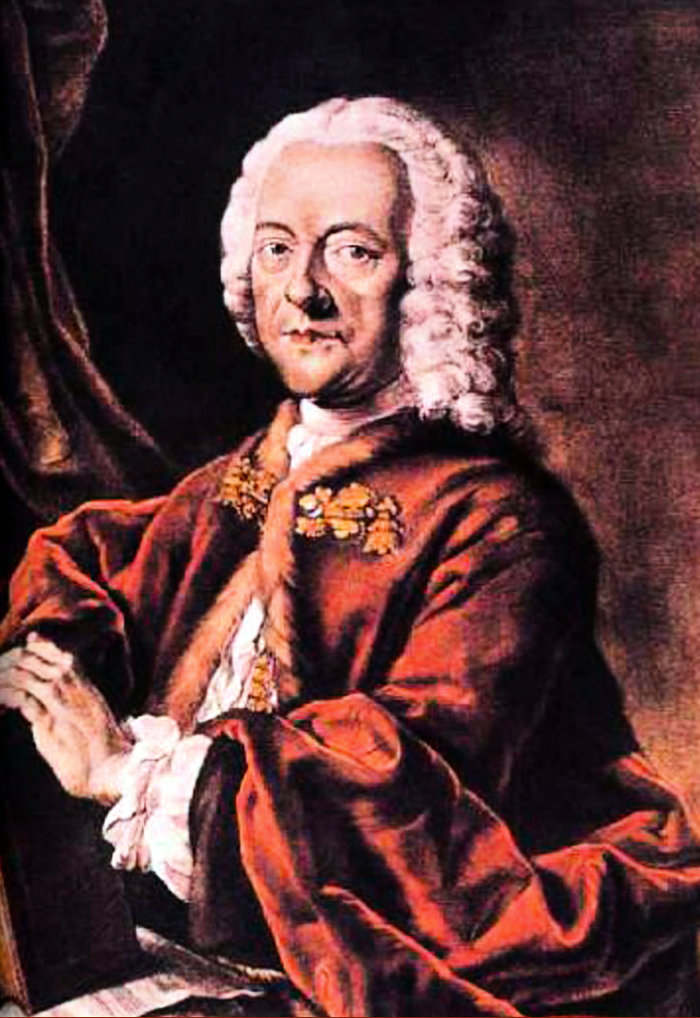 family was not supportive and young Telemann studied in secret, learning to play the recorder, violin, and zither. Upon learning that he continued studying music, his mother confiscated all his instruments. That didn’t stop Telemann from composing. He’d even sneak out of his house at night and play on borrowed instruments. When he was 13, he was sent to school in Zellerfeld, but his main teacher there was interested in music himself and in addition to general subjects introduced Telemann to the relationship between music and mathematics. In 1697 Telemann joined the old and prestigious Gymnasium Andreanum in Hildesheim. (The school was established in 1225, and the town, especially its Market square, was considered one of the most beautiful in all of Germany. It was bombed out during WWII but restored in the 1990s). His musical talents became obvious and acknowledged; the school commissioned him songs, and he also performed in local churches. He even traveled to the courts in nearby Hanover and Brunswick, where he became familiar with Italian music, Corelli and Caldara in particular. All these extracurricular activities didn’t prevent Telemann from graduating third in a class of 150.
In 1701 Telemann entered Leipzig University. Even though his intention was to study law, very soon he found himself composing and performing full time. The Mayor commissioned him to write music for two of the most prestigious churches in the city, the Thomaskirche and the Nikolaikirche (twenty years later these churches would be filled with the of music of Bach). Telemann founded a student orchestra and one year later, in 1702, became the director of the opera house, for which he composed four operas. Johann Kuhnau, a prominent composer, was then the Cantor at the Thomaskirche, traditionally the position of the city’s music director, the one that Bach would assume in 1723. With all of Telemann’s music activities encroaching on Kuhnau’s authority, it was not long before their relationship turned acrimonious. Kuhnau was especially incensed by Telemann using students in opera productions and petitioned city fathers to stop the practice (apparently with little success). It’s interesting that Telemann wasn’t shy to acknowledge that he learned much from studying Kuhnau’s music. Also around that time, Telemann met Handel in Halle and heard an opera by Bononcini, Handel’s future rival, during a trip to Berlin.
In 1705 Telemann left Leipzig for Sorau (now in Poland), where Count Erdmann II, a great lover of music, had just returned from his travels to Italy and France. Telemann assumed the position of Kapellmeister and, to satisfy the Count’s newly acquired French taste, engaged in studying the music of Lully. His stay in Sorau was productive but not long: with the army of Swedish King Carl XII approaching, he left Sorau for Eisenach (Bach’s birthplace) and entered into the service of Duke Johann Wilhelm of Saxe-Eisenach as Kapelmeister. This is where, apparently, he met Johann Sebastian for the first time. Telemann’s output during his four years in Eisenach was prodigious: four or five cycles of church sonatas, masses, 50 cantatas, and many concertos for orchestra. This presents one of the problems with Telemann’s legacy: some of his music is of extremely high quality but it has to be searched for within his vast, ofter mediocre output. Here’s a cantata that’s definitely not: Seele, lerne dich erkennen, it was written around 1725. It’s performed by Ensemble Caprice with the soprano Monika Mauch, Matthias Maute conducting.
Read more...Georg Philipp Telemann - Cantata "Seele, lerne dich erkennen"
Monika Mauch (Soprano)
Ensemble Caprice (Ensemble)
Matthias Maute (Conductor)
Roger Quilter - By a Fountainside
Iestyn Morris (Tenor)