
Chopin, Rossini, Vivaldi, 2016
February 29, 2016. Chopin, Rossini, Vivaldi. These are the composers born this week: Gioachino Rossini, the epitome of the bel canto – on February 29th of 1792, Frédéric Chopin, one of the greatest, if not the greatest Romantic composers – on March 1st of 1810, and Antonio 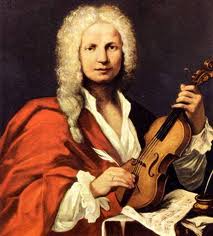 Vivaldi, who occupied a similar position within the Baroque tradition – on March 4th of 1678. We don’t have enough space to celebrate them all but omitting any one of them would be a fault, so we’ll be brief. Vivaldi, the oldest of the three, was born in Venice, one of the centers of European music. Vivaldi’s father, a barber-cum-violinist, was his first music teacher. At the age of 15 Antonio started his training for priesthood at local churches; he was ordained 10 years later. Vivaldi had health issues – probably asthma – and stopped celebrating Mass (and thus lost part of his income) several years into his priesthood. In 1703 Vivaldi became maestro di violino at Pio Ospedale della Pietà, a Venetian orphanage which specialized in the musical training of children in its care. It maintained a well-regarded orchestra and a choir. Musical services at the Pietà were popular among the Venetian nobility, and required continuous supply of new music, providing which was one of Vivaldi’s responsibilities. In 1711, Estienne Roger of Amsterdam published Vivadli’s set of 12 concerti, for one, two and four violins. It was called L'Estro Armonico, op. 3 and was dedicated to Grand Prince Ferdinand of Tuscany (the Prince, the son of Cosimo III de' Medici, Grand Duke of Tuscany, was a famous patron of music; among the musicians who benefited from his largess were Alessandro and Domenico Scarlatti, Benedetto Marcello, and George Frideric Handel). L'Estro Armonico was a huge success, especially in Germany, so much so that Bach transcribed six of the concertos: three for the keyboard, two for the organ and one, Concerto no 10, for four harpsichords and strings. Here’s the “original” Concerto no. 3, op. 3 for solo violin. The Academy of Ancient Music is led by Christopher Hogwood.
Gioachino Rossini composed 39 operas, among them some of the most beloved in all of the Italian repertoire, such as Il barbiere di Siviglia, La Cenerentola and William Tell. This achievement looks extraordinary if we consider that Rossini retired from active composing at the age of 37. Rossini didn’t “invent” bel canto, but he was the first, ahead of Bellini and Donizetti, to create great bel canto roles. The major exponents of the 18-century bel canto style were castrati; Farinelli was probably the most famous singer of the 18th century. It’s said that in 1720s and 1730s almost 4,000 pre-pubescent boys were castrated annually. By the early 19th century few of them remained on stage, but Rossini was greatly influenced by their singing. He said, “I have never forgotten them. The purity, the miraculous flexibility of those voices and, above all, their profoundly penetrating accent — all that moved and fascinated me more than I can tell.” He created a role for Giovanni Veluti, the "last of the great castrati," in his opera Aureliano in Palmira. Rossini’s wife, the famous soprano Isabella Colbran, shared the stage with Veluti in several productions. Colbran herself premiered many of Rossini’s operas, Semiramide, written in 1823 was one of them. Here’s is one of the greatest bel canto sopranos of the 20th century, Joan Sutherland, in the aria Bel raggio lusinghier in the 1960 production of Semiramide. The orchestra of the Covent Garden Opera is conducted by Francesco Molinari-Pradelli.
We’ll celebrate Chopin’s birthday by just one piece, and keeping with the theme of this post, it’s Italian in style. Barcarolle, op. 60 was written in 1846. His health was already deteriorating (Chopin died of tuberculosis on October 17th of 1849) and this was his last relatively large composition. He also played barcarolle in his last public concert in February of 1848 (it’s said that he was so weak that practically the whole concert was played in pianissimo). Here it is performed, with magnificent restraint, by Arthur Rubinstein.
Read more...Antonio Vivaldi - Concerto no. 3, op. 3 (L'Estro Armonico) in G Major for solo violin
The Academy of Ancient Music (Ensemble)
Christopher Hogwood (Conductor)
Gioachino Rossini - Bel raggio lusinghier, from Semiramide
Joan Sutherland (Soprano)
Orchestra of the Covent Garden (Orchestra)
Francesco Molinari-Pradelli (Conductor)
michael moore - missa diva
michael moore (Ensemble)
michael moore - organ work no. 2
michael moore (Organ)
Sergey Akhunov - Sotto Voce
Dmitri Schelkin (Percussion)
Yuri Polubeliv (Piano)
New Russian quartet (Quartet)
Nikolai Choubine--Solo Recital
04/04/2016 19:30, Utah Valley University
Works by Tchaikovsky, Scriabin and Mussorgsky.
Auiric and Kurtág, 2016
February 22, 2016. Auiric and Kurtág. By any count this should’ve been the week of George Frideric Handel, who was born on 23rd of February in 1685, but we’ve written about him many times (here and here, for example), so today we’ll mark his anniversary by playing the aria Ombra mai fu from his opera Xerxes. The magnificent Cecilia Bartoli is accompanied by Il Giardino Armonico, Giovanni Antonini conducting.
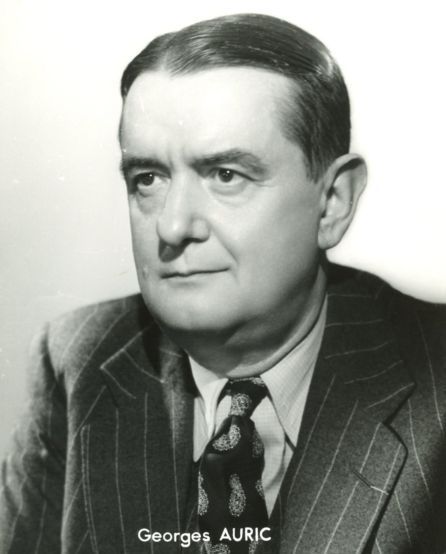 There are several other composers of note who have their birthdays around this date. One of them is the French composer and member of Les Six, Georges Auric. Auric was born in Lodève, a small town in the southwestern part of France, on February 15th of 1899. His family moved to the nearby Montpellier, where Auric attended the conservatory. He studied piano and was introduced to the music of Debussy, Ravel and Stravinsky. He also discovered the music of Satie, which later would become such an influence both on him and his friends. In 1913 his family moved Paris and Georges enter the Conservatory, where he studied with Florant Schmitt and Albert Roussel. When Georges was just 15, he got acquainted with many of the Parisian luminaries: Stravinsky, Apollinaire, Cocteau, Braque and Picasso. At the Conservatory, he met Arthur Honegger, Darius Milhaud and Germaine Tailleferre, all of whom eventually became associated with Les Six. (The group was the brain-child of Eric Satie, who wanted to organize musicians opposed to the music of Wagner and rebelled against the Impressionists. Satie came up with the idea after a concert in a private studio in Montparnasse in 1917. For that amazing concert, the walls were covered with pictures by Picasso, Matisse, Léger and Modigliani. The music that was performed was by Erik Satie himself, Honegger, Auric and Louis Durey). In the 1924, Serge Diagilev asked Auric to remake his incidental music to Molière’s comedy Les Fâcheux into a ballet. The ballet was successful and several other commissions followed, some from Diagilev, others from Ida Rubinstein. He also wrote music for several movies, including 1952 “Moulin Rouge,” with the song “Where is my heart,” which made it to no. 1 on the Billboard chart in 1953. But Auric remained a serious, probing composer throughout his career; in the 1960s and 1970s he even tried out serialism. Auric died on July 23rd of 1983. Here’s his Sonatine from 1922. It’s performed by the pianist Daniel Blumenthal.
We’d also like to mention another 20th century composer, the Hungarian György Kurtág, who was born on February 19th of 1926 in Lugoj, Banat. These days most of the historical Banat lies in Romania, but prior to 1918 Banat was part of the Austro-Hungarian empire; many inhabitants were Hungarian-speakers. It also had a large Jewish population; Kurtág is half-Jewish. He spoke Hungarian at home and Romanian at school. As a child, he studied the piano on and off, first with his mother, then with professional teachers. After WWII, in 1946, the 20-year old Kurtág moved to Budapest and continued taking piano lessons, eventually entering the Franz Liszt Music Academy. There he met György Ligeti and they became friends for life. After the Hungarian revolution of 1956, Kurtág moved to Paris. There he studied with Olivier Messiaen and Darius Milhaud. He returned to Hungary in 1959 and stayed there for the duration of the Communist regime – the only Hungarian composer of international renown to do so (Ligeti, for example, fled to Vienna right after the failed revolution and stayed in the West for the rest of his life). Kurtág resumed traveling only after the fall of communism in 1989, moving first to Berlin (he was the composer in residence for the Berlin Philharmonic in the mid-90s), then Vienna, the Netherlands and Paris, where he worked with Boulez’s Ensemble Intercontemporain. These days Kurtág and his wife live in Bordeaux. Here are Kurtág’s Eight duos for violin and cimbalom. Patricia Kopatchinskaja is the violinist, Viktor Kopatchinsky plays the cimbalom.
Read more...György Kurtág - Eight duos for violin and cimbalom
Patricia Kopatchinskaja (Violin)
Frédéric Chopin - Barcarolle in F-sharp Major, Op. 60
Artur Rubinstein (Piano)