
Alexander Scriabin - Etude Op 2 n 1
Francesco Comito (Piano)
Missed birthdays, January 2016
February 1, 2015. Missed birthdays. Last week we celebrated Mozart’s 260th birthday and missed several important dates. Franz Schubert was born on January 31st of 1797. Composer of immense talent and a tragically short life, he left an 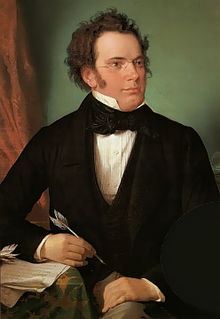 extraordinarily rich body of work: piano sonatas, last three of which have very few peers in all of the piano repertoire; nine symphonies; wonderful chamber music (one has to mention his “Death and the Maiden” quartet (no. 14), his “Trout” Quintet or the great String Quintet in C Major), sacred works, stage work (“Rosamunde,” for example) and much more. But one area where his genius shone the brightest was the Lied. Schubert’s songs pack a great amount of musical material and the broadest range of emotions into little gems that sometimes last less than two minutes. His song cycles Die schöne Müllerin, Winterreise, and Schwanengesang are, of course, incomparable, and so are some individual songs. Here are two, An Die Musik, D. 547, sung by the soprano Elisabeth Schwarzkopf with the great, but in this recording technically imprecise Swiss pianist Edwin Fischer (here), and Gretchen Am Spinnrade, with the flawless Kiri Te Kanawa and Richard Amner (here). Schubert was 17 when he composed Gretchen Am Spinnrade.
The Italian composer Luigi Nono was born on January 29th of 1924 in Venice. Nono studied at the Liceo Musicale with the noted composer Gian Francesco Malipiero and then with one of the first avant-garde Italians, Bruno Maderna. Several early works by Nono were presented in Darmstadt. Soon after he became an active participant and, together with Boulez and Stockhausen, one of the leaders of the movement. In 1955 he married Nuria Schoenberg, daughter of Arnold Schoenberg. Nono was a leftist, as were many of his fellow composers. A principled anti-fascist, he went much further left than that. For example, his opera Al gran sole carico d'amore, (the libretto for which he co-wrote with Yuri Lyubimov, the director of the original production and also the director of the famous Moscow Taganka theater), while based on the plays by Bertolt Brecht, also contained excerpts of speeches by Fidel Castro, Che Guevara, Karl Marx and Lenin. Some of the music composed during the 60s was extremely political and dogmatic. For example, his Non Consumiamo Marx consists of sounds recorded during the 1968 student uprising in Paris and a voice reading the messages left on the walls during that period. A much more interesting piece is his Prometeo, composed during several years in the early 1980s. It’s called “opera,” although the word should be taken in its original Italians sense, “work” – Prometeo is a composition for five singers, two speakers, a chorus and small orchestra. The sounds are supposed to be electronically manipulated. Here’s a suite from Prometeo, performed live in Lucerne on August 20th of 2005. Claudio Abbado is conducting.
One great composer was born this week: Felix Mendelssohn, on February 3rd of 1809. Even though we’ve written about him many times, we’ll dedicate an entry to him at a later date.
Read more...Franz Schubert - An Die Musik, D. 547
Elisabeth Schwarzkopf (Soprano)
Edwin Fischer (Piano)
Luigi Nono - Prometeo Suite
Rachel Harnisch (Soprano)
Lucerne Festival Orchestra (Orchestra)
Claudio Abbado (Conductor)
Franz Schubert - Gretchen am Spinnrade
Kiri Te Kanawa (Soprano)
Richard Amner (Piano)
Giacomo Cataldo - Piccola reminiscenza per violino ed orchestra
Leos Zavadilik (Violin)
Bohuslav Martinu Philharmonic Orchestra (Orchestra)
Petr Pololanik (Conductor)
The Da Capo Duo - Live Stream Concert
Kristin Paxinos (Flute)
Ben Westfall (Guitar)
Mozart 2016
January 25, 2016. Mozart. January 27th marks the 260th anniversary of birth. Every year we focus on a different episode of Mozart’s life and present compositions from that period. Last year was about his rather unhappy trip to Paris in 1777-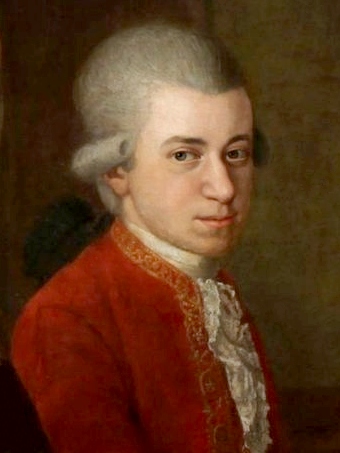 1778. The 22 year-old Mozart had left Paris in September of 1778. He was offered a position in Salzburg at the court of the Prince Archbishop as an organist and concertmaster, and even though it paid three times his previous salary (450 florins instead of 150 – the New York Times has an interesting article on how much that would be in current dollars), Mozart was hesitant: he remembered the stifling atmosphere of Salzburg and was looking for an appointment in other places. He stayed in Mannheim and then in went to Munich but found no offers in either place. To make things worse, his Mannheim lover, the singer Aloysia Weber, seemed to have lost interest in him. (A quick note on these two cities. It was not by chance that Mozart was looking for employment there: Mannheim was famous for its orchestra, considered at that time the best in Germany. Munich had a strong musical connection: in 1778 the Elector Karl Theodor moved his court from Mannheim to Munich, bringing with him 33 musicians who became the core of his court’s orchestra; they also performed in the royal opera.) On January 15th of 1779 Mozart returned to Salzburg. For a while his relationship with Hieronymus Colloredo, the Prince-Archbishop, was quite good, but soon the same tensions that dominated their relationship before the Paris trip, became apparent again. Colloredo wanted Mozart to compose more church music while Mozart was getting more and more interested in opera and other non-liturgical genres. These difficulties were spelled out in a 1782 document appointing Michael Haydn, the younger brother of Franz Joseph Haydn, to the same position as Mozart had previously held: “we accordingly appoint [Michael Haydn] as our court and cathedral organist, in the same fashion as young Mozart was obligated, with the additional stipulation that he show more diligence … and compose more often for our cathedral and chamber music.” What Mozart did compose during that time were three symphonies (a short one, no. 32, no. 33 and no. 34, with a wonderfully energetic Finale, which you can hear in the performance by The Academy of Ancient Music, Christopher Hogwood conducting). Also, a concerto for two pianos, the famous Sinfonia Concertante for Violin and Viola and several other pieces, none of which could’ve been performed either in the Cathedral or at the Court. (Here’s the 1956 recording of the Concertante made by Jascha Heifetz, violin and Willian Primrose, viola)
In 1780 Mozart received a commission from Munich, from the Elector Karl Theodor himself, to compose a “serious” opera (opera seria). It was to become Mozart’s first mature opera, Idomeneo. (Here’s a Quartet Andrò ramingo e solo from Idomeneo with a great cast: Edita Gruberová and Lucia Popp, sopranos, Baltsa, mezzo-soprano and Luciano Pavarotti, tenor). The premier in Munich in January of 1781, with Mozart conducting, was highly successful. Papa Leopold traveled from Salzburg to attend. The whole family stayed in Munich for another two months. Then came a summons from Vienna where Archbishop Colloredo went to attend the celebrations of the accession of Joseph II as the Holy Roman Emperor. Spoiled by his triumph in Munich, Mozart was especially offended by the Archbishop treating him as a servant. In May of 1781 Mozart asked to be dismissed and a month later he was let go “with a kick on my arse,” as he wrote in a letter. Thus commenced the Viennese period of his life. The portrait of Mozart by Johann della Croce, above, is part of a picture of the family; it was made around the time of the described events, in 1780 or 1781.
Read more...Wolfgang Amadeus Mozart - Quartet Andrò ramingo e solo Idomeneo, from Idomeneo
Edita Gruberová (Soprano)
Lucia Popp (Soprano)
Agnes Baltsa (Mezzo-soprano)
Luciano Pavarotti (Tenor)
John Pritchard (Conductor)
michael moore - deluge
michael moore (Orchestra)