
Prokofiev 2015
April 20, 2015. Sergey Prokofiev. Here at Classical Connect we love all music, from the Renaissance to the contemporary. Of course we cannot get enough of the core, from Bach to the Viennese masters, to the 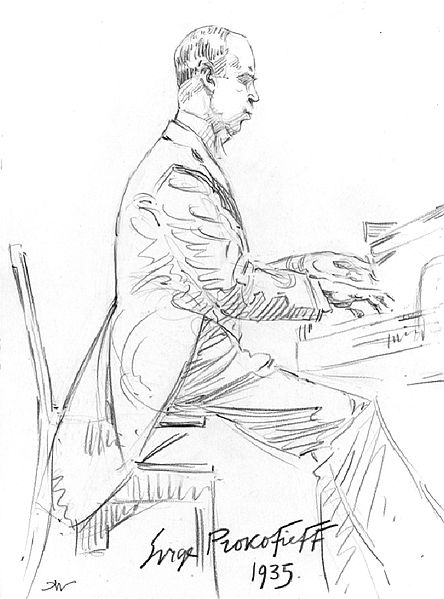 Romantics of the 19th century, and then, through Mahler into the 20th and on. But life would be boring without the great experiments of the early composers, who were trying to find their way from craft to art. Or the more obscure baroque musicians who developed the unheard-of-before styles, such as, for example, opera. And of course we value the music of the late 20th century, as challenging as it sometimes is. And within this enormous aural universe, we have our favorites. Some of them stay with us for a very long time, other retire to the background. The same of course happens with musical tastes in general: just take a look at the Klavierabend (piano recital) programs of the first half of the 20th century: they are drastically different from what you would hear today. One composer that remains our perennial favorite is Sergei Prokofiev. As is the case with so many talented Russian artists whose life spanned two different eras, one before, another after the October Revolution, his life was full of tragedies and triumphs, exiles and returns. We’ve written about Prokofiev, who was born on April 23rd of 1891, many times, for example, here last year, and here the year before. That’s why this time we’ll just play one piano sonata, no. 8. This is the third of the so-called War sonatas; this is a traditional misnomer as the first of the three, Piano Sonata no. 6, was completed in February and premiered in April of 1940, before the Soviet Union was invaded by the Germans. Sviatoslav Richter was the pianist to first play sonatas no. 6 and 7. Sonata no. 8, on the other hand, was premiered by Emil Gilels; the event took place on December 30th of 1944 in the Great Hall of Moscow Conservatory.
Prokofiev started writing the sonata much earlier, in 1939. That was the year when he met and fell in love with Mira Mendelson, a young writer half his age. At the time Prokofiev was still married to Lina Llubera (they married in 1923), a Spanish singer whom he met in New York and brought to Moscow in 1936 when he decided to return to the Soviet Union. By 1941 Prokofiev and Lina were separated, and he was living openly with Mira. Mira became Prokofiev’s wife in 1948 and a very troubling story ensued (we’ll write about it another time). Mira is the dedicatee of the Eighth sonata, probably the most complex and deep of the three. Gilels’s 1944 performance was a triumph and soon became an essential part of his vast repertoire. He recoded it a number of times and played it, very successfully, around the world (Richter also made a great recording of the sonata). Here’s a studio recording, made by Gilels in Vienna in 1974. It’s four minutes longer than, for example, his live concert recording of 1967.
Read more...
Richard Strauss - Sonata for Violin in E-flat Major, Op. 18
Jessica Mathaes (Violin)
Heidi Louise Williams (Piano)
Ernest Bloch - Nigun, from Baal Shem
Jessica Mathaes (Violin)
Heidi Louise Williams (Piano)
Ernest Bloch - Vidui, from Baal Shem
Jessica Mathaes (Violin)
Heidi Louise Williams (Piano)
Sergei Prokofiev - Piano Sonata no. 8
Emil Gilels (Piano)
Rebel and de Wert, 2015
April 13, 2015. Rebel and de Wert. This week, just like the previous one, looks rather bare: only one composer of note was born during this period, and even he was much more popular during his lifetime than he is today. His name is Jean-Féry Rebel, and he was born in Paris on April 18th, 1666 (that makes him two years older than François Couperin). His father was a singer at 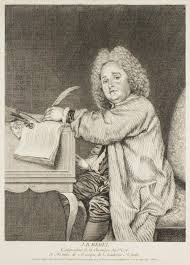 the King’s chapel (the King being Louis XIV), and apparently Jean-Féry began studying music at an early age. He was noticed by Jean-Baptiste Lully, then the most famous composer in France, and became his pupil. In 1705 Rebel was made one of the 24 musicians in Violons du Roi orchestra, and some years later – the Chamber composer, a very prestigious position. His only opera, Télémaque, was not successful; on the other hand, his dance music was extremely popular with the court. This is not surprising, considering how much Louis XIV liked to dance himself and later in his life, to watch ballet. But Rebel was a serious and innovative composer; in 1737 he wrote a ballet called Les elemens, which he preceded by a short section called Le Cahos (Chaos). You can listen to it and imagine how startled the listeners would’ve been (in this recording Musica Antiqua Köln is conducted by Reinhard Goebel). And here is Rebel’s earlier piece, Le tombeau de M. Lully, written as a tribute to his teacher. It’s performed by the violinist Amandine Beyer and the ensemble L'Assemblée des Honnestes Curieux.
Giaches de Wert is one of many Renaissance composers whose date of birth was either unrecorded or lost. We’ve never written about him before, and this week is as good as any to rectify this omission. Giaches, whose first name was spelled in many ways, including the frenchified Jacques, was born around 1535 somewhere in Flanders (his name suggests that he 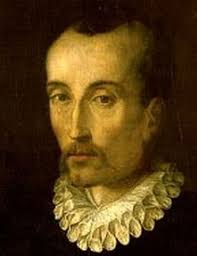 may have been born in Weert, not far from Antwerp). One of the many Flemish composers who spent most of their productive years in Italy, he belonged to the same generation as Palestrina, Orlando di Lasso and Andrea Gabrieli. Most of his life de Wert was associated with two very powerful (and related) Italian families: d’Este and Gonzagas. As a youngster he sung at the chapel of Maria di Cardona, wife of Francesco d’Este (Francesco was a son of Lucrezia Borgia from her third marriage to Alfonso d’Este, Duke of Ferrara). In 1550 Wert moved to the town of Novellara, when he washired as a musician for a branch of the Gonzaga family; he would live there for the following 15 years. Mantua was the main seat of the Gonzagas, while d’Este ruled in Ferrara; Wert traveled to both cities. (Just six years earlier, Ferrante Gonzaga had brought a 12 years old Orlando di Lasso to Mantua; some year later, Frescobaldi and Monteverdi would work there for the Gonzagas. Ferrara, at least as much a musical center as Mantua, hosted Orlando, Frescobaldi and Gesualdo, among many others). In 1565 Wert was appointed the Maestro di Capella of the newly built ducal chapel of Santa Barbara in Mantua and moved there from Novellara. He got married (according to some sources, to one Lucrezia of a minor branch of Gonzaga,) but his wife cuckolded him with Bonvicino, a composer and Wert’s rival; when the affair became public, Lucrezia was expelled from Mantua. Wert stayed behind, his reputation compromised. Wert had his own share of scandals: he started an affair in Ferrara with one Tarquinia Molza, an accomplished musician of noble descent and a lady-in-waiting to the Duchess of Ferrara. That was considered inappropriate and when the Duke Alfonso d’Este learned about the affair, Tarquinia was banished from the court.
All along Wert was composing, mostly secular music. He wrote about 230 madrigals, many of them on the verses by famous poets, Bembo, Petrarca, Ludovico Ariosto, and especially his contemporary, Torquato Tasso. We’ll hear two of his madrigals, Ah dolente partite (here) and Io non son però morto (here). The first one is performed by the ensemble La Venexiana, the second, by the Quink Vocal Quintet. Also, one piece of sacred music by Giaches de Wert: his sublime motet Vox in Rama. Ensemble Currende is directed by Erik van Nevel.
Read more...Giaches De Wert - Ah dolente partita
La Venexiana (Ensemble)
Giaches De Wert - Vox in Rama
Currende (Ensemble)
Erik van Nevel (Conductor)
Giaches De Wert - Io non son però morto
Quink Vocal Quintet (Quintet)
Arnaud Desvignes - Miniature de Midi VI
Nicolas Horvath (Piano)