
Wagner 2015
May 18, 2015. Wagner’s Tannhäuser. Richard Wagner was born on May 22nd of 1813. Somehow, this date seems incongruous: was he really just three years younger than Chopin and Schumann? Those are geniuses firmly established in the Pantheon of classical music, while people still argue about Wagner. His music and his writings still can create controversies, as we’ll see in a minute. Wagner was living in Paris 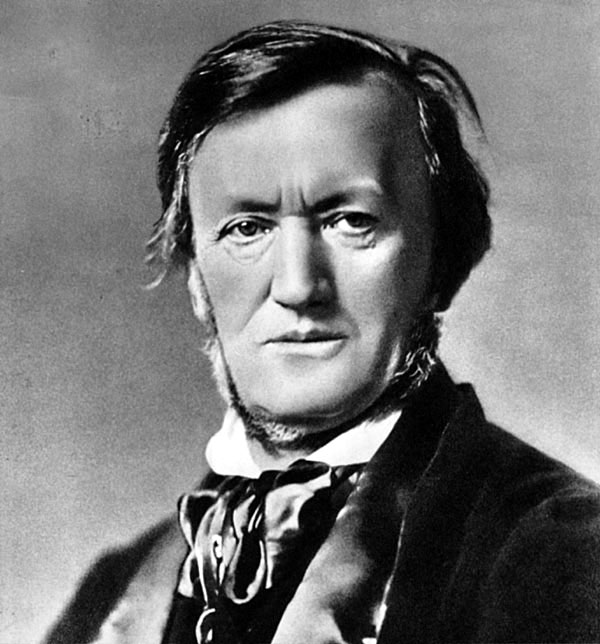 when he completed his third and fourth operas, Rienzi and The Flying Dutchman. He approached Giacomo Meyerbeer, a German-Jewish composer who was living in Paris and asked for advice on the staging of Rienzi. Wagner’s letters to Meyerbeer sound almost obsequious, which is worth noticing, considering the events that followed. In the previous decade Meyerbeer had conquered Paris with his own operas, Robert le Diable in particular. Even though he had lived in Paris for many years, Meyerbeer still maintained connections in Germany, which he used to help Wagner, in Dresden with Rienzi and in Berlin with The Flying Dutchman. In 1842 Rienzi was accepted at the Dresden Court Theater and Wagner moved there right away. The opera was premiered in October of that year and proved to be a success, Wagner’s first. A couple years later he was appointed the conductor at the Court Theater. Wagner, whom Meyerbeer not only helped at a critical moment of Wagner’s life, but who also deeply influenced him by his operas, eventually became Meyerbeer’s biggest enemy. He wrote several pamphlets against Meyerbeer, all of them deeply anti-Semitic in nature. But that was to come later. While still in Dresden, Wagner wrote Tannhäuser, an opera on his own libretto, derived from German legends about a 13th-century German minnesinger Henrich Tannhäuser and a certain song contest. Long, convoluted, and at times incoherent, it tells a story of the poet and singer Tannhäuser who lives in the realm of Venus, the goddess of love, surrounded by young beautiful women. After some sexual shenanigans he decides that he’s had enough and returns to real life in Wartburg. There, the local count holds a song contest. Tannhäuser’s love song is considered too profane and he’s banished from Wartburg and ordered to visit the Pope. More fantastic events take place, involving Tannhäuser, his love interest Elisabeth, and his friend Wolfram, with Venus making an appearance and the Pope’s staff flowering at the very end of the opera. None of it makes much sense, but the juxtaposition of Venus and the church, of lust, love and faith gives directors ample opportunity to excersize their fantazy. Modern productions set Tannhäuser in different eras and some use a good doze of nudity and profanity. One such production, rather mild by European standards, was recently created in the Russian city of Novosibirsk. What followed was a rather typical Russian story. The hierarchs of the local Orthodox church rose in protest, and so did the more conservative members of the local society. Demonstrations were staged, accusations were hurled in the media, the courts got involved. And even though some members of the Russian artistic community tried (rather meekly, it has to be said) to defend the production, the minister of culture moved in and sacked the director. Truly, modern Russia is more bizarre than any of Wagner’s librettos.
All of this doesn’t really matter: the music of Tannhäuser is great, and gets better as the opera evolves. The third act is magnificent. Here’s an excerpt, with the great German baritone Dietrich Fischer-Dieskau, the orchestra of Staatsoper Berlin, Franz Konwitschny conducting.
Read more...Maurice Ravel - La Valse
Shelest Piano Duo (Duo)
Anton Arensky - Suite for Piano Four Hands No. 2, Op. 23, Silhouettes
Shelest Piano Duo (Duo)
Bedřich Smetana - The Moldau from Má vlast
Shelest Piano Duo (Duo)
Johann Sebastian Bach - Variations on Chaconne from "Partita No.2 in D minor" (Full)
Catherine Stay (Violin)
Johann Sebastian Bach - Variations on Fuga from "Sonata No.1 in G minor" for violin solo
Catherine Stay (Violin)
Johann Sebastian Bach - Variations on Chaconne from "Partita No.2 in D minor" for violin solo
Catherine Stay (Violin)
Monteverd 2015
May 11, 2015. Monteverdi. The great Italian composer Claudio Monteverdi was born this week, on May 15th of 1567. And so were three French composers, Jules Massenet, Gabriel Fauré and Erik Satie: Massenet on May 12th of 1842, Fauré on the same day three years later in 1845 and Satie on May 17th, 1866. We wrote about Massenet and Fauré last year, and the wonderfully whimsical Satie will have to wait for another occasion, as this entry will go to the “father of the Italian opera.”
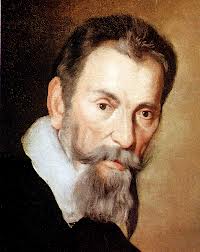 The art of Monteverdi spans two epochs, from the late Renaissance and the early years of the Baroque. He was born in Cremona; a child prodigy, he published his first composition, a collection of sacred songs, at the age of 15. He studied music with the maestro di capella of the Cremona Cathedral. Around 1590 he found a position of the viola player at the court of Vincenzo Gonzaga, Duke of Mantua. Mantua was a very important center of arts and music: practically all the major composers of the previous 100 years had spent at least some time at the court of the Gonzagas. When Monteverdi joined the court orchestra, it was being directed by Giaches de Wert, a famous composer about whom we wrote just three weeks ago. Even though Monteverdi started low in the ranks, his talent was soon noticed, so when the Duke went to fight the Turks, Monteverdi became part of the retinue. In 1600, he again accompanied Duke Vincenzo, this time on a trip to Florence to celebrate the wedding of Maria de’ Medici, a daughter of the Grand Duke of Florence and Henri IV of France. It was during these festivities that he heard Jacopo Peri’s opera Euridice, one of the very first operas ever written. One year later Monteverdi was appointed Duke Vincenzo’s maestro della musica. By then he had written and published a large number of madrigals, and was well known even outside of Italy. Monteverdi started working on his operas around 1607. L'Orfeo, ordered by the Duke as music for the Carnival, was written and first performed, according to different sources, either in 1607 or 1608; Arianna followed in 1609. L’Orfeo is being performed to this day, while just one aria, Lamento d’Arianna, survived from the other one. Duke Vincenzo died in 1612 and was succeeded, for a short time, by his son Francesco. Running out of money (Vincenzo was profligate), Francesco reduced the size of the court, firing Monteverdi in the process. Monteverdi returned to Cremona. With the death of one Giulio Cesare Martinengo, the position of maestro di cappella at the San Marco opened up in Venice. Monteverdi auditioned and was appointed maestro in August of 1613. He lived in Venice for the rest of his life, becoming a priest in 1632. He continued to compose into his old age, writing a large number of madrigals, which were published in different “books.” In 1639 he wrote a very successful opera Il ritorno d'Ulisse in patria (The Return of Ulysses to his Homeland) and, in 1642, another masterpiece, L'incoronazione di Poppea (The Coronation of Poppea). Monteverdi died a year later, in 1643 at the age of 76.
Here are two episodes from L’Orfeo: first, Rosa del ciel, (Orfeo and Euridice nuptial ceremony) from Act I, with Montserrat Figueras and Furio Zanasi, with Jordi Savall directing Le Concert des Nations; then, aria Tu se' morta from Act II. Georg Nigl is Orfeo. And here’s from the 2010 production of L'incoronazione di Poppea, with the wonderful Danielle de Niese as Poppea and Philippe Jaroussky as Nerone. William Christie conducts Les Arts Florissants.
Read more...Claudio Monteverdi - Lasciatemi morire, from 'L'Arianna
Anne Sofie von Otter (Mezzo-soprano)
Antiqua Koln (Ensemble)
Reinhard Goebel (Conductor)
Frédéric Chopin - Nocturne in b-flat minor Op. 9, No. 1
Anastasya Terenkova (Piano)