
Richard Strauss - Night
Stanislava Maslennikova (Soprano)
Giuseppe Verdi - La forza del destino "Melodia Leonore"
Stanislava Maslennikova (Soprano)
Lutoslawski and Dutilleux, 2015
January 21, 2015. Lutoslawski and Dutilleux. Two wonderful composers, both born in the 1910s, have their birthdays this week. The Polish Witold Lutoslawski was born on January 25th of 1913. As we wrote two years 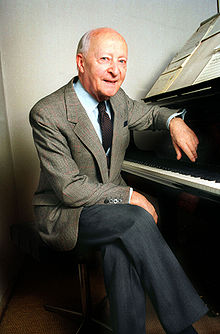 ago, Lutoslawksi’s life was exceptionally difficult, even by tough east-European standards of the 20th century. An aspiring composer in the pre-War years, a student of Nadia Boulanger in Paris, he returned to Poland on the eve of WWII. As the Germans invaded the country, he was conscripted and shortly after captured by the Germans. He escaped eight days later and made it to Warsaw (his younger brother was captured by the Red Army and died in the Gulag a year later). During the occupation, he earned his living by playing piano in bars together with his best friend, Andrzej Panufnik. Just before the heroic and ill fated Warsaw Uprising was to begin, his mother took him to a small town of Komorów, just outside of the city. Things didn’t get much better after the Soviet Union installed a communist regime in Poland. After several relatively liberal years, in 1949 Lutoslawki became the first composer to be officially banned by the Composer’s Union. The ban lasted for almost 10 years, even after Stalin’s death. During those difficult years Lutoslawki survived by writing children songs, and music for theater and radio plays. As he couldn’t use his own name, he wrote under the pseudonym of "Derwid." It’s worth noting that he didn’t write a single piece in the Socialist Realism style, as was expected from him and as so many of his contemporaries in Easter Europe were forced to do (or chose to). Another difficult period came in the 1980s: Lutoslawki actively supported the Solidarity movement, and suffered when its leadership was suppressed by the Communist regime. In defiance, Lutoslawki started what he termed “the boycott of the State,” refusing to conduct, to meet with officials and rebuffing all entreaties from the State.
As most composers, Lutoslawki went through many creative stages. His composing style was changing and evolving his whole life. During some periods it was more modernistic, atonal and even aleatoric, with chance playing a role in note selection, in others? – more tonality-based, almost romantic. Here, from his twelve-tone period, is String Quartet, written in 1954, it’s performed by the New Budapest Quartet. A much "warmer" but still atonal is Lutoslawski’ orchestral piece called Mi-Parti from 1976. It was recorded the same year by the Polish National Radio Symphony Orchestra with the composer conducting. You can listen to it here.
Lutoslawski died in Warsaw on February 9th of 1994. Henri Dutilleux, three year younger than Lutoslawski (he was born on January 22nd of 1916), had a longer life: he died in 2013 at the ripe age of 97. And even though he, like Lutoslawski, lived through the war (and also earned money playing piano in his respective occupied capital), overall his career was a happier one. Throughout his life his achievements were acknowledged by his peers and his country, from the Grand Prix du Rome which he won in 1938 to the highest honor a Frenchmen can receive – the Grand Cross of the Legion of Honor, which he received in 2004. He received commissions from many orchestras and musicians, and taught in several important conservatories. Dutilleux’s place in French music is quite unique: on the one hand, he was influenced, even if indirectly, by Debussy and Ravel, and also by Stravinsky and Bartok; on the other, he never belonged to any musical school, even frowned at them and maintained independence all his life. You can hear some of these influences – the beauty of the orchestral writing combined with a contemporary, almost jazzy edge – in the orchestral piece called Metaboles, as a simple musical structure moves though the different sections of the orchestra, gaining complexity in the process. Metaboles was commissioned in 1965 by George Szell for the Cleveland Orchestra; here it’s performed by the Boston Symphony under the direction of Alan Gilbert.
Read more...Henri Dutilleux - Métaboles
Boston Symphony (Orchestra)
Alan Gilbert (Conductor)
Witold Lutoslawski - Mi-Parti
Polish National Radio Symphony Orchestra (Orchestra)
Witold Lutosławski (Conductor)
Witold Lutoslawski - String Quartet
New Budapest Quartet (Quartet)
Nelly Shin - Wayfarer's Point
Eden's Rose (Piano)
Morton Feldman 2015
January 12, 2015. Morton Feldman. Last week, as we celebrated Alexander Scriabin’s anniversary, we had to pass over several birthdays, like Nikolai Medtner’s and Francis Poulenc’s. This week is not as rich: many names but few first-rate talents. Ermanno Wolf-Ferrari, born on January 12th of 1876 was considered the best composer of comic 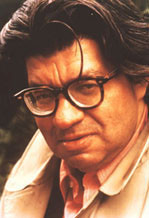 operas of his time; now he’s practically forgotten. Another Italian, Niccolò Piccinni (born on January 16th of 1728), was also a very popular opera composer: he wrote for the Paris Opera and was considered Gluck’s equal. The only problem is that none of his works are staged these days; they’re just not very good. A Russian composer with a very French name, Cesar Cui, was also born this week, on January 18th of 1835. He’s the least interesting of the Mighty Five. Some of his songs are very nice but not much more is performed outside of Russia. The most significant composer of those born this week is the American Morton Feldman. The problem with him is different: in his mature years he wrote enormously long and sometimes difficult compositions and for that reason they are rarely performed.
Feldman was born on January 12th of 1926 in New York into a family of Russian-Jewish immigrants. As a child he studies piano and then composition; both of his teachers were followers of the New Viennese school of Schoenberg and Webern. When he was 24 Feldman met John Cage and they became fast friends; Feldman even moved into the same building where Cage lived. By then Cage, 14 years older than Feldman, was already well known in the avant-garde circles of New York. Cage introduced Feldman to a number of musicians and painters, such as Cage’s teacher the composer Henry Cowell, Virgil Thompson, George Antheil and Robert Rauschenberg. The 1950s were the golden age of Abstract Expressionism and Feldman became highly influenced by the art of Jackson Pollock, Mark Rothko and, especially, Philip Guston, who was then going through his abstract phase. Years later, in 1984, Feldman would write a four hour-long piece in memory of their 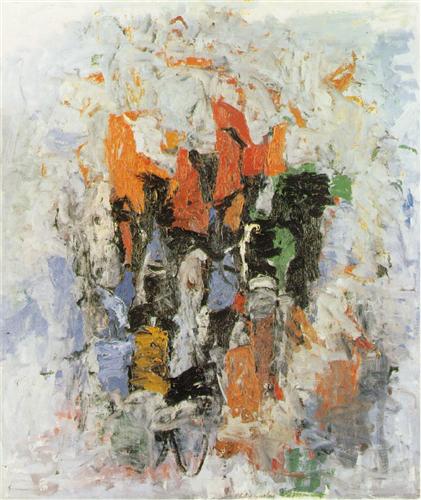 friendship. Called For Philip Guston it’s scored for flute, percussion and piano. The painting “Clock,” on the right, was made by Guston around 1956-57. Of course there’s no clock in sight.
Feldman created a unique graphic system of music notation, within which many things were undetermined and left for performers to interpret. Sometimes it was the pitch, at other times the duration. Somehow, when you listen to his music, the results are always pure Feldman: sparse, whispering, exquisite, atonal but often lyrical, with a tremendous weight given to every sound (or silence), and often insanely long. In 1971 he wrote a piece called Rothko Chapel in memory of his friend Mark Rothko, who committed suicide a year earlier. The chapel, located in Houston, contains 14 large paintings by Rothko. You can listen to Feldman’s tribute to his friend here, it’s performed by members of the Seattle Modern Orchestra. The melody for the viola at the end of the piece was written by Feldman when he was 15. Rothko Chapel is a relatively short piece, it runs for about 24 minutes. Palais de Mari for the piano, written in 1986, was Feldman’s last piano work: he died of cancer on September 3rd, 1987. It’s performed here by Aki Takahashi, a Japanese pianist who premiered several of Feldman’s works. In her interpretation Palais de Mari runs for about 29 minutes.
Read more...
Morton Feldman - Palais de Mari
Aki Takahashi (Piano)
Vincenzo Bellini - la sonnambula
Stanislava Maslennikova (Soprano)