
P. Kellach Waddle - Places In The Snow Vampire's Castle: Trio Sonata for Violin, Bass Viola Da Gamba And Harpsichord
The Colonials (Trio)
Johannes Brahms, 7 Fantasien, op. 116
August 25, 2014. Johannes Brahms, 7 Fantasien, op. 116. This set of miniatures, sometimes called Seven Fantasies, was written by Brahms in 1892. Popular both with the listeners and performers, it is represented in our library with the recordings made by the young 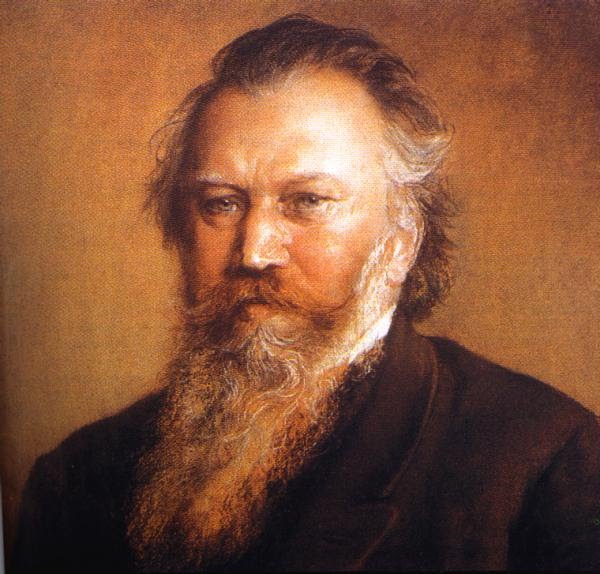 English pianists Sam Armstrong and Ashley Wass; Israel-born Benjamin Hochman and Rafael Skorka; the Russian pianist Yury Shadrin; and the Americans Christopher Atzinger and David Kaplan. Joseph DuBose takes an in-depth look into this piano masterpiece by the German composer. Read the complete article and listen to the Fantasies here.
One of the several offspring of the Romantic period, and developing nearly contemporaneously with the German Lied, the piano miniature opened to composers a world as vastly rich and imaginative as the larger forms handed down from the Classical masters – indeed, perhaps even more so. With the nocturnes of John Field among its earliest examples, the piano miniature was further developed by the same hands that brought the German Lied into maturity – Franz Schubert and Robert Schumann – as well as in the many "dances" of Frédéric Chopin. Like the Lied, the miniature was given a deeply philosophical expression, and rendered with such remarkable introspection and calculated effect, by Johannes Brahms.
Though Brahms was widely considered the immediate heir of Beethoven and Schumann, in opposition to the New German School of Liszt and Wagner, it is his several collections of miniatures rather than his sonatas that are perhaps the most brilliant gems of his output as a composer of piano music. Somewhat curiously, Brahms composed his only three piano sonatas, a form which, like the symphony, was a staple of the Classical composer, very early in his career. From thence he conquered the challenges of the large-scale variation set during the middle of his career. His earliest efforts in the realm of the miniature followed quickly on the heels of the completion of the third and last piano sonata with the composition of the opus 10 Ballades during the summer of 1854. However, twenty-five years would pass before Brahms once again composed a set of miniatures. In 1879-80, two important sets appeared: the eight Klavierstücke, op. 76 (played here by Sam Armstrong) and the two Rhapsodies, op. 79 (no. 1 and no. 2, played by Michael Krücker and Dmitry Paperno, respectively). Most notable is the Klavierstücke, which built upon the basic groundwork laid by the Ballades, and further set the stage for Brahms’s final essays in the genre, as well as his last works for the piano.
During the early 1890s, Brahms compiled together the twenty pieces that were published during 1892-93 as the opp. 116-19. It is acknowledged that he composed more than the twenty pieces known to us today, and it is possible that some were drafted earlier. However, it is generally accepted that most of the pieces were composed roughly close to their dates of publication. As a whole, these pieces display Brahms as intensely meditative; combined with opus 76, they are a gradual progression away and an ultimate departure from the extroverted Sturm und Drangstyle of his more youthful years; taken as a part of his entire output for the piano, they are an immensely rich and imaginative culmination, and quite easily some of the most beautiful music composed for the instrument.
Of these four later sets, opus 116 is unique among its companions. [continued]
Read more...Johannes Brahms - Capriccio in g minor, Op. 116, No. 3, from Seven Fantasies
Héctor J. Sánchez (Piano)
Isaac Albéniz - La Vega
Héctor J. Sánchez (Piano)
Frédéric Chopin - Polonaise in A-flat major, Op. 53
Yury Shadrin (Piano)
Frédéric Chopin - Valse Op. 70, No. 1 in G-flat Major
Yury Shadrin (Piano)
Frédéric Chopin - Waltz in F Major, Op.34, No.3
Yury Shadrin (Piano)
Frédéric Chopin - Valse in c-sharp minor op. 64 no. 2
Yury Shadrin (Piano)
Alexander Scriabin - Piano Sonata No. 4 in F-Sharp Major, Op. 30
Yury Shadrin (Piano)
P. Kellach Waddle - Hopes : Mini Cantata from the Requiem Mass for Oboe, Tenor And Piano
P. Kellach Waddle (Conductor)