CHAMBER MUSIC RECITAL
04/01/2014 15:15, Catholic University Of America, Ward Recital Hall Washington DC
Fanny Nemeth-Weiss, Cello
Martin Labazevitch,Piano
Netanel Draiblate, Violin
Program:
- F.Mendelssohn Bartholdy: Piano Trio No.1 Op.49.
- D.Shostakovich: Trio for Piano and Strings no 2
in E minor, Op. 67
http://www.fannynemethweiss.com/
http://fannynemethweiss.instantencore.com/web/events.aspx
CELLO RECITAL
03/18/2014 13:45, Catholic University Of America, Ward Recital Hall Washington, DC
First DMA Recital
Fanny Nemeth-Weiss, Cello
Martin Labazevitch, Piano
Program:
-N.Paganini: Variations on Rossini's "Moses" on G String
-L.v. Beethoven: Sonata for Cello and Piano no 1 in F major,
Op. 5 no 1
-P.Sarasate: Zigeunerweisen, Op. 20 (Gypsy Airs)
-G.Fauré: Elégie, Op. 24
-D.Popper: Spinning Song, Op. 55 no 1
http://www.fannynemethweiss.com/
http://fannynemethweiss.instantencore.com/web/events.aspx
SLAVIC ARTS ENSEMBLE
04/06/2014 17:00, The Kosciuszko Foundation Washington DC Center
The Kosciuszko Foundation Washington DC Center
Performers:
Krzysztof Kuznik - Violin
Tatiana Chulochnikova - Violin
Maurycy Banaszek - Viola
Fanny Nemeth-Weiss - Cello
Martin Labazevitch - Piano
PROGRAM
-F.Chopin - Sonata for Cello and Piano Op. 65
-F.Chopin - Waltzes, Nocturnes, and Mazurkas
arranged for string trio by Miecz Gubernat
-F.Chopin - Piano Concerto No.2 Op.21
( version for piano and string quartet )
http://www.thekf.org/chapters/washington_dc/events/upcoming_events/slavi...
CHOPIN BIRTHDAY BASH
03/01/2014 17:00, The Kosciuszko Foundation, Inc.
The Kosciuszko Foundation's Chopin Days 2014.
Performers:
Krzysztof Kuznik - Violin
Tatiana Chulochnikova - Violin
Maurycy Banaszek - Viola
Fanny Nemeth-Weiss - Cello
Martin Labazevitch - Piano
PROGRAM
-F.Chopin - Sonata for Cello and Piano Op. 65
-F.Chopin - Waltzes, Nocturnes, and Mazurkas
arranged for string trio by Miecz Gubernat
-F.Chopin - Piano Concerto No.2 Op.21
( version for piano and string quartet )
Recital at Vassar College Art Center
04/05/2014 19:00, Lehman Loeb Art Museum, Vassar College
Two Scarlatti Sonatas
Beethoven "Les Adieu" Sonata
Chopin Ballade in G minor
Grieg selected works
Schubert Wanderer Fantasy
Recital at Croton-on-Hudson Library
03/23/2014 02:00, Croton-on-Hudson Library
Two Scarlattis Sonatas
Beethoven "Les Adieu" Sonata
Chopin Ballade in G minor
Grieg selected pieces
Schubert Wanderer Fantasy
Augusta Read Thomas - Cathedral Waterfall
Nicolas Horvath (Piano)
Carl Philipp Emanuel Bach and others, 2014
March 10, 2014. Carl Philipp Emanuel Bach and many others. We just cannot catch up! Last week we celebrated the birthday of Antonio Vivaldi but missed on Maurice Ravel, Heitor Villa-Lobos, Carl Philipp Emanuel Bach and Samuel Barber. And three more interesting composers were born this week: Arthur Honegger, Hugo Wolf, and Georg Philipp Telemann. All these composers are just too good to be missed, and we’d like to note at least some of them, however briefly. Maurice Ravel remains as popular as ever. In our library we have several dozens of his compositions, but not Valses nobles et sentimentales, so we decided to remedy this ommission. Ravel composed Valses in 1911 as an homage to Schubert’s 1823 Valses nobles and Valses sentimentales. The original version was written for the piano; one year later Ravel orchestrated it, as he often did with his piano pieces. Here is the original, performed by Alicia de Larrocha.
It’s not just any anniversary of Carl Philipp Emanuel Bach, it’s his 300th: he was born on March 8th of 1714. Emanuel lived and worked during an “interregnum,” a period when 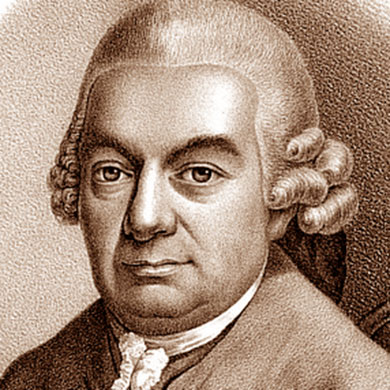 Baroque music went out of vogue but any composer of genius in the new “classical” style was yet to emerge. Emanuel’s older brother, Wilhelm Friedemann, was active, and so were composers of the Mannheim school. And of course Christoph Willibald Gluck was writing operas in Paris. Still, the world had yet to wait for Haydn and Mozart to create real masterpieces. In the mean time, Emanuel became one of the most influential composers of the transitional period (he would be highly praised by Mozart and Beethoven). Emanuel was the fifth child of Johann Sebastian Bach and his first wife, Maria Barbara, but only the second to survive childhood. Georg Philipp Telemann was his godfather (thus the Philipp in his name). Emanuel was born in Weimar, but in 1723 the Bach family moved to Leipzig, were Johann Sebastian became the cantor at the famous St. Thomas church and school. That’s were Emanuel went to study (as did his elder brother, Friedemann). Later he attended the University of Leipzig, studying law. In 1738 he moved to Berlin were he obtained a position at the court of Crown Prince Frederick, the future king of Prussia, Frederick the Great. Emanuel stayed in his employ for thirty years. While in Berlin, he composed a large number of keyboard sonatas, several symphonies and other music. Berlin under Frederick became a center of arts and philosophy, and Emanuel acquired many friends, Gotthold Ephraim Lessing, Friedrich Gottlieb Klopstock and Moses Mendelssohn among them. Here’s a keyboard sonata in A Major, W55, no. 4. It was composed at the end of Emanuel’s stay in Berlin, in 1765. It’s easy to hear how this sonata could’ve influenced Haydn. The pianist is Marc-André Hamelin (recorded in concert, with some small mishaps in the otherwise impeccable and brilliant performance, quite unusual for the virtuoso Hamelin).
As long as we’re celebrating Emanuel Bach, we should also mark the birthday of his godfather, Georg Philipp Telemann, who was born on March 14th 1681. Telemann, a good friend of Johann Sebastian Bach and an acquaintance of George Frideric Handel, was four years older than both and at some point more famous. That would change drastically in the early 19th century when public opinion turned against Telemann, being inferior to Bach. That may be the case, but the change created some amusing misconceptions. For example, two major biographers of Bach, Philipp Spitta and Albert Schweitzer, would favorably compare a Bach cantata to those of Telemann, except that now we know that the “Bach” cantata was actually written by Telemann. Here’s a good example: the first two parts of Telemann’s Cantata Das ist je gewisslich wahr. For a long time it was attributed to Bach as his Cantata BWV 141. It is performed by the ensemble I Febiarmonici, Wolfgang Helbich conducting.
Read more...Georg Philipp Telemann - Cantata Das ist je gewisslich wahr
I Febiarmonici (Ensemble)
Wolfgang Helbich (Conductor)
Alexander Scriabin - Étude in D-sharp minor, Op. 8, No. 12
Sophia Agranovich (Piano)