
Couperin and Copland, 2013
November 11, 2013. Couperin and Copland. François Couperin was born on November 10, 1668. He was called Le Grand, the great, because for one, he was a composer of genius, but also because had to be distinguished from other member of his musically talented family. The Couperins came from the town of Brie, just east of Paris, 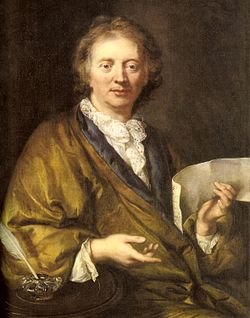 famous for its cheese. The first Couperin to come to Paris was Louis: as the story goes, the famous harpsichordist of the time, Jacques Champion de Chambonnières, was celebrating his birthday outside of Brie, and the Couperin brothers serenaded him with a song composed by Lois. The delighted Chambonnières invited him to Paris. In 1653 Louis became the organist at the church of St-Gervais in the Marais, just across the Seine from the cathedral of Notre-Dame. For several generations Couperins would occupy this position, and live in a house adjacent to the church. The last member of the family, Gervais-François, played the organ till 1826, 173 years after Lois’ arrival in Paris. Lois was a talented composer and harpsichordist; a collection of his work for the organ was discovered only in 1960, and together with his compositions for the harpsichord they represent a major body of work. Lois died at the age of 35; had he lived longer he probably would’ve developed into one of the greatest French composers of the 17th century. Two younger brothers followed Lois to Paris, both musicians but not as accomplished. Charles became the organist at St-Gervais and in 1668 had a child, François Le Grand. Charles died when François was only eleven, but church officials reserved the position of organist for François, waiting for him to turn 18. He studied music with the best teachers and assumed the position at St-Gervais before he reached the designated age. He became famous both as the organist and as a composer (his two mass settings were published in1690), and in 1693 he became an organist in the Chapelle Royale as a King Louis XIV musician. He also taught the harpsichord to the King’s children. It’s that instrument that Couperin loved and composed for the most. Four books of music for the harpsichord were published during his life, from 1713 to 1730. Instead of organizing them into suites, as was customary at the time, he set them in Orders, from five to eight to a book. He didn’t use dances, the usual components of suites (Bach’s are the supreme example), very often; instead he wrote pièces de caractère (character pieces), some with evocative names: Le rossignol-en-amour (Nightingale in Love), Le croc-en-jambe, which means to trip somebody, or Les graces incomparables, ou La Conti (in reference to a princess of Conti). In 1723 his passed the position at St-Gervais to his nephew Nicolas. Though in poor health in his later years, he continued to compose and edit his music. In 1725 he wrote Apothéose de Lully, a concert in memory of Jean-Baptiste Lully. The concert “describes” the meeting of Lully and Corelli, two founders of rival Baroques styles, the French and Italian, on Parnassus. Apollo attempts to reconcile them. (Couperin also wrote a separate concert for Corelli, Le Parnasse ou L'Apothéose de Corelli). Originally composed for two harpsichords, these days Apothéose de Lully is usually performed by chamber orchestras. Here it is, recorded in 1963 by the Toulouse chamber orchestra, Louis Auriacombe conducting. François Couperin died in Paris on September 11th, 1733.
Aaron Copland was born this week, on November 14th, in 1900. We’ll write about him later, but to celebrate, here’s his Fanfare for the Common Man as performed by the London Symphony Orchestra, also in 1963.
Read more...
Aaron Copland - Fanfare for the Common Man
London Symphony (Orchestra)
François Couperin - Apothéose de Lully
Toulouse chamber orchestra (Orchestra)
Louis Auriacombe (Conductor)
Audio Inversions presents The Season Finale: Meditations and Homage
05/22/2009 20:00, Debra and Kevin Rollins Studio Theater at the Long Center for the Performing Arts
Three Lullabies (Henryk Gorecki)
Gemini Variation (Delvyn Case)
Passacaglia (Anthony Suter)
Incline, O Maiden (James D. Norman)
Azeroka Woda "Broad Waters", op. 39 (Henryk Gorecki)
Songs in the Forest (Lou Harrison)
Lou (Balijinder Sekhon II)
P. Kellach Waddle - Dust Covered Bible on Walnut Table: Lied for flute and piano
Lauryn Gould (Flute)
Nikki Birdsong (Piano)
PKWproductions presents The Flute According to PKW
02/27/2011 15:00, Ascension Lutheran Church
featuring Lauryn Gould, flute
Mathew Petrone, violin
Nikki Birdsong, piano
P. Kellach Waddle, bass
HAAM (Health Alliance for Austin Musicians) Benefit Concert
05/03/2009 00:00, Congregation Agudas Achim
Viola by Choice: Around the Viola in 80 Minutes
05/02/2008 20:00, Christ Chapel--Episcopal Theological Seminary of the Southwest
a concert of Folk & World-Inspired Classical Music
Luciano Berio's The Folks Song, along with works by Piazzola, Ravel and others
Viola by Choice: Listening to People of Note
12/14/2008 18:00, Episcopal Church of the Resurrection
Listening to People of Note: A concert of Tributes and Celebrations
Giacomo Puccini: Cristantemi
Dan Welcher: Tickets for a Prayer Wheel
Philip Koplow: Sonata In Memoriam--Martin Luther King Jr.
Ned Rorem: Serenade on Five English Poems
Paquito d'Rivera: Village Street String Quartet
Nikki Birdsong, piano
Jennifer Bourianoff, violin
Julia Cory, cello
Alexis Ebets, violin
Aurelien Petillot, viola
Elizabeth Petillot, mezzo-soprano
David Small, baritone
Arnold Bax - Sonata for Viola and Piano in G Major
Shuangshuang Liu (Viola)
Ron Regev (Piano)