
Vincenzo Bellini 2013
November 4, 2013. Vincenzo Bellini. We missed Vincenzo Bellini’s birthday by one day (he was born on November 3rd of 1801), but did mention him in our previous post. Here’s some more about this great bel canto composer. Bellini was born in Catania, Sicily into 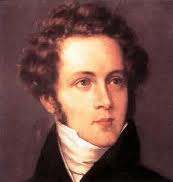 a musical family: his father was an organist and grandfather – his first music teacher. Legend has it that Vincenzo began learning music at a very young age: he took his first lessons in music theory at the age of two and started playing piano at three (considering Bellini’s talents, it all may be true). In 1819 he went to Naples to study at the conservatory; his first opera was presented at the Conservatory’s theater while Bellini was still a student. His next opera, Bianca e Gernando, was presented at Teatro di San Carlo, one of the most important (and the oldest) opera houses in Italy. In 1827 Bellini moved to Milan and that same year wrote Il Pirata, which was successfully staged at La Scala and brought Bellini international recognition. In 1830 he was commissioned to write an opera for Teatro La Fenice in Venice, the third (with La Scala and San Carlo) major opera house in Italy. The opera, I Capuleti e i Montecchi, a reworking of Shakespeare’s Romeo and Juliet, was completed in a month and a half (Bellini reused some music from his previous, and unsuccessful opera, Zaira).
The following years were tremendously productive. In 1831 Bellini wrote La sonnambula (The Sleepwalker), on the libretto by his constant collaborator, the poet Felice Romani. The main female role of this bel canto opera was written for the famous soprano Guiditta Pasta, who had a huge vocal diapason covering both the soprano and the mezzo registers; Maria Malibran, a mezzo-soprano as famous as Giuditta Pasta, sung the role of Amina the next several years. (Malibran also had an exceptional voice: she sung the roles from contralto to soprano. She died at the age of 28 on the same day as Bellini, September 23, following him by one year). In the 20th century Amina’s role was sung mostly by sopranos (last week’s sample featured Anna Netrebko). The first mezzo to record this role was Cecilia Bartoli. La sonnambula premiered in Teatro Carcano in Milan and was a huge success. That same year, 1831, Bellini followed with an opera that reached an even higher level, exceeding everything Bellini has written thus far, and probably any opera to date. Norma was written with Guiditta Pasta in mind: the main role, that of a Druid priestess, is one of the most difficult in the entire opera repertoire. In the 20th century it became a touchstone for any soprano. Maria Callas was a great Norma, and several years later Joan Sutherland created a role which, if not as dramatic, was technically probably even better. Montserrat Caballé was another famous Norma. Casta diva from Act I remains one of the most popular arias, and so is the duet Mira, o Norma from Act II (it was a specialty of Sutherland and Marilyn Horne, here, for example, from a live 1970 performance).
In 1833 Bellini moved to London and then to Paris, where Gioachino Rossini secured him a commission from the A Te, O Cara from Act I of I Puritani. Arturo is Luciano Pavarotti. In this 1973 recording you can also hear Joan Sutherland. Richard Bonynge conducts the London Symphony Orchestra.
We planned to write about François Couperin, who was born this week on November 10th of 1668. We’ll do it in our next post.
Read more...Vincenzo Bellini - A Te, O Cara, from Act I of I Puritani
Luciano Pavarotti (Tenor)
Joan Sutherland (Soprano)
London Symphony (Orchestra)
Richard Bonynge (Conductor)
Vincenzo Bellini - Mira, o Norma, from Act II of Norma
Joan Sutherland (Soprano)
Marilyn Horne (Mezzo-soprano)
Metropolitan Opera (Orchestra)
Richard Bonynge (Conductor)
Emanuel Leplin - Firecracker
Members of the SF Symphony (Ensemble)
Emanuel Leplin - Prologue
Fresno Philharmonic/Paul Vermel (Orchestra)
Nikki Chooi, Violin and Jung-A Bang, Piano
11/27/2013 12:15, Preston Bradley Hall
Violin Sonata in E-Flat Major, K. 302 -- Wolfgang Amadeus Mozart
Sonata No.3 for Solo Violin "Ballade" -- Eugène Ysaÿe
Violin Sonata No. 2 in G -- Maurice Ravel
Clara Yang, Piano
11/20/2013 12:15, Preston Bradley Hall
Maverick Pieces, Op.37 -- Robert Muczynksi (1929 – 2010)
Ballade, Op. 46 -- Samuel Barber
Humoreske, Op.20 -- Robert Schumann
Horszowski Trio
11/13/2013 12:15, Preston Bradley Hall
Jesse Mills, Violin
Raman Ramakrishnan, Cello
Rieko Aizawa, Piano
Piano Trio in C Major, Hob. XV/21 -- Joseph Haydn
Piano Trio in D minor, Op. 120 -- Gabriel Fauré
Hye-Won Cho, Piano
11/06/2013 12:15, Preston Bradley Hall
Concert Étude No. 2 in F minor, "La leggierezza" -- Franz Liszt
Piano Sonata No. 31 in A-Flat Major, Op. 110 -- Ludwig van Beethoven
Danzas Argentinas -- Alberto Ginastera
I. Danza del viejo boyero ("Dance of the Old Herdsman")
II. Danza de la moza donosa ("Dance of the Beautiful Maiden")
III. Danza del gaucho matrero ("Dance of the Arrogant Cowboy")
Emanuel Leplin - Suite for String Quartet
Emanuel Leplin and members of SFS (Quartet)