
Franz Liszt - Hungarian Rhapsody n.6
Mauro Bertoli (Piano)
Franz Liszt - Après une Lecture de Dante (Fantasia quasi Sonata)
Nicolas Horvath (Piano)
Franz Liszt - Aprés une Lecture du Dante, from Années de Pèlerinage Book II: Italy
Jason Cutmore (Piano)
Franz Liszt - Après une Lecture de Dante (Fantasia quasi Sonata)
Alexandre Dossin (Piano)
Franz Liszt - Après une Lecture de Dante (Fantasia quasi Sonata)
Keti Sharumashvili (Piano)
Franz Liszt - Après une Lecture de Dante (Fantasia quasi Sonata)
Yllka Istrefi (Piano)
Franz Liszt - Après une Lecture de Dante (Fantasia quasi Sonata)
Yukiko Akagi (Piano)
Franz Liszt - Après une Lecture de Dante
Beatrice Berrut (Piano)
Bell and Denk play French Violin Sonatas
February 6, 2012. Bell and Denk play French Violin Sonatas. The brilliant American violinist Joshua Bell and his good friend and recital partner pianist Jeremy Denk issued a CD with three sonatas for violin and piano for Sony Classical, called French Impressions. It’s their first album together, and after listening to it, one hopes it won’t be their last.
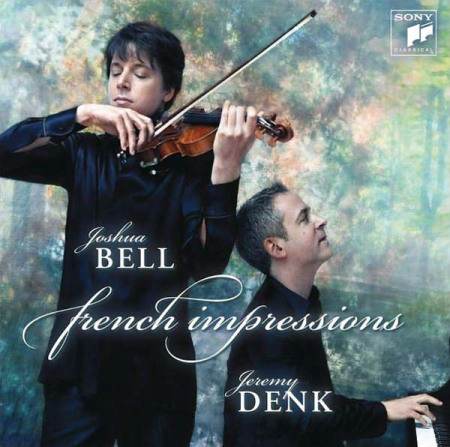 The three violin sonatas are by Saint-Saëns, Franck and Ravel. The first two were written at the height of the Belle Époque, Saint-Saëns’ in 1885 and Franck’s just one year later, in 1886. Ravel wrote his violin sonata late in his life, in 1927, and it belongs to a very different age.
Violin Sonata No. 1 in d minor by Camille Saint-Saëns, very French and very elegant, is essentially salon music. Bell and Denk play it with great style. The 3rd movement, Allegretto Moderato, is especially attractive. The dynamics are lively and Bell’s sound is beautiful. You can listen to it here.
César Franck, born in 1822 in what is now Belgium, spent his adult life in Paris. He was an organist at Saint Clotilde in Saint-Germain-des-Prés for more than 30 years, a professor at the Paris Conservatory, and, as required for that position, became a French national. Franck wrote the Violin Sonata in A Major when he was 63; it was a wedding present for Eugène Ysaÿe. Ysaÿe became a great proponent of the sonata and played it regularly throughout his life, contributing to the public recognition of Franck as a major composer. Joshua Bell has a very special connection to this piece: his teacher, Josef Gingold, was a pupil of Eugène Ysaÿe. Maybe this connection to Franck affected the way Bell and Denk play the famous first movement of the Sonata: it’s slower, statelier than many well-known interpretations (Jascha Heifetz and Arthur Rubinstein play it in less than five and a half minutes. Bell and Denk take more than six). But who knows - his approach might be closer to what Franck intended: he originally wrote it as a slow movement: it was Ysaÿe who wanted a quicker tempo and convinced Franck to mark it Allegretto. Listen to it here.
It’s interesting that both sonatas figure prominently as possible prototypes of the violin sonata by the fictional composer Vinteuil in Marcel Proust’s In Search of Lost Time. In the novel Swann is haunted by the “little phrase” from the sonata, which he associates with his obsessive love for Odette. Of course we’ll never know for sure, but Proust scholars suspect that it could be the opening chords of Franck’s sonata, the beginning of the Adagio in Saint-Saëns’s sonata, or Faure’s Ballade in F-sharp Major op. 19.
Read more... « first ‹ previous … 706 707 708 709 710 711 712 713 714 … next › last »
Franz Liszt - Hungarian Rhapsody No. 6 in D-flat Major
Mauro Bertoli (Piano)