Welcome to our free classical music site

Do you write about classical music? Are you a blogger? Want to team up with Classical Connect? Send us a message, let's talk!
Do you write about classical music? Are you a blogger? Want to team up with Classical Connect? Send us a message, let's talk!




January 7, 2013. In this first post of 2013 we’d like to mention several composers whose birthdays fall on the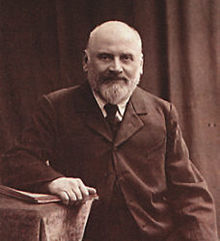 first week of the year: Mily Balakirev, Giovanni Pergolesi, Nikolai Medtner, Max Bruch, and Alexander Scriabin. On top of this, Francis Poulenc was born on this day. A mighty handful for sure. “Mighty handful” was, of course, the name given to a group of Russian composers of the mid-19th century, and Balakirev, born on January 2, 1837, was one of them. Probably not the most talented (musically, Mussorgsky, Borodin, and Rimsky-Korsakov were in a different league), he is now known mostly as an educator and incessant promoter of classical music in Russia. He did, however, compose a piano piece which to this day is considered one of the most difficult, a poem Islamey. Here it is, performed by the Italian pianist Sandro Russo.
Giovanni Battista Pergolesi’s life was tragically short. He was born on January 4, 1710 and died at the age of 26, from tuberculosis. He wrote his first opera when he was 21, the first truly successful piece, an intermezzo La Serva Padrona (The Servant Mistress), at the age of 23. He wrote six operas altogether, a violin concerto, and some other secular music, but for the last two years of his life he wrote mostly sacred music. He composed two Masses, several psalm settings and more. You can listen to one of his most famous works, Stabat Mater, here; it’s performed by the Chicago authentic instruments ensemble Baroque Band.
Nikolai Medtner, born on January 5, 1880, was a younger contemporary of the much more famous Rachmaninov and Scriabin, but he wrote a number of charming piano pieces called Tales and several sonatas, some of them very interesting. Here, for example, Marc-André Hamelin plays Medtner’s Piano Sonata no.13, Minacciosa (courtesy of YouTube). As so many artists and composers, Medtner left Russia after the Revolution (he was helped by his friend Rachmaninov) and eventually settled in England. He died in London in 1951. His music is very much worth discovering.
Alexander Scriabin’s music doesn’t need to be "discovered" – it’s being widely played and recorded. Still, his popularity these days cannot be compared to the adulation he receiving during his lifetime (accompanied by some criticism as well). Scriabin was born on January 6, 1872. His early piano compositions were heavily influenced by Chopin, though even then his style was individual and idiosyncratic. Later it evolved, losing most of the romantic traces of the earlier period, and becoming more chromatic and dissonant. Scriabin’s piano works are more popular these days than his orchestra music, but in the pre-Revolutionary Russia his The Poem of Ecstasy was one of the most celebrated composition (he received one of his many Glinka Prizes for it in 1908). Here it is performed by the Chicago Symphony Orchestra, Pierre Boulez conducting (courtesy of YouTube).
We have to mention Max Bruch, born on January 6, 1838 and these days mostly famous for his Violin Concerto. He also wrote a popular Kol Nidrei for cello and orchestra, named after the ancient declaration recited in synagogues before the beginning of the Yom Kippur (Day of Atonement) service. Bruch was a protestant, and introduced to the Jewish prayer by his teacher. Still, many Germans though that Bruch was Jewish, and the Nazis even banned his music. Here’s an arrangement of Kol Nidrei for viola and piano. It’s performed by Viacheslav Dinerchtein, viola, and George Lepauw, piano.
PermalinkDecember 31, 2012. Forgotten birthdays. Throughout the year we’ve celebrated dozens of composers, the great ones, whose work form the foundation of western musical tradition, as well as some minor ones along the way. We try to do it on the weeks of their birthdays, but that creates a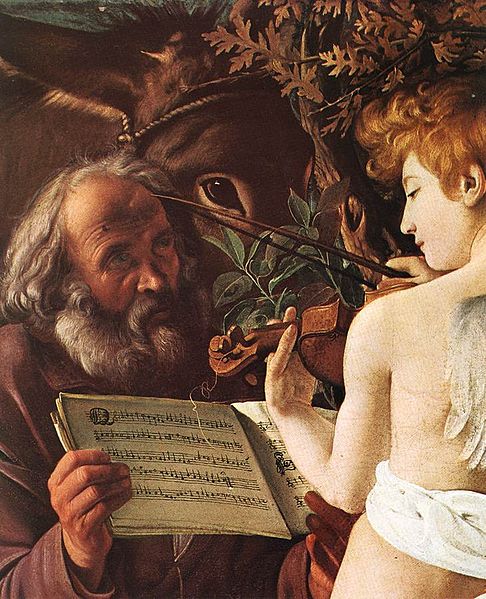 problem: we don’t know when some of the composers were born! Here’s an incomplete list of very influential composers who never made it on our pages for that very reason: Josquin des Prez, who was born sometime around 1450, the supreme master of the Renaissance polyphonic form; Thomas Tallis, one of the greatest early English composers, born around 1505; Orlando di Lasso, sometime spelled as Orlande de Lassus, born around 1530, a Franco-Flemish/Netherlandish composer as Des Prez and also a great master of polyphony; Giovanni Gabrieli, the Venetian born around 1550 and the master of San Marco; Tomás Luis de Victoria, the most famous (and important) Spanish composer of his time, who was also born around 1550; Dietrich Buxtehude, born around 1637, one of the most interesting German Baroque composers of the era preceding Johann Sebastian Bach’s; and there are many more.
We’ll write about these composers in the future, but in the mean time here’s from one of our personal favorites, Tomás Luis de Victoria. It’s a short piece for four voices called O vos omnes (Oh, all ye) and it comes from his liturgical setting, Tenebrae Responsories, which is celebrated on early mornings of the last three days of Holy Week. It’s performed by The Tallis Scholars (here, courtesy of YouTube).
The angel playing the violin, above, is by Caravaggio, from his Rest on the Flight into Egypt. He painted it around 1597 in Rome, about 10 years after Victoria left the city, where he lived and studied the previous 20 years, to return to his native Spain.
Happy New Year to all!Permalink
December 24, 2012. Merry Christmas to all!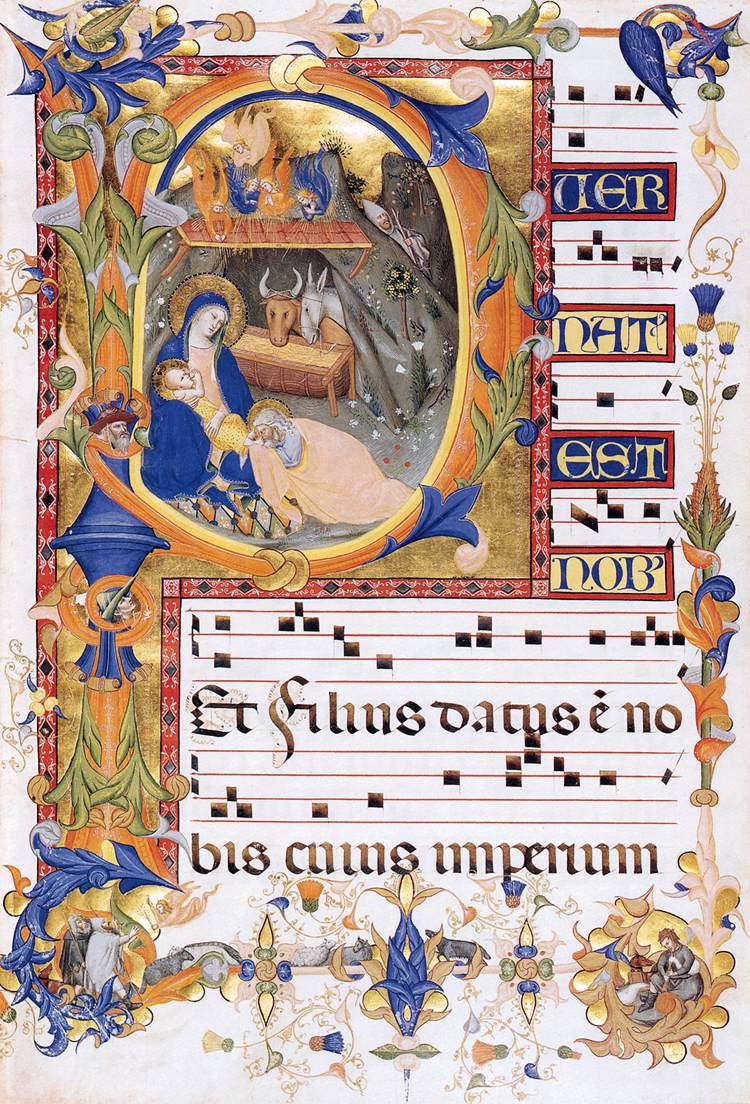 The wonderful leaf from a Choir book you see here comes from 1395 and contains a little bit of music and a little bit of art. The music is the introit (entrance) to the Mass for Christmas Day. The picture represents the Nativity and the Annunciation to the Shepherds. This illustration was created by a monk, Don Silvestro dei Gherarducci who went on to become a rather well known painter (but not as famous as his younger partner, Lorenzo Monaco, who worked with Gherarducci at the same monastery of Santa Maria degli Angeli in Florence).
And here is the first movement of the first part, Chorus, of Johann Sebastian Bach’s Christmas Oratorio. It starts with Jauchzet, frohlocket, auf, preiset die Tage, or Celebrate, rejoice, rise up and praise these days, a good command to follow. The performance is by the Monteverdi Choir and the English Baroque Soloists under the baton of Sir John Eliot Gardiner (courtesy of YouTube).
PermalinkDecember 17, 2012. Zoltan Kodály. One of the most prominent Hungarian composers of the 20th century, fame he shares with Béla Bartók, Zoltan Kodály was born on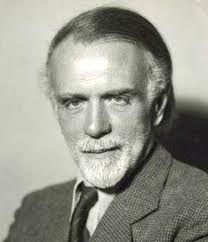 December 16th of 1882 in a small town in central Hungary. As a child he studied the violin with his father, and at the age of 18 entered Budapest University to study languages and, simultaneously, the Hungarian Academy of Music, a composition class of Hans von Koessler. In 1907 he traveled to Paris to study with Charles Vidor at the Paris Conservatory. Starting 1905 he went on regular field trips collecting folksongs, often in the company of Béla Bartók, his lifetime friend. The folk tunes formed the basis of many, highly sophisticated, compositions of Kodály. From 1912 he taught at the Budapest Academy of Music (Antal Dorati was one of his pupils). Here are his Dances of Galánta, composed in 1933. Galánta is a small market town on the old railway line between Vienna and Budapest, where Zoltan spent seven years of his childhood. At that time, a famous gipsy band lived there. According to Kodály, the principle melodies of the Dance come from that music. Throughout his adult life, Kodály was very interested in the problems of music education. The Hungarian music education program that he developed in the 1940s became the basis for what is called the "Kodály Method". Kodály, who was born in the Dual Monarchy and had his most productive period during the Hungarian Republic, lived long enough to see the advent of the Hungarian Peoples Republic – but not the end of it: he died in 1967, at age 84.Permalink
December 16, 2012. Beethoven! Today is the day to celebrate the 242nd anniversary of Ludwig van Beethoven’s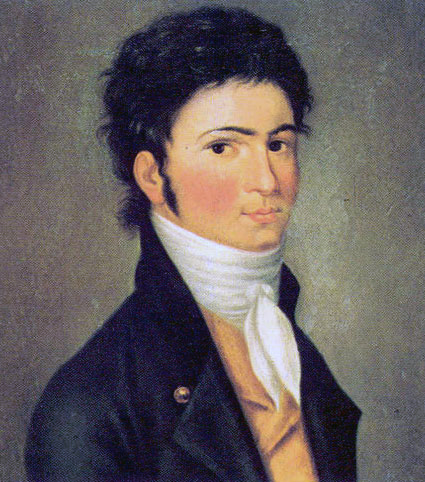 birthday. Here’s Sviatoslav Richter’s performance of Beethoven’s Piano Sonata no. 1 in f minor, op. 2, no.1. The very first one of the eventual 32, the set that is still the pinnacle of piano literature, this sonata was written in 1795. The young Beethoven dedicated it to his teacher of several years, Franz Joseph Haydn. The portrait, by Carl Traugott Riedel, was made a bit later, in 1801.
PermalinkDecember 10, 2012. Three Francophone composers. César Franck was born in Liège, in what is now Belgium, on December 10, 1822, but he spent most of his life in France. His ambitious father wanted Franck to become a virtuoso pianist, à la Franz Liszt, and enrolled him in the Royal Conservatory of Liège. In 1835 he brought César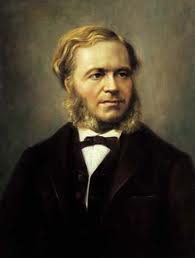 and his younger brother to Paris to study privately. Two years later César entered the Conservatory (his father had to take French citizenship, as at that time the Conservatory didn’t accept “foreigners”). César studied piano, counterpoint, and eventually took organ classes with François Benoist (Benoist was the professor of organ at the Conservatory for half a century, and, in addition to Franck, had as his students Camille Saint-Saëns, Georges Bizet, Léo Delibes, and Adolphe Adam). After a brief sojourn to Belgium, Frank returned to Paris to become a teacher and organist. That was also the time he started seriously composing. He became the organist at the newly constructed church of Saint-Clotilde, which had a beautiful organ built by the famous Aristide Cavaillé-Coll, who also built organs for Notre Dame de Paris andLa Madeleine, reconstructed the great organ of Saint-Sulpice and worked with many other important churches in France and beyond, as well as built organs for major concert halls, such as the Great Hall of Moscow Conservatory. After Benoist’s death, Franck was offered a position at the Conservatory. In 1886 he wrote his Violin Sonata in A Major, probably his most famous composition. The sonata was a wedding present for a fellow Liégeois, the violinist Eugène Ysaÿe. It became one of the most popular pieces in the violin repertoire, and we have many recordings of it in our library. You can hear it performed by the Canadian violinist Kai Gleusteen, who spent some time studying in Paris (here). Catherine Ordronneau is on the piano. Franck continued composing for the rest of his life: his notable Symphony in D Major was written in 1888 and three organ chorals in 1890. He died in Paris on November 8,1890. The funeral mass, attended by practically all notable French composers of the time, was held in Franck’s church of Sainte-Clotilde.
Olivier Messiaen, without a doubt one of the greatest French composers of the 20th century, was born on December 10, 1908. As much an innovator as Franck was a traditionalist, Messiaen shared his love for the organ. As Franck years earlier, Messiaen was appointed the organist of a Paris church, in his case that of Église de la Sainte-Trinité, not far from Gare Saint-Lazare a position which, like Franck, he held for the rest of his life. In 1940, at the outbreak of World War II, Messiaen was drafted into the French army as a medical auxiliary (he had poor eyesight). He was captured by the Germans soon after, at Verdun, the site of the terrible battles of the previous war, and sent to a camp. There he met a violinist, a cellist and a clarinetist. He wrote a trio for them, and eventually incorporated it into the Quartet for the End of Time, creating a part for himself on the piano. It was first performed in January 1941 in the camp to an audience of prisoners and prison guards. We’ll hear two movements from the Quartet: Movement III, Abyss of the Birds for solo clarinet (here) and Movement VI, Dance of fury, for the seven trumpets, for the full quartet (here). It’s performed by Artisict Voyage, Yana Reznik music director (courtesy of YouTube).
We don’t have the time and the space for the most famous of the three composers, Hector Berlioz, who was born on December 11, 1803, but here’s the first movement of his masterpiece, Symphonie fantastique. Igor Makevich is conducting the Rundfunk-Sinfonieorchester Berlin. Just an incidental link to Messiaen: Berlioz’s funeral was held at the new Église de la Sainte-Trinité (he died on March 8, 1869), where 62 years later Messiaen would become the organist.
And of course later this week we’ll celebrate the 242nd anniversary of Ludwig van Beethoven’s birthday.
Permalink