Welcome to our free classical music site

Do you write about classical music? Are you a blogger? Want to team up with Classical Connect? Send us a message, let's talk!
Do you write about classical music? Are you a blogger? Want to team up with Classical Connect? Send us a message, let's talk!




April 9, 2012. The Ukrainian-born pianist Anna Shelest has delighted audiences throughout the world. Born in Kharkiv, the second-largest city of Ukraine, she began her piano studies at the age of six. She attended the Kharkiv Special Music School for Gifted Children, and at the age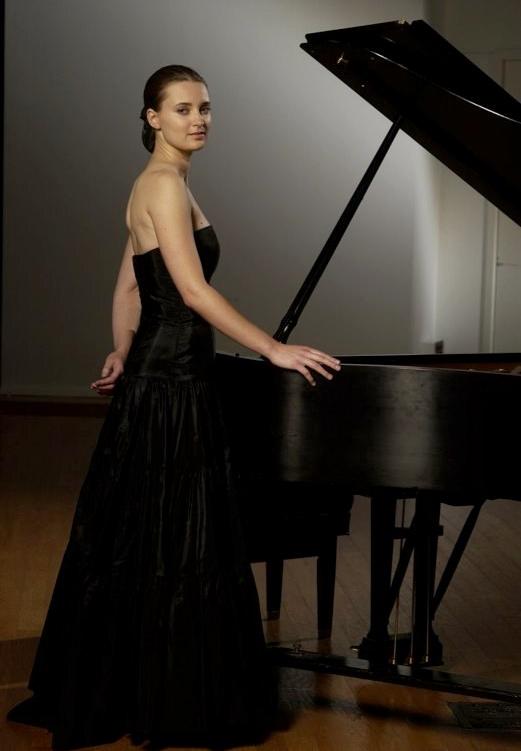 eleven she performed at the UNESCO Headquarters in Paris as the youngest prize-winner of the Milosz Magin International Piano Competition. Anna continued her education in the US, first with Sergei Polusmiak at Northern Kentucky University and privately with Eugene and Elizabeth Pridonoff of the University of Cincinnati College Conservatory of Music. She then entered the Juilliard School and received her Masters in Music in the class of Jerome Lowenthal. Anna won awards in a number of international piano competitions, including the Louisiana International Piano Competition; the Kawai American Recording Contest; and the Jefferson Symphony Young Artists Competition in Denver, among others.
Ms. Shelest made her orchestral debut at age 12 with the Kharkiv Symphony Orchestra, playing Rachmaninov's Piano Concerto No. 1. Since then she has performed on many prestigious stages around the world. In the spring of 2010 she debuted at the Alice Tully Hall and at Stern Auditorium at Carnegie Hall in New York City. She played at the Great Hall of Moscow Conservatory, the Palacio de Bellas Artes in Mexico City, and gave recitals in Canada, France, Japan, Mexico, Netherlands, and South Africa. As a soloist she performed with some of the world’s most renowned orchestras, such as the Montreal Symphony, St. Petersburg Philharmonic Orchestra, Cincinnati Symphony Orchestra, under Maestro Paavo Jarvi, and the Netherlands Symphony Orchestra. Among her other appearances are with the Cincinnati Chamber Orchestra, Corpus Christi Symphony Orchestra, Northwest Florida Symphony Orchestra, and Kentucky Symphony Orchestra.
An avid chamber musician, Ms. Shelest established the successful Shelest Piano Duo with her husband Dmitry (in 2011 they won the Bradshaw-Buono International Piano Competition). She’s also collaborated with the Amernet String Quartet, Cincinnati ARC Ensemble, and musicians from the Cincinnati Symphony Orchestra.
Recently Anna played a concert in Chicago. On her program was Beethoven’s Sonata No. 24 in F-sharp Major, Op. 78 (here) and Nocturne No.6, Op. 63 in D-flat Major by Gabriel Fauré (here). While her repertoire is wide, covering music from the Baroque to contemporary, she has a special affinity for Russian piano music. She recently released a CD of Rachmaninov’s Etudes-tableaux op. 39 and Moments Musicaux op. 16 and another one with Mussorgsky’s Pictures at an Exhibition as well as works by Tchaikovsky and Glinka. Here’s Valse in A Flat Major, Op. 40 No. 8 by Tchaikovsky. You can listen to Mikhail Glinka’s romance The Lark in the piano transcription by Mily Balakirev here. Permalink
April 2, 2012. Rachmaninov and Busoni. Sergei Rachmaninov was born on April 1, 1873. The last composer in the Russian tradition of the 19th century and a great admirer of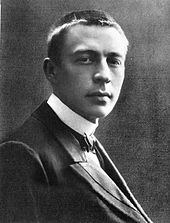 Tchaikovsky, he wrote music that was unaffected be new developments in the early 20th century and continued writing in the romantic style even as composers like Schoenberg, Stravinsky and Bartók were developing completely different and new idioms. Rachmaninov was born into a family of Russian aristocracy and spend his early years in Semyonovo, the family estate in the Northwestern part of Russia. He stared piano lessons with his mother at the age of four and continued with a professional teacher that was brought from St-Petersburg. At the age of ten he entered the St-Petersburg conservatory. Not the most diligent pupil, he failed some examinations before moving to the Moscow Conservatory in 1884 to study under a great disciplinarian Nikolai Zverev; the transfer was arranged by Alexander Siloti, a talented pianist and a relative of the Rachmaninovs (among Zverev’s other pupils were Scriabin, and two of the founders of the Soviet school of pianism, Konstantin Igumnov and Alexander Goldenweiser). While at the Conservatory, Rachmaninov wrote the first version of his Piano Concerto no. 1, Trio élégiaque No. 1 (you can listen to it here in the performance of Jupiter Trio), and several other pieces. For his graduation he wrote a one-act opera Aleko based on Pushkin’s poem The Gypsies. The opera was a success, the Bolshoi Theater staged it one year later with Tchaikovsky attending the premier, and on the 100th anniversary of Pushkin, in 1899, the great bass Feodor Chaliapin performed the title role in St-Petersburg. Rachmaninov graduated the Conservatory with the gold medal, which he shared with Scriabin and Josef Lhévinne, the pianist and future husband of Rosina Lhévinne, the famed Juilliard piano teacher. Soon after Rachmaninov wrote the Prelude in C-sharp minor, which made him famous. A piano roll recording of Rachmaninov performing this prelude has been preserved, and you can listen to it here, played on a Bösendorfer Reproducing Piano (courtesy of YouTube). Less than a year later Tachaikovsky, a mentor and a friend, died at the age of 53. It was a personal blow to Rachmaninov, who immediately wrote the second Trio élégiaque in Tchaikovsky’s memory. In some sense this episode marked the end of Rachmaninov’s youthful period.
We also remember the Italian pianist and composer Ferruccio Busoni, who was born on April 1,1866. A child prodigy, he started performing at the age of seven. On a tour in Vienna in 1975 he met Liszt, Brahms and Anton Rubinstein and heard Liszt play. He taught piano in several cities of Europe and in the US and eventually settled in Berlin. Busoni had a large number of piano students, many of whom became famous and started their own piano schools. He also taught composition; among his students were Edgard Varèse and Kurt Weill. Busoni was an interesting composer, but these days he’s much better known for his piano transcriptions of the music of Bach. Here is a piano roll recording of Busoni playing his famous transcription of the Chaconne from the Partita No. 2 in D minor for solo violin, BWV 1004.Permalink
March 26, 2012. Bartók and Haydn. The anniversary of the great Hungarian composer Béla Bartók was this past Sunday, March 25. He was born in 1881 in what was then the Dual Monarchy of Austria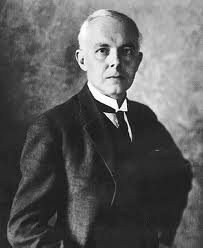 and Hungary, in a small town of Nagyszentmiklós (Great Saint Nickolas in Hungarian; after World War I as the town, and most of the regions of Banat and Transylvania reverted to Romania, its name was changed to Sânnicolau Mare, which means exactly the same, only in Romanian). When he was five, his mother began giving him regular piano lessons. At the age of 19 he moved to Budapest and started lessons with István Thomán, a pupil of Franz Liszt. While there, he met Zoltán Kodály who became his lifelong friend. By 1907 Bartók was teaching piano at the Royal Academy. Among his students were Fritz Reiner and Georg Solti, two Hungarian Jewish kids who became world-famous conductors and whose careers pinnacled at the Chicago Symphony Orchestra (Reiner was the CSO’s music director from 1952 to1963, Solti from 1969 to 1991). Both were champions of Bartók’s music. The period between the two world wars was tremendously productive for Bartók. Starting with the ballet The Miraculous Mandarin in 1918, he wrote string quartets, two piano concertos, Music for Strings, Percussion and Celesta, and a large number of piano pieces and songs. In 1940 Bartók, who was opposed to Nazism, emigrated to the US. He never felt comfortable in America, and was not as productive as in previous years, although not long before his death he created one of his masterpieces, Concerto for Orchestra. The last years of his life Bartók was quite ill; in 1944 he was diagnosed with Leukemia. He died on September 26, 1945 in New York. His remains were transferred to Hungary and he was given a state funeral in 1988. We’ll hear Romanian Folk Dances, based on the folk tunes of Transylvania that Bartók himself collected around 1910; it is performed by Camerata Chicago, Drostan Hall conductor (here).
Like Bartók,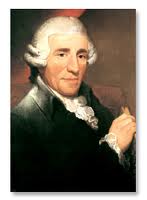 Franz Joseph Haydn was also born in Austria-Hungarian realm, but on the Austrian side, in a small village of Rohrau near the border with Hungary. His birthday is March 31, 1732. Haydn’s parents noticed his musical talents when he was a child and sent six year old Josef to live with their relative, a schoolteacher and choirmaster in Hainburg, a small town nearby. He lived in poverty and hunger but learned to play the harpsichord and violin. He also had a good voice, which brought him to Vienna as a chorister at the St. Stephen Cathedral, the musical center of the Empire. In 1749, as he lost his boy soprano voice, Haydn was kicked out of the choir. For the next 12 years he lead an uneasy life of a freelancing music teacher, accompanist, organ player, and also a composer. He eventually was hired by the Esterházy, one of the wealthiest families in the empire. He soon became the Kapelmeister with many responsibilities as composer, player and person in charge of the orchestra. Haydn lived in the Esterházy’s estates in Eisenstadt and later in the newly built grand estate of Esterháza. It was there that Haydn composed three piano sonatas, numbers 25, 26, and 27 in the Hoboken catalogue. They’re performed by Nina Tichman, an American pianist living in Germany. Sonata 25 in E-flat major is here, number 26 in A Major is here, and number 27 G major is here.Permalink
March 19, 2012. Johann Sebastian Bach. The great German composer was born on March 21, 1685. Bach’s musical output was enormous, but for him composing was work: practically all his life Bach wrote music to order. While at Köthen, where Bach was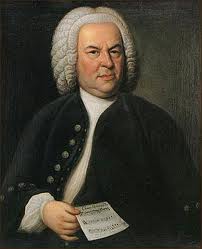 hired as Kapellmeister, he composed for the orchestra at the court of Prince Leopold. And when later on he was appointed the Cantor (music director) of the Thomasschule, part of his job was to compose music for Sunday services at major churches of Leipzig, Thomaskirche and Nikolaikirche. All the while his main task was to instruct student in singing. So it comes as no surprise that Bach recycled a lot of material from one composition to another (to reuse your own or even someone else compositions was quite acceptable in the 18th century: Italian composers did it quite often, and Bach himself transcribed Alessandro Marcello’s oboe concerto to harpsichord and used a number of pieces from Vivaldi’s L'estro Armonico). What is really interesting is how organically Bach’s music could be rearranged from one instrument (or set of instruments) to another. A great example of such transformation is his harpsichord concertos. These concertos were written while Bach was director of the Collegium musicum in Leipzig in 1730s, but scholars believe that most of these concertos are Bach’s own arrangements of violin concertos written inKöthen some years earlier. The famous Concerto no. 1 (who hasn’t heard Glenn Gould’s stupendous recordings of this piece on a contemporary Steinway piano?) was most likely based on a now lost D minor violin concerto. The harpsichord concerto in turn was later arranged by Bach as an organ concerto and was used in two of his Cantatas, the first movement of Wir müssen durch viel Trübsal (We must pass through great sadness), BWV 146, and the last movement (Sinfonia) of cantata Ich habe meine Zuversicht, (I have my confidence), BWV 188. Here’s the first movement, Allegro, of the Wir müssen cantata performed by Gächinger Kantorei and Bach-Collegium of Stuttgart, Helmuth Rilling, Director (courtesy of Youtube).
Bach was not the only one to transcribe his music. In the 19th and 20th centuries his music was arranged numerous times, starting with the famous performance of Saint Matthew Passion by Mendelssohn in 1842, the first one in almost 90 years: it was abbreviated and re-orchestrated for a much larger orchestra and chorus. Ferruccio Busoni made a large number of piano transcriptions of Bach’s works, including such repertoire staples as Toccata and Fugue in D Minor, originally a work for organ, and Chaconne from the Partita No. 2 in D minor for solo violin, BWV 1004. We’ll hear Chaconne in performance by Russian-German pianist Elena Melnikova (here). Camille Saint-Saëns wrote a wonderful if quite Romantic piano transcription of Overture from Cantata Wir danken dir, Gott, wir danken dir (Unto Thee, O God, do we give thanks), BWV 29. It’s performed by the pianist Nadejda Vlaeva (here). The recording is from her new Hyperion CD of Bach transcriptions.Permalink
March 12, 2012. Igor Cognolato plays Casella. In one of our recent posts about Vivaldi we mentioned that Alfredo Casella played a very significant role in popularizing his music. Casella (July 25,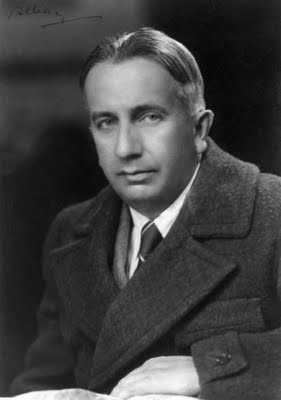 1883 – March 5, 1947) was a very interesting composer in his own right, even though his music is rarely played these days. He lived through one of the most turbulent periods in modern Italian history: the First World War, Mussolini’s fascist regime, and then the Second World War. Casella entered the Paris Conservatory in 1896 to study piano and composition, and while there he met "everybody": Debussy and Ravel, Stravinsky and Enescu, de Falla and Richard Strauss. He returned to Italy during the Great War and for some time taught at the Accademia di Santa Cecilia in Rome. He became involved in the new "futurist" music and even wrote a "futurist" piece, Pupazzetti (Puppets), here. But Casella’s interest in ahistorical Futurism was fleeting. In 1917 he, together with composers Ottorino Respighi and Gian Francesco Malipiero founded the National Music Society to perform new Italian music and also "resurrect our old forgotten music." In 1923 Casella, the poet and playwright Gabriele D'Annunzio and the same Malipiero organized Corporazione delle nuove musiche (CDNM), again with the goals of promoting modern Italian music as well as reviving the old.. CDNM brought to Italy a number of composers, including Béla Bartók and Paul Hindemith; CDNM’s concerts featured music of Schoenberg, Stravinsky, Poulenc, Kodály and other contemporaries. The 1920s was also the time of great interest in the European musical patrimony, the interest often tinged with nationalism. Like Respighi, who wrote The Birds and Ancient Airs and Dances, and Stravinsky (Pulcinella), Casella created pieces that echoed the music of his predecessors, in his case Scarlattiana (1926), an orchestral piece based on Domenico Scarlatti’s sonatas. It was only natural that Casella became involved in research and promotion of the music of Vivaldi. Ezra Pound and the violinist Olga Rudge, Pound’s companion, were also actively involved in reviving Vivaldi’s music. Pound at that time was a strong proponent of fascism; Casella too was a follower of Mussolini, especially his effort to create a national, state culture based on Italian cultural “self-sufficiency.” Casella of course was not the only one being seduced by fascism: most of the Italian cultural elite of the time, from D'Annunzio to painters Filippo Marinetti, Mario Sironi and even to some extent De Chirico, were either supporters of Mussolini or were strongly influenced by fascist ideals. Casella continued composing and teaching into the 1940s; his last composition was written in 1944, while Italy was a battlefield. It was called Missa Solemnis Pro Pace – a mass for peace. Among his students was the composer Nino Rota, who wrote Cantico in memoria di Alfredo Casella.
Italian pianist Igor Cognolato was born in Treviso. He studied at the Academy "Benedetto Marcello" in Venice, and at the Academy of Music in Hanover. Among his teachers were Aldo Ciccolini and Paul Badura-Skoda. Mr. Cognolato has extensively performer throughout Western Europe and North America. We’ll hear him play three parts of the Casella’s Sinfonia, Arioso e Toccata, op.59. Sinfonia can be heard here, Arioso – here, and Toccata – here.Permalink
March 5, 2012. Ravel and C. P. E. Bach. Maurice Ravel was born on the 7th of March, 1875 in Ciboure, a French Basque town on the border with Spain. This most French composer had a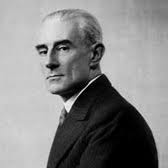 Swiss-born father (Igor Stravinsky, a good friend, called Ravel “the most perfect of Swiss watchmakers”) and a Basque mother who, prior to marrying Joseph Ravel, spent most of her life to Madrid. Around 1900 Ravel joined a group of French musicians, writers and artists, who called themselves Les Apaches (in French the word not only refers to the native American tribe but also means hooligans). Besides Ravel (and later Stravinsky), composers Florent Schmitt and Manuel de Falla also belonged to the band. Ricardo Viñes, the pianist who premiered many of Ravel’s compositions, was a member. Ravel even suggested a musical theme for the group, a rather wild and exotic entry to Borodin’s Second symphony. Ravel dedicated his piano suite Miroirs, written in 1905, to Les Apaches, and each of the five movements to a different person: Noctuelles to the poet Léon-Paul Fargue; Oiseaux tristes – to Ricardo Viñes, who premiered this work in 1906, Une barque sur l'océan – to the painter Paul Sordes (for many years the group met every Saturday at his home); Alborada del gracioso was dedicated to the music critic Michel-Dimitri Calvocoressi, a big fan of Russian music, especially that of Mussorgsky and an advisor to Sergei Dyaghilev; and La vallée des cloches – to the composer and pianist Maurice Delage. We’ll hear all five: Noctuelles is performed by the Italian pianist Igor Cognolato (here); Oiseaux tristes by the Chinese-born pianist Di Wu (here); Une barque sur l'océan – by Spencer Myer (here) Alborada del gracioso – by Milton Rubén Laufer (here), and La vallée des cloches – again by Igor Congnolato (here).
If we were asked to name a composer farthest removed musically from Ravel, Carl Philipp Emanuel Bach probably would make the list. But here he is, born the same week, on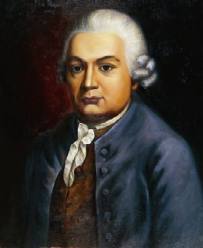 March 8, 1714. The fifth child of Johan Sebastian Bach became an important composer in his own right, one of the most significant composers of the era straddling Baroque and Classicism. His father was a great influence on him, as was his godfather, Georg Philipp Telemann, who in his time was at least as popular as J. S. Bach, if not more so. Emanuel Bach was born in Weimar, studied at the famous St. Thomas School at Leipzig (his father became a cantor there just a year before he entered the school, in 1723), and then for 30 years lived in Berlin. He started his service at the court of Crown Prince Frederick of Prussia in 1738. Two years later Frederick (who became known as Frederick the Great) succeeded his father as the king of Prussia, and Emanuel joined the royal orchestra. By then he was already famous as a harpsichordist and composer. The Berlin period was very prolific for Emanuel: he wrote a large number of keyboard sonatas and several orchestral pieces, among them a Magnificat and several symphonies. In 1768 Emanuel left the service of Frederick to become the court composer for his sister, Princess Anna Amalia in Hamburg – a post previously occupied by his godfather, Georg Philipp Telemann. That was the time when Emanuel wrote most of his choral pieces, including the oratorio Die Israeliten in der Wüste (The Israelites in the Desert), cantatas, and different settings of the Passion. He died on December 14, 1788. Mozart, who regarded him very highly and called himself and other contemporary composers of the time "children of Emanuel Bach," was by then at the pinnacle of his career. We’ll hear Rondo in F Major, Wq. 57 performed by the young Israeli pianist Einav Yarden (here) and Flute Sonata in G Major (here), performed by the flutists Martha Councell with Richard Steinbach on the piano.Permalink