Welcome to our free classical music site

Do you write about classical music? Are you a blogger? Want to team up with Classical Connect? Send us a message, let's talk!
Do you write about classical music? Are you a blogger? Want to team up with Classical Connect? Send us a message, let's talk!




August 1, 2011. Boyce Lancaster interviews the famous American lutenist and baroque guitarist Hopkinson Smith. Since the early 1970s Mr. Smith has been living in Switzerland. He was one of the founders of Hespèrion XX, an international early music ensemble. Mr. Smith plays different plucked string instruments, including the vihuela (called viola da mano in Italy), Renaissance lute, theorbo, Renaissance and Baroque guitars and the baroque lute. During the interview he plays music of the Spanish Baroque composers Gaspar Sanz and Francisco Guerau. Here’s Boyce:
A tall, slender gentleman with a regal bearing glides toward me, extends his hand, and says “Hello, I’m Hopkinson Smith.” His voice is soft, not unlike the instrument he plays, but at the same time, he commands attention as he speaks. He chooses his words carefully, describing his instruments and the music he plays as a painter describes what he sees with a brush. His accent is unique and rests pleasantly on the ears…an amalgamation of his life in the Northeastern United States and his current home in Switzerland, where he teaches at the Schola Cantorum Basiliensis.
In my conversation with Hopkinson Smith, I learned that he played electric guitar, horn, saxophone, and trumpet, among many other instruments. If there was an instrument missing in the band, he would simply pick it up and figure it out on his own. He was about 17 when he discovered the classical guitar. After a couple of years, the lute caught his attention. He would soon move to Europe to study with Emilio Pujol, who had once been a student of Francisco Tarrega.
In the years since, he has expanded his expertise to include many instruments, renaissance lute, vihuela, theorbo, Renaissance and baroque guitars and the baroque lute among them. He has release 20+ solo recordings on these various instruments, as well as collaborating with many of the world’s greatest musicians. He was involved in the founding of the ensemble Hesperion XX and collaborated for some ten years with Jordi Savall, who also teaches at Schola Cantorum Basiliensis.
I could go on, but it is far more interesting to hear in Hopkinson Smith’s own words. Here’s the interview.Permalink
 Our friends at GetClassical recently wrote about the talented Israeli violinist and composer Ittai Shapira. His Concierto Latino, inspired by Latin dances and based on elements of Tango and Flamenco, premiered in 2008. You can listen to the final movement ("The Party") here, it’s performed by Ittai with London Serenata, Krzysztof Chorzelski, conductor. You can also listen to Frédéric Chopin’s Polonaise Brilliante arrange by Ittai for violin and piano, performed by him and the pianist Jeremy Denk (here). And here you can listen to the 3rd movement of the violin concerto by the brilliant Israeli composer Avner Dorman. Here is what GetClassical wrote about Ittai.
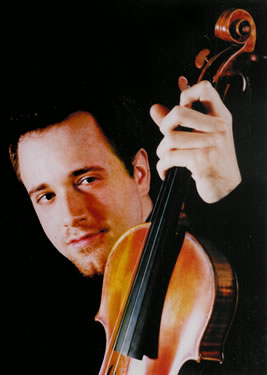 So far, 14 compositions by different contemporary composers have been dedicated to violinist Ittai Shapira. Belonging to the now thirty something generation of performers of the New York classical music scene – he and pianist Jeremy Denk were roommates in college- he is now renowned as a versatile performer of an enormous classical violin repertoire, incorporating past and present, traditional as well as contemporary.
July 25, 2011.
Violinist Ittai Shapira: how everyone can relate, when personal events transpire into musical compositions
One of these premieres included the violin concerto written for him by Israeli compatriot and Pulitzer Prize winner, Shulamit Ran. It was performed at Shapira’s acclaimed Carnegie Hall debut in 2003 with the Orchestra of St.Luke’s. In 2007, it was incorporated into Ran’s compilation of works performed by Daniel Barenboim and the Chicago Symphony Orchestra.
Shapira’s international performances as a fine soloist with many leading orchestras as well as chamber groups, coupled with his varied recordings, show his widespread interest in standard and unusual repertoire, explaining why so many composers dedicate works for his performance.
Another Israeli compatriot, a composer who lately enjoys great international demand, Avner Dorman, wrote a violin concerto for Shapira as well, in 2006. It was performed with the Jerusalem Symphony Orchestra.
Dorman was, as was Shapira, trained at Juilliard after leaving Israel for New York. While Dorman studied composition with John Corigliano, Shapira studied violin with Dorothy DeLay and Robert Mann and privately coached with Itzhak Perlman and Pinchas Zukerman.
PermalinkJuly 18, 2011
From recent uploads. The Lithuanian pianist Ieva Jokubaviciute regularly performs for audiences in the US, Europe, and South America. Over the last several seasons, Ieva made her Chicago Symphony debut at the Ravinia Festival under the baton of James Conlon as well as an orchestral debut in Rio de Janeiro. She has played at London's Wigmore Hall, Carnegie Hall's Stern Auditorium, Lima, Peru, and many other cities. Ieva recently recorded a CD of music of Alban Berg. Among the pieces on the CD is Piano Sonata no. 1. You can hear this wonderful and under-performed piece as recorded in concert earlier this year.
The twenty year-old violinist Emma Steele is a pupil of Cyrus Forough at Carnegie Mellon University. Emma is the concertmaster of the Carnegie Mellon Philharmonic and received the Young Talent award in the Sibelius International Violin Competition. Here she plays Ballade, from Romantic Pieces, Op. 115 by Jean Sibelius (with Shirley Trissell on the piano).
The young Chinese-born pianist Di Wu was praised in The Wall Street Journal as "a most mature and sensitive pianist," and it’s certainly true. Ms. Wu is the winner of many competition prizes; she made her professional debut at the age of 14 with the Beijing Philharmonic, and in recent seasons she has played more than 60 concerts, both as a recitalist and a soloist with orchestras. Highlights of the 2009-2010 season include her performance with the Philadelphia Orchestra; a concert at Chicago’s Ravinia Festival; at the Cincinnati May Festival; in Germany, with the Hamburg Philharmonic; and in Tokyo, where she appeared as a soloist with an orchestra in front of an audience of 11,000. We’ll hear the Une barque sur l'océan, from Miroirs by Maurice Ravel. To listen, click here.
The Russian-born cellist Dmitri Atapine was described as a “splendid, elegant cellist." The First Prize winner at the Carlos Prieto International Cello Competition, Dmitry began his musical education with his parents at the age of five and soon thereafter entered the St. Petersburg Conservatory School of Music. Since 1992 he has been living in Spain. Dmitry studied at the Michigan State University with Suren Bagratuni, and was recently appointed as a Cello Professor and cellist of the Argenta Trio at the University of Nevada, Reno. Since 2007 Mr. Atapine has been the Artistic Director of the International Music Festival of Ribadesella (Spain) and also appears as both a soloist and chamber musician in many festivals throughout Europe and the US. We’ll hear him perform Introduction and Polonaise Brillante by Frédéric Chopin. He’s accompanied by Adela Hyeyeon Park, piano. Click here to listen.
Finally, we’ll hear the Claremont Trio play Beethoven’s Archduke Trio (Piano Trio in B-flat Major, Op. 97. Claremont Trio (twin sisters Emily Bruskin, violin and Julia Bruskin, cello, and the pianist Donna Kwong) won the inaugural Kalichstein-Laredo-Robinson International Trio Award. They widely perform around the US and recently recorded Beethoven’s Piano Trio Op. 1, no. 3 and Ravel’s Trio for Tria Records. In our recording the piano part is played by the young Israeli pianist Benjamin Hochman. To listen to the Archduke, click here.
July 11, 2011
The International Tchaikovsky Competition is one of the most prestigious musical contests in the world. Founded in Moscow in 1958, it began with just two disciplines, piano and violin. The winner of the piano competition, the 23 year-old Texan by the name of Van Cliburn, became an overnight sensation and the darling of both the Russian and American public. This summer in Moscow he presided as the honorary Chairman of the piano jury, still adored by the older generation of the competition’s regulars. In 1962 the cello was added, and four years later, the voice competition rounded out the expanded list of musical fields. Among the winners were such outstanding musicians as pianists Vladimir Ashkenazi, John Ogdon, Vladimir Krainev, and Mikhail Pletnev; violinists Viktor Tretiakov, Gidon Kremer; cellists Natalia Shakhovskaya and David Geringas, sopranos Elena Obraztsova and Deborah Voight. And of course during its more than fifty year history, the competition has had its share ups and downs as well as controversies.
The recently completed 14th edition of the competition had an unusual format. Due to the ongoing renovations of the Grand Hall of the Moscow Conservatory, it was decided that the competition would be split between two cities: the pianists and cellists would play in Moscow, while St.-Petersburg would host the violinists and vocalists. Valery Gergiev was the chairman; realizing that in recent years the Tchaikovsky’s reputation was somewhat sagging, he attempted to improve the quality and reputation of the jury panels by inviting the best musicians. It seems that to a large extent he succeeded. The piano jury included such luminaries as Vladimir Ashkenazy and Yefim Bronfman (both judged only the final round), Peter Donohoe and Dmitri Alexeev. Among the violinists were Anne-Sophie Mutter, Leonidas Kavakos and Maxim Vengerov. Renata Scotto, Ileana Cotrubas, and Olga Borodina were on the vocalists’ jury.
Among the pianists the winner was Daniil Trifonov (Russia), Narek Hakhnazaryan (Armenia) won the cello competition, the first prize in the violin competition was not awarded, and two South Koreans, Sun Young Seo, soprano and Jong Min Park, bass, won among the vocalists. The 14th Competition had its share of controversies. One of the public’s favorites, the pianist Alexander Lubyantsev was eliminated after the second round. The conductor Mark Gorenstein drew a lot of unwanted attention when he made derogatory remarks about the cellist Narek Hakhnazaryan during the orchestral rehearsals before the final round. Unbeknownst to Gorenstein the rehearsal was being recorded and broadcast on Internet (these innovative broadcasts were a welcome addition to the competition). The video went viral; Gorenstein apologized and withdrew “due to illness.”
We’re very proud that two of the winners, Daniil Trifonov and Narek Hakhnazaryan are represented in our library. You can listen to Daniil playing Chopin’s Barcarolle in F-sharp Major, Op. 60 here. Narek’s interpretation of Claude Debussy’s Sonata for Cello and Piano can be heard here. He’s accompanied by the pianist Roman Rabinovich.
July 7, 2011. The great Austrian composer Gustav Mahler was born on this day in 1860. Our congratulations to all Mahlertites!
July 4, 2011.
The Italian pianist Igor Cognolato was born in Treviso, Italy, in 1965. He started his musical training at the age of five. At nineteen he received a diploma, magna cum laude, in piano performance from the Benedetto Marcello Academy in Venice, where he studied under the late Vincenzo Pertile, himself a student of the great Arturo Benedetti Michelangeli. He pursued his musical education at the Academy of Music in Hanover, Germany, with the Brazilian pianist Roberto Szidon. In his debut concert, which was broadcast live, he played Liszt's Second Piano concerto with NDR Symphony Orchestra. Igor continued his studies in composition and piano with Aldo Ciccolini, Paul Badura-Skoda, the composer Ugo Amendola, and others.
Igor Cognolato has successfully performed throughout the Western Europe and the US. As a soloist with a number of orchestras (Radiophilharmonie Hanover, Orchestra di Padova e del Veneto, Bourgas Philharmonic, Orchestra del Gran Teatro La Fenice di Venezia among them), he recorded for RAI, NDR Radio, and for Norwegian National Radio. Since 2009 he has been performing with Athenaeum String Quartet, which consists of the members of the Berlin Philharmonic. Recently they took part in the Aix-en-Provence chamber music festival and their performance was broadcast live on ARTE TV channel.
Presently, Igor Cognolato teaches piano performance at the Academy of music “Giuseppe Tartini" in Trieste, Italy. He also gives master classes at the Musikhochschule in Graz, and in Vienna, in Lübeck, Germany, and in London (the Trinity college of music).
We’re fortunate to have a large selection of Igor Cognolato’s recordings, both as a soloist and a chamber musician. Igor’s repertoire is broad and includes a number of pieces by modern Italian composers. We’ll hear him play the following: Noctuelles and Oiseaux tristes from Miroirs, by Maurice Ravel; Arioso, from the rarely performed Sinfonia, Arioso e Toccata op.59, by the Italian composer Alfredo Casella; Blues, the second movement of Maurice Ravel’s Sonata for violin and piano (with the violinist Ara Malikian). Finally, we’ll hear Liszt’s Scherzo and March, S.177. To listen, click here.