Welcome to our free classical music site

Do you write about classical music? Are you a blogger? Want to team up with Classical Connect? Send us a message, let's talk!
Do you write about classical music? Are you a blogger? Want to team up with Classical Connect? Send us a message, let's talk!




June 27, 2011
Our friend GetClassical recently published an article about the pianists Lucille Chung and Alessio Bax. Our listeners are familiar with these wonderful musicians, who are represented individually (Lucille in Scriabin, Brahms and Ligeti, Alessio in Rachmaninov and Ravel), as well as a duo, playing Starvinsky and Piazzolla. Here it is.
Pianists Lucille Chung and Alessio Bax: Sharing their lives at the piano
I am enjoying a cappuccino, that borders perfection, at pianists’ Lucille Chung’s and Alessio Bax’ tasteful, un- cluttered and brand new address on New York’s Upper-Upper West side. Lucille’s organizational skills translate into the modern streamlined, yet comfortable chic atmosphere, echoing Alessio’s Italian classy design heritage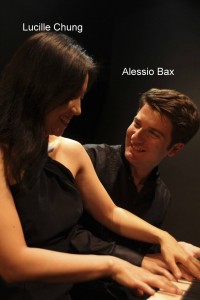 that takes a decisively leading voice when it comes to the kitchen as well as, to my delight, handling the professional grade cappuccino maker.
This generous space that the attractive young couple calls home, when in New York, holds two grand pianos. One in their study that for now doubles as a guestroom, for practicing and teaching; the other one in the living room, for practicing simultaneously or to entertain each other and guests who typically are music lovers or musicians as well.
Playing the piano is what both regard as central to their lives. That’s why they might as well spend time doing it together. Two young, successful musicians in their own right, they share the rest of their time together, between juggling the piano faculty at Dallas’ SMU and their increasingly busy performance and recording schedules. In great demand as soloists, they have found themselves increasingly performing as a duo as well.Not that they necessarily planned it that way. Even though it always seemed like a great idea and it had happened on occasion, their duo performances have only recently gained in volume, taking up about 20 percent of their time, which was previously engaged with their professional solo performances. And, the truth is, they enjoy spending this 'quality time' at the piano together.
PermalinkJune 20, 2011
Igor Stravinsky. We just missed the anniversary of the great composer, who was born on June 17, 1882 in Oranienbaum, near St-Petersburg. Probably one of the most influential musicians of the 20th century, he changed styles as often as he adopted countries. Born in Russia, he moved to Switzerland in 1910 and then, in 1920, to France, where he settled for the next 20 years and became a citizen. With the Second World War approaching, Stravinsky moved to the United States, where he lived for the rest of his life (he was naturalized in 1945). Stravinsky died on April 6, 1971. But even more remarkable was the ease with which he changed his compositional styles. The early (Russian) period saw the creation of the three ballets, The Firebird in 1910, Petrushka a year later, and The Rite of Spring in 1913. All three were commissioned by Sergei Diagilev, the celebrated impresario and creator of Ballets Russe. The Rite of Spring famously provoked a riot during the premier at the Théâtre des Champs-Élysées in Paris. Almost 100 years later one still looks at this star-studded event in awe: the ballet was choreographed by Vaslav Nijinsky, one of the greatest dancers of all time, the set design and costumes were created by Nicholai Roerich, the famous Russian painter (and philosopher). The conductor on that night was Pierre Monteux.
In the 1920s Stravinsky radically changed his style. The exuberance of the Russian period was replaced with the neoclassical detachment of such compositions as the ballet Apollon musagète and three symphonies, Symphony of Psalms, Symphony in C, and Symphony in Three Movements. Later, in the 1950s he dabbed in serialism, the ballet Agon being probably the most important piece of that period. One thinks of Pablo Picasso, another cosmopolitan genius of the 20th century, who in the span of 20 years went from the Blue period to the Rose period to cubism, and then, like Stravinsky, to neoclassicism. (There are other similarities in their biographies: both lived most of their lives outside of their countries of birth, which they for the most part detested; France was central to both of them; both were married to Russian women; and even their lives practically coincided: Picasso was born less than a year earlier than Stravinsky, and died just one year later).
We’ll hear four compositions. First, Danse Russe, from the ballet Petrushka, arranged for the piano by the composer himself in 1921. It’s played by Gideon Rubin. Then, also from the Russian period, Five Easy Pieces (1917). They’re performed by Silver-Garburg Piano Duo. Two following pieces are from the neoclassical period: Suite Italienne for violin and piano, based on the ballet Pulcinella, is performed by the violinist Ilana Setapen, with Kuang-Hao Huang on the piano. Finally, Sonata (1924) is played by the young Israeli pianist Einav Yarden. To listen, click here.
June 13, 2011
“A very gifted romantic pianist, highly emotional, with a great temperament and bright, creative individuality” – is how the late Vladimir Krainev characterized Victoria Lyubitskaya. Born in Moscow, Victoria studied at the Conservatory-affiliated music schools, first with Valentina Sedova-Berman and then with the well-known pianist and teacher Victor Bunin. She continued her education in the Moscow Conservatory under Professors Samvel Alumyan and Lev Naumov. Victoria Lyubitskaya is currently a soloist of the Moscow State Philharmonic Society. She is a laureate of several international competitions.
Victoria's concert repertoire is wide and diverse, embracing works from the 18th to the 20th century. Rachmaninov occupies a special place for her, and she performs all of his solo piano works as well as all four concertos and Rhapsody on a Theme of Paganini. Victoria has collaborated with such well-known conductors as Saulius Sondeckis, Mark Gorenstein, Veronika Dudarova, Vladimir Verbitsky; she has performed with leading orchestras such as the State Academic Symphony Orchestra of Russia, the Moscow Philharmonic Orchestra, the Russian Symphony Orchestra, and the St. Petersburg Philharmonic Symphony Orchestra. Victoria has given concerts at the Grand Hall of the Moscow Conservatory and at the Tchaikovsky Concert Hall, and in the Grand Hall of the St. Petersburg Philharmonic Society; she has also gave concerts in other Russian cities. Internationally, she has performed in Switzerland, Italy, Montenegro, Croatia, Poland, Latvia, Germany, Hungary and Australia and participated in a number of international and national music festivals.
Ms. Lyubitskaya has been recorded for various radio, television and CD companies. In 2008, her recording of Alfred Schnittke's piano works, released on the Belgian label Fuga Libera, was awarded the top rating by the prestigious French classical-music magazine Diapason (“The only possible reproach one could make… is that there isn’t more of it”). We present three pieces from that CD. First, the recording of Schnittke’s Concerto for Piano and Strings, written for Vladimir Krainev in 1979. Schnittke was not satisfied with the original version and re-wrote the concerto. Although the initial reception to the concerto was cool, it is now recognized as one of Schnittke’s most significant compositions. Reviewing the CD for the classical music magazine La Scena Musicale, René Bricault praised Ms. Lyubitskaya’s recording as setting a new standard for this work. Ms. Lyubitskaya is accompanied by the Russian State Academy Orchestra, Mark Gorenshtein, conductor. We’ll also hear two pieces for piano solo: Schnittke’s Variations on one chord and Improvisation and Fugue, Op. 38. To listen, click here.
The (Glamorous) World of Jeremy Denk, by Boyce Lancaster
Jeremy Denk is thoughtful and reflective, both in his interviews and his performance. It would be very simple to “phone it in” when you do multiple performances of the same pieces…but as our conversation progressed, it quickly became evident that Denk is not one to play a piece of music just to earn a paycheck. He recently subbed for an ailing Maurizio Pollini at Carnegie Hall (his debut in that venue), just a couple of weeks after filling in for an ailing Martha Argerich with Gustavo Dudamel and the Los Angeles Philharmonic, performing Beethoven’s Piano Concerto No. 1. When asked about that performance, he said if he had been asked to play something with which he was not very familiar or had not played in a long time, he would most likely have turned down the gig, rather than go into such high-profile venues less than fully prepared.
In the Carnegie Hall performance, he coupled the Bach Goldberg Variations with the Concord Sonata by Charles Ives. At first, they seemed to be two pieces which did not really fit together, but Denk’s thoughtful, reflective description of how he decided to pair Bach and Ives in recital left me wondering why I had never thought to present them together on the radio. During that part of our conversation, I also began to see Charles Ives from Denk’s perspective, which gave me an entirely new appreciation for that oft-ignored composer.
I hope you’ll take the time to listen to our conversation...and that it’s as much fun for you as it was for me.
Part I of the interview is here, Part II -- here.
PermalinkJune 6, 2011
The great German Romantic composer, Robert Schumann was born on June 8, 1810 in Zwickau, Saxony. Schumann's music was immediately accepted as central to the classical canon and has stayed popular ever since, although these days it may not be played as often as in the mid-20th century, when pieces like Carnival, Symphonic Studies, and Fantasy in C seemed practically obligatory in piano recitals. A large portion of Schumann's music was written for piano solo – his first composition for an instrument other than piano didn't come till 1840, ten years since Variations on the name "Abegg" Op. 1 (it was Liederkreis, Op. 24, a song cycle on nine poems by Heinrich Heine). Schumann's first symphony came the following year, and a set of quartets – a year later.
Schumann's music needs no introduction, so we'll just present pieces from the different periods of his career. We'll start at the beginning: Variations on the name "Abegg," Op. 1. It's played by the brilliant Taiwanese pianist Jung Lin. Next is the piece that followed, Papillons Op. 2, performed by the pianist Tanya Gabrielian. Ms. Gabrielian was born in the US but currently lives in London. Following these two early pieces we'll play a much later work, Adagio and Allegro, Op. 70 (1849). It was originally written for the horn and piano, but these days it's usually heard in the arrangements for the viola or cello. You'll hear it performed by the Milan-based Duo Lopez Cafiero, the cellist Martina Lopez and the pianist Clelia Cafiero. Schumann wrote a large number of vocal works, as a lied composer he's on par with Schubert. We'll hear one of his most famous songs, Widmung, Op. 25, No. 1, the opening piece from the cycle Myrthen, his wedding present to Clara Wieck. It is sung by the soprano Hyunah Yu, with Alon Goldstein on the piano. We'll finish with one of his last compositions, Märchenerzählungen (Fairy tales), Op. 132, a trio for the clarinet, viola, and piano. It was written in 1853, three years before Schumann's death, when he was already deeply ill (the following year he would voluntarily enter a mental hospital). The performers are Trio di Colore. To listen, click here.
May 30, 2011
Recent anniversaries. We missed several of them in the last couple of weeks and would like to catch up. Jules Massenet and Gabriel Fauré were both born on May 12, Massenet in 1842 and Fauré three years later. (Doesn't Fauré sound much more contemporary? Massenet is so firmly planted in the 19th century French Romanticism, while Fauré influenced so much of the 20th century music). Here is Meditation from Massenet's opera Tais; it's performed by the flutist Katherine DeJongh with Yoko Yamada-Selvaggio on the piano. As for Faure, we selected his famous song, Après un rève, in a viola arrangement. It's performed (on the 1615 Amati "La Stauffer" viola) by Anna Serova, who is accompanied by Jenny Borgatti, piano. Click here to listen.
The wonderfully eccentric French composer Erik Satie was born on May 17, 1866. A friend of Debussy and Ravel, and later of the Dada artists, he's mostly famous for his brief pieces for piano, Gymnopédies and Gnossiene. Here's his Gnossiene No. 2, played by the pianist Tania Stavreva.
While some of Satie's pieces barely run a minute, some of the operas of Richard Wagner, who was born on May 22, 1813, run longer than 5 hours (Die Meistersinger von Nürnberg, depending on the conductor, takes about five and a half hours to perform). Although we love Wagner, our selection might be considered blasphemous by the Wagnerian purists: it's Ride of the Walküre, from the opera Die Walküre played by The Fauxharmonic Orchestra, Paul Henry Smith conducting. From Wikipedia: "The Fauxharmonic Orchestra is an orchestra made up of digital orchestral instruments, some including the Vienna Symphonic Library conducted by Paul Henry Smith using a Wii remote controller instead of a baton and a Wii balance board instead of a podium, both of which are programmed to modify the sounds in real time in response to the acoustics of the hall and the demands of the music." We think this performance is a lot of fun; listen to it here.
The French composer Jean Françaix was born on May 23, 1912. Françaix once said that his goal of is to "give pleasure." That he certainly does. Here is his charming Tema con variazioni. It's performed by the clarinetist István Kohán and Noémi Kanizsár is on the piano.
And last but not least of the recent anniversaries, Isaac Albéniz was born on May 29, 1860. His Cordoba, Op. 232, No. 4 is played by the Russian pianist Dmitry Paperno. To listen, click here.