
Musings, December 2020
This Week in Classical Music: December 7, 2020. Musings. If it were a normal year, we would be writing about Pietro Mascagni, or Jean Sibelius, or Cesar Franck, or, very likely, about  Hector Berlioz, all of whom were born this week. Or, if we had felt that we’d done justice to these wonderful composers in our earlier posts, we might have written about the less popular ones, like the Polish-Russian composer Moise Weinberg, or the great American Modernist Elliott Carter. And we would most likely mention one of our favorites, Olivier Messiaen. This is a big week, but times are by no means normal, so we’ll divert and address other issues. First of all, Covid, which decimated the musical scene. Who could have imagined in February of this year, that the pandemic would close all our concert halls and opera theaters not for a couple of months, but for at least a year and probably much longer? The effects of Covid are devastating: musicians lost their jobs, the lucky ones kept their salaries, often reduced, but most did not. Young performers were hit the worst; not yet established, without a following or financial institutional support, they attempted to continue online only to learn that this is a poor substitute. Music lovers were also hurt, but at least they could revert to their CD collections, classical music radio stations or streaming sites. This was supposed to be the Year of Beethoven, whose 250th anniversary the world will celebrate one week from today, but that was not to be: Covid ruined all of the planned festivals and music series. This is very unfortunate: even though Beethoven’s music is being played all the time, much of it is the same, while some of his pieces are performed less often; those could’ve been showcased this year by the best and most imaginative musicians. And, to state the obvious, Beethoven was a giant – there was music before him, then there were his 30 creative years, and then a whole new period was started, forever affected by his genius.
But Covid and Beethoven are not the only dominant events of this year. During the last several months we’ve also underwent a rapid cultural transformation that afforded much weight to race and gender. This has put classical music in a rather precarious state: it would’ve never occurred to us to mention this before, but now we have to acknowledge that Beethoven was white and male. And so were most of the major figures of classical music, from its beginning in the 15th century when Guillaume Dufay and then Josquin du Pre introduced melody into their masses and motets, making music recognizable to the modern ear; then the greats of the high Renaissance: Palestrina, Lasso and Victoria, and on to Monteverdi, the first of the Baroque composers, the era that also gave us Italian and French opera, the Scarlattis, Purcell, J.S. Bach and Handel and on to the Classical and Romantic period all the way to 2020. The end of the 20th and 21st century is different: never before have we had so many talented female composers: Jennifer Higdon’s name comes to mind, but also Shulamit Ran, Sofia Gubaidulina, Augusta Read Thomas or Ellen Taaffe Zwilich. And of course, there are more, but it doesn’t mean that we hear more of their compositions - it’s the accessible salon music by Cécile Chaminade and minor pieces by Amy Beach and Florence Price that make their way to the airwaves and the Web. Classical music has been culturally diminishing for years, so what will happen to it now? Will this process accelerate, or will it be reborn in some other form? Something is bound to happen as the current state of it is just too precarious and unsustainable.
Read more...Frédéric Chopin - Waltz Op 64 / 2
Nico De Napoli (Piano)
Stefan Kristinkov - Better To Have
Stefan Kristinkov (Clarinet)
Stefan Kristinkov (Organ)
Stefan Kristinkov - Incipit
Stefan Kristinkov (Clarinet)
Irina Binder (Violin)
Stefan Kristinkov - On a Raising Value of Ice
Stefan Kristinkov (Clarinet)
Meitar Brit Forkosh (Violin)
Maria Mejeny (Violin)
Hannah Hens-Piazza (Viola)
Nashira Pearl (Cello)
Stefan Kristinkov - Observation (No. 5)
Stefan Kristinkov (Clarinet)
Budapest SO (Orchestra)
Arvo Pärt - Für Anna Maria
Nicolas Horvath (Piano)
Kempff 2020
This Week in Classical Music: November 30, 2020. Kempff, Lupu, Callas. Three composers were born this week: the late Baroque Spaniard, Padre Antonio Soler on December 3rd of 1729, Francesco Geminiani, an Italian who was tremendously popular during his life but now is almost totally forgotten (on December 5th of 1687), and Henryk Górecki, a 20th century Polish composer who became very popular with his sacred minimalist pieces (on December 6th of 1933). We’ve written about all three of them (here, about both Soler and Geminiani, and here about Górecki). Today, though, we’d like to remember a name we’ve failed to mention in our recent posts.
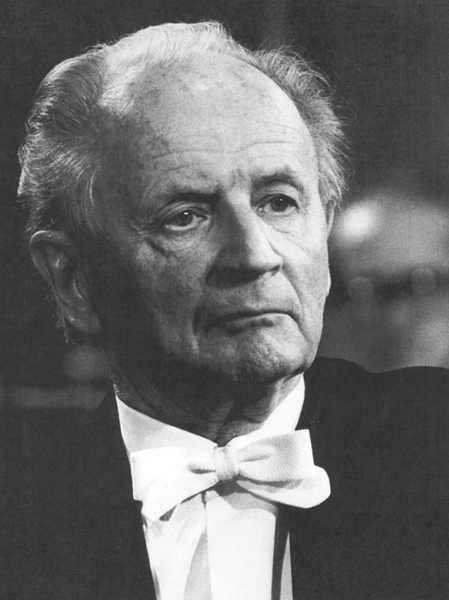 Wilhelm Kempff’s 125th anniversary was just five days ago. Kempff was one of the most interesting pianists of the 20th century. He was born on November 25th of 1895 in a small town of Jüterbog, not far from Berlin. His first teacher was his father, a music director to the royal family. Kempff studied the piano and composition at the Berlin Hochschule für Musik (Conservatory) and later took classes in philosophy and music history. Kempff gave his first recital in 1917, when he played, among other pieces, Beethoven’s Hammerklavier Sonata and Brahms’s Variations on a theme of Paganini. For the next three decades he concertized all across Europe, South America and Japan, but it was only in 1954 that he played in London for the first time and his American début had to wait till 1964 when he was already 68. Kempff recorded all piano sonatas by Schubert and Beethoven; he was also well known for his interpretation of the Romantic composers. Kempff was famous for his singing tone and beautiful coloration. He also didn’t like very fast tempos, preferring the more relaxed, “natural” speed. Kempff lived a long life: he still performed in his eighties and died at the age of 95. Here’s a rarely played Schubert piano sonata in E major, D 157; it’s an early piece, composed when Schubert was just 18. Kempff recorded it in 1968.
The Romanian pianist Radu Lupu, who is considered one of the greatest living musicians, will turn 75 on November 30th. He was born in 1945 in Galați. He studied in Bucharest with Florica Musicescu who had taught another great Romanian pianist, Dinu Lipatti, and then at the Moscow Conservatory with, among other professors, Heinrich Neuhaus, but thinks that he had learned more by listening to other musicians, and not necessarily pianists: “I took some from Furtwängler, Toscanini, everywhere..” he says. Lupu’s repertoire is broad, but like Kempff he excels in Schubert and Beethoven. Here Radu Lupu plays Schubert’s Piano Sonata in A minor, D 845. The sonata was written ten years after D 157, in 1825.
And of course, we cannot forget Maria Callas. She was born on December 2nd of 1923.
Read more...Franz Schubert - Piano Sonata in A minor, D845
Radu Lupu (Piano)
Muzio Clementi - Waltz in C Major, Op. 39, No. 9
Inga Kashakashvili (Piano)