
Ignacy Jan Paderewski - Au Soir, Op. 10, No. 1
Huiping Cai (Piano)
Giuditta Pasta, 2019
October 21, 2019. Giuditta Pasta. There are several anniversaries which we’d like to commemorate today: the birthdays of Franz Liszt, Luciano Berio, George Biset and Domenico Scarlatti. And there is also a very special singer we’d also like to write about as well. Franz Liszt was born on October 22nd of 1811 in the Kingdom of Hungary, then part of the Austro-Hungarian Empire. One of the most important composers of the 19th century, he was also the first (and the greatest) in a long line of piano virtuosos. We’ve written about his life and, separately, about his piano cycle Années de pèlerinage (for example, here and here). Please browse our library, which has an extensive collection of his works. Some of Liszt’s best works were written for the then newly-improved keyboard instrument, the piano, and so were most of Domenico Scarlatti’s numerous sonatas, though during his lifetime the main keyboard instrument was not the piano but the harpsichord. Domenico, the son of the great composer Alessandro Scarlatti, was born on October 26th of 1685 in Naples. Like Liszt, he was an excellent keyboard player, he even beat Handel in a 1709 harpsichord competition organized by Cardinal Pietro Ottoboni (Handel was judged to be a better organ player). Scarlatti wrote 555 sonatas; though we don’t have all of them, you could find several wonderful performances on our site.
Another Italian, Luciano Berio, was born on October 24th of 1925 in Oneglia, Liguria, not far from the French border. One of the most interesting composers of the late 20th century, he had an unusual distinction of being uncompromisingly experimental and very popular at the same time. Here’s Berio’s O King, dedicated to Martin Luther King. Soprano Elise Ross is accompanied by members of the London Symphonietta, with the composer conducting. Finally, Georges Bizet, the author of Carmen, was born on October 25th of 1838 in Paris.
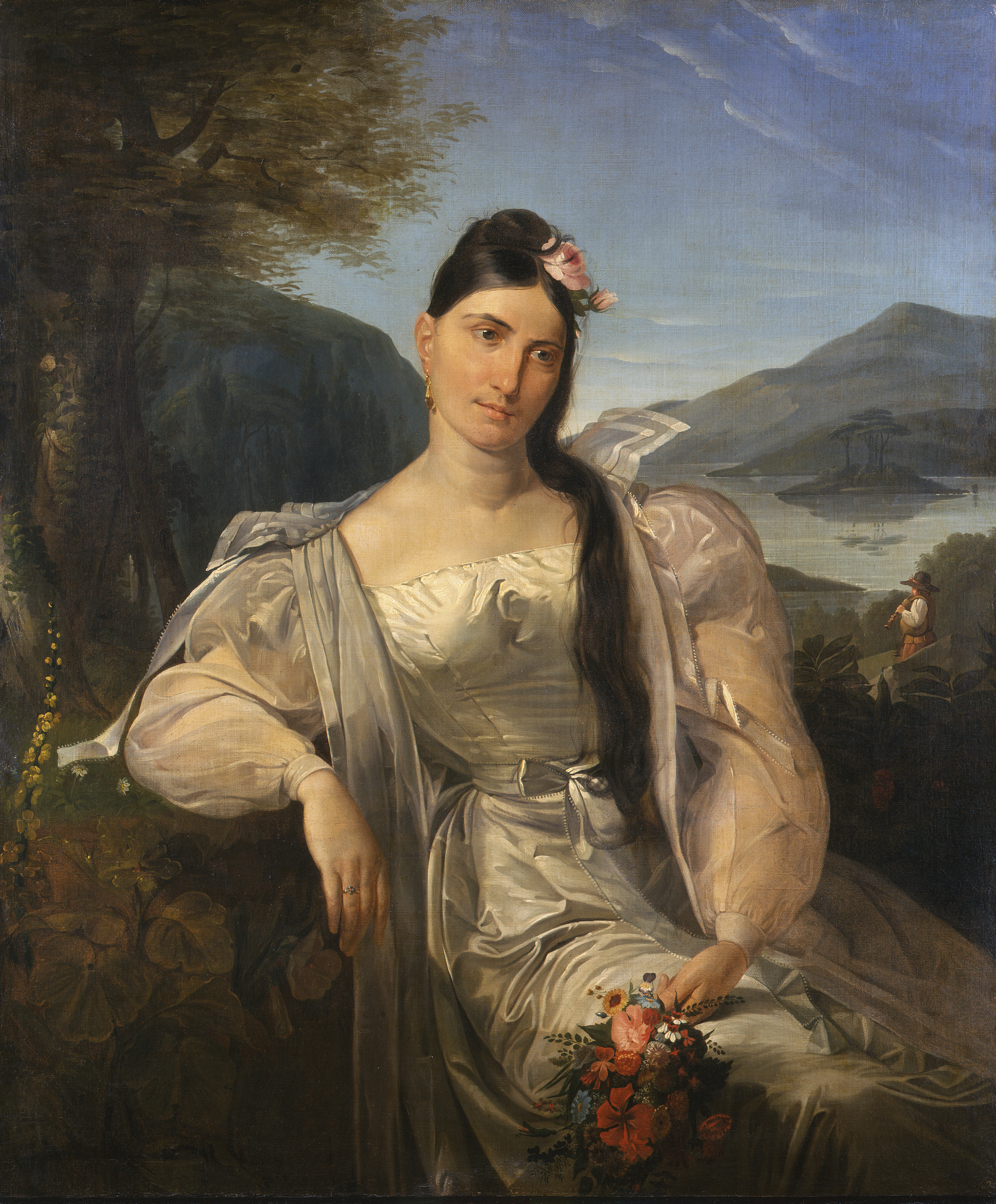 The singer we mentioned above is Giuditta Pasta, born on October 26th of 1797. She had an unusually beautiful voice with a huge range, the voice Italians call soprano sfogato. What is more, several opera roles, central to the bel canto repertoire, were written specifically for her. Giuditta Pasta was born Giuditta Negri on November 26th of 1797 in Saronno near Milan (in 1816 she married one Giuseppe Pasta, a fellow singer, and took his name). She studied in Milan and sung her debut role at the age of 19. By her early 20s she had performed in all major opera theater of Italy. Her first great triumph was the role of Desdemona in Rossini’s Otello which she sung at the Théâtre Italien in 1821 in Paris. In the subsequent years she became acclaimed as the greatest soprano in Europe. Rossini wrote the role of Corinna in Il viaggio a Reims for her in 1825; Donizetti – the role of the protagonist in the opera Anna Bolena in 1830. Bellini wrote two roles for Pasta, that of Amina in La sonnambula and then the great role of Norma, both in 1831. In 1835 Pasta retired from stage – she was only 38 years old. Her voice, soprano sfogato, had an enormous range: naturally a mezzo it went up to the coloratura soprano range. Wikipedia gives a wonderful quote from Stendhal, who describes Giuditta Pasta’s voice this way: “… she possesses the rare ability to be able to sing contralto as easily as she can sing soprano. Many notes … have the ability to produce a kind of resonant and magnetic vibration, which, through some still unexplained combination of physical phenomena, exercises an instantaneous and hypnotic effect upon the soul of the spectator.” Giuditta Pasta died in Como, Italy, on April 1st of 1865.
The portrait, above, was made by the Italian painter Giuseppe Molteni in 1829. Its title is “Portrait of the Singer Giuditta Pasta in the Stage Costume of “Nina or the Girl Driven Mad by Love”.” “Nina” is an opera by Giovanni Paisiello.
Read more...Luciano Berio - O King
Elise Ross (Soprano)
London Symphonietta (Ensemble)
Luciano Berio (Conductor)
Karl Richter, 2019
October 14, 2019. Karl Richter. A noted German composer Alexander von Zemlinsky was born on October 14th of 1871. Here’s our entry from six years ago. We think that the brief aside at the end of it, about the painter who created Zemlinky’s portrait, is quite fascinating and characteristic of the pre-Great War Viennese society. Luca Marenzio, the Italian composer of the late Renaissance active in Rome and Ferrara, was born on October 18th of 1553. Here’s a madrigal Solo et pensoso i più deserti campi, a setting of Petrarch’s poem, by Marenzio. It’s performed by the ensemble La Venexiana, Claudio Cavina conducting. And here is our previous entry on this wonderful composer. Also, the great Soviet pianist Emil Gilels was born on October 19th of 1916. Here is his 1972 recordings of Beethoven’s Piano Sonata No. 21 in C major, Op. 53, Waldstein. Read more about Gilels here.
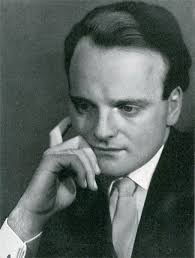 Listening to Karl Richter’s recordings of Bach’s St. Matthew and St. John Passions soon after they were released in 1960s was a revelation. That was before the “historically-informer” and “authentic” performances became modish, and Richter’s taut, brisk tempos and the focused sound of both the chorus and the orchestra felt very fresh. They still do, we think: just listen to how he propels the introductory chorus of Bach’s St. John’s Passion, Herr, unser Herrscher, dessen Ruhm in allen Landen herrlich ist! (Lord, our Lord, whose glory is magnificent in all the earth!). Karl Richter, German organist, harpsichordist and conductor, was born on October 15th of 1926 in Plauen, Saxony. He studied in Dresden and in Leipzig, both cities associated with Johann Sebastian Bach. His musical career started in the German Democratic Republic: in 1949 he was appointed organist in the Thomaskirche in Leipzig. He made a number of organ and harpsichord recordings; he was even awarded GDR prizes. In 1951 he defected from the GDR to West Germany; soon after he was offered the position of organist and cantor at St. Mark's Church in Munich. He accepted and also taught at the Musikhochschule, one of Germany’s best conservatories. A couple of years later Richter formed the Heinrich-Schütz-Kreis (Heinrich-Schütz-Circle), a vocal ensemble which he eventually developed into the Munich Bach Choir and Orchestra, one of the finest interpreters of German baroque music. With the Bach Choir and Orchestra, he performed around the world; from 1965 till 1980 he regularly conducted and played in the US; in 1968 he came to the Soviet Union with a series of sensational concerts. His recordings were numerous: most of Bach’s symphonic and choral works, including more than 100 cantatas were put on LPs. Richter’s repertoire was broad: with his Bach ensemble he performed and recorded music of Heinrich Schütz, George Frideric Handel, Mozart and Beethoven. Karl Richter died of a heart attack on February 15th of 1981 in Munich. He was 54.
Johann Sebastian Bach - Herr, unser Herrscher, from St. John Passion
Munich Bach Choir (Chorale)
Munich Bach Orchestra (Orchestra)
Karl Richter (Conductor)
Ludwig van Beethoven - Piano Sonata no. 21 in C major, Op. 53, Waldstein
Emil Gilels (Piano)
Johannes Brahms - Piano Concerto No. 2 in B-Flat Major, Op. 83
Alexander Yau (Piano)
Verdi, Pavarotti 2019
October 7, 2019. Verdi and Pavarotti. Giuseppe Verdi was born this week (on October 10th of 1813) and so was Luciano Pavarotti, a great interpreter of his music. We’ve written about Verdi 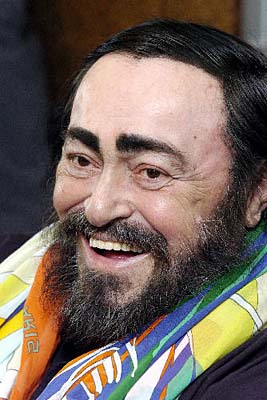 before (for example, here and here) but never about Pavarotti. Luciano Pavarotti was born on October 12th of 1935 in Modena, Italy into a poor family: his father, Fernando, was a baker and his mother a cigar factory worker. Fernando was an amateur tenor (and, according to Luciano, a good one). From an early age Luciano was listening to his father’s recordings of the great Italian tenors: Beniamino Gigli, Tito Schipa, Enrico Caruso, and later those of his hero, Giuseppe Di Stefano. Luciano studied singing in Modena, where one of his teachers, Ettore Campogalliani, also taught his childhood friend, Mirella Freni (Campogalliani also worked with Renata Tebaldi, Renata Scotto, Ruggero Raimondi and Carlo Bergonzi). Rumor has it that Pavarotti never learned to read music. Pavarotti made his debut in 1961 in Reggio Emilia, singing the role of Rodolfo in La bohème. In the next two years he sung in Yugoslavia, Vienna, Moscow and London. While well-received, he wasn’t acclaimed as a future superstar. His break came when Joan Sutherland asked him to join her on an Australian tour, the main reason being that he was tall enough to stand next to her (she was 6’2’’). The grateful Pavarotti later said that he learned the breathing technique from Sutherland during that tour. Pavarotti made his La Scala debut in 1965 in La bohème; Mirella Freni sung the role of Mimi. In 1966 he sung Tonio in Donizetti's La fille du regiment at the Covent Garden, that was when music critics started calling him "King of the High Cs." In 1967 he made his Metropolitan opera debut, again as Rodolfo against’ Freni’s Mimi.
With Joan Sutherland he sung on stage and made numerous recordings; some of these recording became legendary. By the early 1980s Pavarotti’s fame hit its zenith. He sung at the Metropolitan (altogether, he performed in 357 Met opera productions) and at all the major opera houses. (He was banned from the Lyric Opera of Chicago, though, for cancelling 26 of his planned 41 appearances). With Placido Domingo and Jose Carreras he created the “Three Tenors” act which became immensely popular, with the public usually not very interested in opera buying millions of records. Pavarotti maintained his voice for a very long time, though not always on the same level. His last performance at the Met was in March of 2004, when he was 68; he sung the role of Mario Cavaradossi in Puccini’s Tosca and received a standing ovation. In July of 2006 Pavarotti was diagnosed with pancreatic cancer. He died in Modena on September 6th of 2007.
Pavarotti, a lyrical tenor, had a bright and open voice of exceptional beauty which floated, seemingly effortlessly, above a full orchestra. In his New York Times obituary, the chief music critic Bernard Holland wrote: “… he possessed a sound remarkable for its ability to penetrate large spaces easily. Yet he was able to encase that powerful sound in elegant, brilliant colors. His recordings of the Donizetti repertory are still models of natural grace and pristine sound. The clear Italian diction and his understanding of the emotional power of words in music were exemplary.” Pavarotti was especially good in the bel canto repertory and in the Puccini operas, but several of his Verdi roles were outstanding. Here he is in the 1983 Metropolitan production of Verdi’s Ernani. James Levine conducts the Metropolitan Opera orchestra and chorus.
Read more...Giuseppe Verdi - Ernani, from Act II
Luciano Pavarotti (Tenor)
Metropolitan Opera Orchestra (Orchestra)
Metropolitan Opera Chorus (Chorale)
James Levine (Conductor)
Ignacy Jan Paderewski - Caprice-Valse, Op. 10, No. 5
Huiping Cai (Piano)