
Eugène Ysaÿe, 2019
July 15, 2019. Mostly violinists. The famous Belgian violinist and composer, Eugène Ysaÿe was born this week, on July 16th of 1858 in Liège. At the age of seven Eugène entered the Liège Conservatory, dropped out four years later but then returned to graduate with a silver medal. After 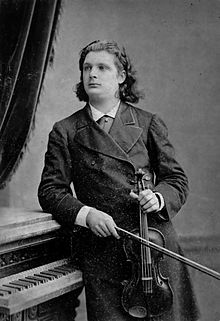 leaving the Conservatory, he took lessons with two of the greatest violinists of the time, with Henryk Wieniawski in Brussels and with Henry Vieuxtemps in Paris. In 1879 he became the concertmaster of the Bilse orchestra in Berlin, that eventually evolved into the Berlin Philharmonic. Anton Rubinstein, the famous Russian pianist and the founder of the Saint Petersburg conservatory, heard him play and helped Ysaÿe with his first contracts as a soloist. After touring several countries, Ysaÿe returned to Paris, already an acclaimed virtuoso. While in Paris, Ysaÿe met many contemporary composers, among them Saint-Saëns, Franck and Fauré. He played at the prestigious Concert Colonne to great success. In 1887 he returned to Brussels to teach violin class at the Conservatory. He was also composing: a quartet and several violin sonatas were his first pieces. Such was his fame that many newly-written compositions were dedicated to him, among them César Franck’s Violin Sonata, Ernest Chausson’s Concert and Poème, Vincent d'Indy's First String Quartet and Claude Debussy’s String Quartet. In 1895 Ysaÿe formed a duo with the French pianist and composer Raoul Pugno which became world famous; he also played with Arton Rubinstein, Ferruccio Busoni, Alexander Siloti and other celebrated pianists of the time. In 1914 Ysaÿe toured the US, again to great success; the time from 1900 to the beginning of WWI was the peak of his career. Ysaÿe had health problems from the age of 50 (he had diabetes, his right foot would be eventually amputated), he also had problems with the right hand and bow control. As his playing deteriorated (which happened rapidly), his performances became rare; he concentrated instead on conducting, composing and teaching. As a teacher, he was extremely influential; among his students were Joseph Gingold, who himself became a famed violin teacher (Gil Shaham, Joshua Bell and Leonidas Kavakos are just three of Gingold’s students); one of the greatest viola players of the 20th century William Primrose, as well as Nathan Milstein, and Jascha Brodsky. Ysaÿe’s influence on the development of the modern style of violin playing is hard to overestimate. Here’s Ysaÿe’s Sonata no. 2, op. 27 for violin solo, dedicated to Jacques Thibaud, Ysaÿe’s friend. It’s performed by Frank Peter Zimmermann
Pinchas Zukerman was born on July 16th of 1948 in Tel-Aviv, Israel. He started his music studies at the age of four, though not on the violin but on the recorder. He then switched to the clarinet and started studying the violin relatively late, at the age of eight. Isaac Stern heard him play in 1962 while in Israel and was very impressed. That year Zukerman moved to the US with Stern becoming his legal guarding and was admitted to the Juilliard. There he studied with Ivan Galamian. He also took classes in the viola. Itzhak Perlman, another Israeli kid, was also Galamian’s student. They became good friends. The pianist Daniel Barenboim, his girlfriend and later wife the cellist Jacqueline du Pré, and the (slightly older) conductor Zubin Mehta also became close friends, forming an incredible group of talented musicians. They worked and recorded together often, in twos and threes (for example, Zukerman recorded all of Beethoven’s Piano Trios with Barenboim and du Pré); there’s even a recording of all five of them playing Schubert’s Trout Quintet. Zukerman went on to become not just a brilliant violinist and violist, but also a conductor, first with the English Chamber Orchestra, then the Saint Paul Chamber Orchestra and later – with the major symphony orchestras.
Isaac Stern, one of the most influential violinists of the 20th century, was born on July 21st of 1920. He deserves a separate entry, and we’ll do it at another date.
Read more...Eugène Ysaÿe - Sonate No.2 In A Minor, Op. 27 No. 2 (A Jacques Thibaud)
Frank Peter Zimmermann (Violin)
Carl Orff, 2019
July 8, 2019. Carl Orff. It’s quite strange, but we’ve never written about a popular, if somewhat controversial, 20th century composer, Carl Orff. Orff was born in Munich on July 10th of 1895; his father came from a line of Bavarian military officers. At the age of five Carl started music 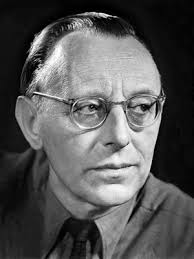 lessons, playing piano, cello and organ. In his youth he became fascinated with two very different composers, Claude Debussy and Arnold Schoenberg; one wouldn’t discern their influence on his mature works but apparently it was more obvious with his early operas, which Orff later dismissed. In 1914 he became the conductor of the Munich Kammerspiele, the state theater. During the Great War Orff was drafted, sent to the front and wounded, after which he spent the rest of the war working at the theaters of Mannheim and Darmstadt. He returned to Munich in 1919 and immersed himself in the music of the 16th and 17th centuries. In 1924 Orff staged Monteverdi’s L'Orfeo; the German text was written by Dorothée Günther, who also did the choreography. Günther, an artist and pedagogue, became Orff’s collaborator in many endeavors. It was the first such production in modern German history. Around that time Orff got interested in the concept of elementare Musik, or elemental music, understood as the synthesis of music, gesture/dance and spoken poetry. In 1924 these ideas led Orff and Günther to establish the Güntherschule, a school for gymnastics, music and dance. Orff composed a number of short simple pieces for the school, which in 1932-35 were published as Schulwerk: elementare Musikübung. Here’s the easily recognizable Gassenhauer (it was used in many movies, including Terrence Malick’s Badlands).
In 1935-36 Orff composed a cantata based on a collection of poems from the 11th and 12th centuries called Carmina Burana, or "Songs from the town of Benediktbeuern" (Buria in Latin). It was premiered at the Frankfurt opera on June 8th of 1937 and became an immediate success, both with the public and officials, in the Nazi Germany. The music and especially the old texts managed to encapsulate the zeitgeist: the Nazis, avid environmentalists, worshipped nature, and so did the poems of Carmina Burana. Same with the idyllic “folk” of the poems and Nazi historic myths. The music, while influenced by Stravinsky (not a Nazi favorite), was simple in structure, pulsating with energy and forward-moving. It became a symbol of the party-approved modernism. Here’s the opening section, O Fortuna (the closing is a repeat). As Gassenhauer, it’s beenused in popular culture to no end. The recording was made by the London Symphony Orchestra with St. Clement Danes Grammar School Boys’ choir under the direction of André Previn.
In 1939 Orff was involved in a morally questionable episode. The Nazis leadership of the city of Frankfurt decided to replace Midnight Summer’s Dream composed by the outlawed (Jewish) Mendelssohn with an Arian piece. Orff responded to the official call and presented his version. In 1943 he composed another cantata, Catulli Carmina, set to the verses of the Latin poet Catullus. It became his second most popular work. In 1951 he followed with Trionfo di Afrodite which, with Burana and Catulli formed a triptych. To the end of his life Orff was involved with music education. He died in Munich on March 29th of 1982.
So, what are we to think about Orff? Obviously, he isn’t guilty of the Nazis loving his Carmina Burana. He never joined the Nazi party, and had Jewish and leftist friends. On the other hand, to submit his own version of the Midsummer Night’s Dream to replace Mendelssohn’s – that’s something you wouldn’t expect from a decent person. He also composed the music for the 1936 Berlin Olympic Games – only a composer with good standing with the Nazis could be given such a role. On the other hand, he composed the music for the 1972 Munich Olympics as well. He went through the de-Nazification process after the war and was cleared of any direct collaboration. Still, after reading about him, one is left with a bad taste in the mouth. A talented but compromised figure.
Read more...Carl Orff - O Fortuna, from Carmina Burana
London Symphony Orchestra (Orchestra)
St Clement Danes Grammar School Boy's choir (Chorale)
André Previn (Conductor)
Carl Orff - Gassenhauer, from Schulwerk
Carl Orff (Conductor)
Lamwoc - Piano Sonata no. 1 in A minor
Andreas Knudsen (Piano)
Gluck and more, 2019
July 1, 2019. Gluck and more. We should’ve written about Gustav Mahler as his birthday falls on next Sunday, July 7th: we are good internationalists and start our week on Monday, so it would 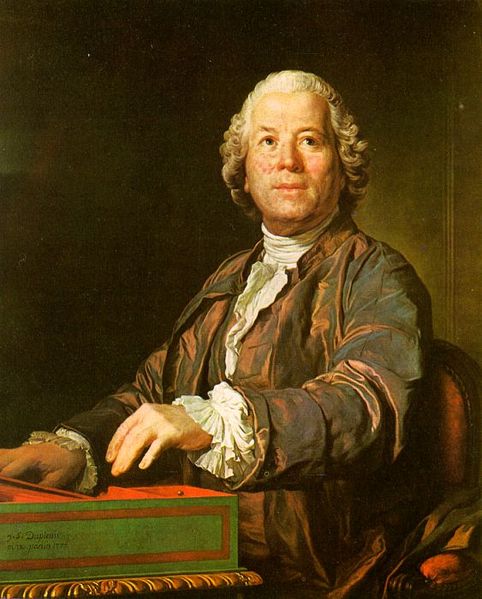 be still this week for us; however, we’ll do it in our next entry. In the meantime, we’ll remember Christoph Willibald Gluck, who was born on July 2nd of 1714 in Erasbach, a small town in Upper Palatinate, now in Bavaria. Here’s what we wrote about Gluck on his 203rd birthday anniversary; we ended our entry with Gluck settling in Vienna in 1751: “The most productive, but also the most disappointing period of his life was still ahead of him.” Gluck’s early years in Vienna were quite promising: he became the Kapellmeister to Prince Joseph of Saxe-Hildburghausen. He also taught music to Maria Antonia Habsburg, the younger daughter of Empress Maria Theresa and, as Marie Antoinette, the future queen of France. Gluck was also composing; some of his operas were performed at the Prince’s palace theater for the Emperor’s family. In 1761 Prince Joseph disbanded his orchestra and Gluck’s permanent employment was gone. This was the period during which Gluck was thinking about changing the opera. He wanted it to develop more naturally, without convoluted plots of the Italian opera seria. He didn’t like repetitions, so numerous in the baroque opera, its “da capo” arias, in which the third part duplicates the first. He wanted to get rid of the improvisations, the staple of the famous castrati. Overall, to think of it, what Gluck wanted to accomplish around 1760 was very much what Richard Wagner would do a century later. Gluck didn’t just muse about these things, he put them in writing (together with his librettist, Ranieri de' Calzabigi) in the published dedication and the preface to his opera Alceste. In that he also reminds us of Wagner who wrote extensively about the opera.
In 1762 Gluck composed what would become his most famous opera, Orfeo ed Euridice. It followed some of his own “reform” principles: a straightforward libretto, rather than cockamamie plots of the opera seria; fewer repetition in music and text, no long “melismas,” when a syllable is stretched over several notes (Handel and many other baroque composers were fond of them). Orfeo ed Euridice was premiered in Vienna’s Burgtheater on October 5th of 1762. Gaetano Guadagni, a famous castrato, sung the title role. Between 1762 and 1770 Gluck wrote eight operas. Somewhat disenchanted with the Italians, Gluck turned to the French, studying the works of Lully and Rameau (Rameau had died recently, in 1764). A French diplomat suggested to him a libretto based on Racine’s tragedy Iphigénie en Aulide. Gluck got interested; he also wanted it to be staged in Paris. When he sent the score to the Académie Royale de Musique (now, the Paris Opera), the directors rejected it. Gluck turned to his former pupil, now the Dauphine of France, wife of the heir to the French throne, Marie Antoinette. Soon after (it was the end of 1773), Gluck was on his was to Paris to start the rehearsals of his newest creation.
We’ll mention several important musicians born this week and will write about them separately: Vladimir Ashkenazy, the pianist and conductor, was born on July 6th of 1937 in Moscow. He won (together with John Ogdon) the 1962 Tchaikovsky Piano Competition, and, being married to an Islandic woman, left the Soviet Union in 1963. Ashkenazy has a broad piano repertoire, from Bach and Shostakovich to Beethoven (all sonatas), complete piano works of Chopin, Rachmaninov, Scriabin and Schumann; all piano concertos by Beethoven and Brahms, and more. He’s also a prominent conductor.
János Starker was born on July 5th of 1924 was one of the most interesting cellists of the 20th century. Starker died six years ago, on April 28th of 2013. Carlos Kleiber, the son of Erich Kleiber, was born on July 3rd of 1930; he was regarded by many as one of the greatest modern conductors.
Read more...Franz Liszt - Mephisto Waltz no. 1
Brian Lam (Piano)
Franz Schubert - Three Klavierstücke, D. 946
Brian Lam (Piano)
Johannes Brahms - Piano Concerto No. 2 in B-Flat Major, Op. 83, Mov. 1. Allegro non troppo
Leon Fleisher (Piano)
Cleveland Orchestra (Orchestra)
George Szell (Conductor)