
Giovanni de Macque - Gagliarda Prima
Rinaldo Alessandrini (Harpsichord)
Wagner, Alicia de Larrocha 2019
May 20, 2019. Wagner, Alicia de Larrocha. Richard Wagner was born on May 22nd of 1813. For some years we’ve been following Wagner’s life thru his operas; two years ago we arrived at 1848, the year Wagner started working on the monumental Der Ring des Nibelungen. It is 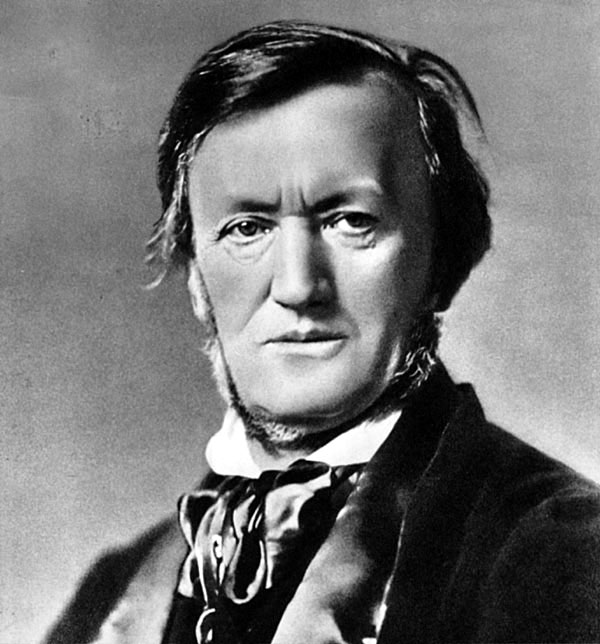 hard to imagine, but during the years leading up to the Revolution of 1848 Wagner was involved in left-wing politics. He was living in Dresden and active among the local socilaists; he knew Mikhail Bakunin, the famous anarchist, and read Ludwig Feuerbach, a philosopher important in Marxist thought. Wagner participated in the May 1848 uprising and had to flee Germany to avoid arrest. He settled in Zurich, lonely and poor, existing mostly on small funds provided by his friends. While he did finish Lohengrin, very little music was composed in the next several years. What Wagner was writing were articles: some on the art of opera, but also the dreadful Judaism in Music, the first of his many antisemitic pieces. An influential Opera and Drama expounded the concept of music drama and “total work of art,” which he subsequently used in Der Ring. Wagner wrote librettos to all of his operas; first he would create a rough sketch, then a draft in prose, for the Ring he would also versify it in alliterative form, the style of old German legends. Sometime around 1848 Wagner started working on a libretto about the mythical German hero, Siegfried, which he planned to call Siegfried's Death.
He read many ancient German and Norse sagas (he had some knowledge of Old Norse and Middle German) and commentaries written by the Grimm brothers. Eventually he decided to expand the project to two or three operas; but ultimately it became four: Siegfried's Death turned into the last opera in the tetralogy, Götterdämmerung, or Twilight of the Gods. The preceding three librettos were finished and named in 1852; they were Das Rheingold (The Rhine Gold), which serves as the prologue; Die Walküre (The Valkyrie), and Siegfried. The librettos were written in reverse chronological order, Das Rheingold coming in last. The music, on the other hand, was composed more or less in the order the operas are presented: even though some music for Die Walküre was composed earlier, Das Rheingold was the first one to be finished, in January of 1854 (Die Walküre was completed two years later). It was premiered in Munich in September of 1869 against the wishes of Wagner, who preferred to stage the complete tetralogy (Götterdämmerung was finished only in 1874). The Bayreuth premier took place in August of 1876, in the newly built theater, the Bayreuth Festspielhaus. We have a sample of the Prelude to Act I (here); about two and a half hours later, in the final scene, Wotan leads the gods into his newly built castle-fortress, Valhalla (Zubin Mehta conducts the New York Philharmonic Orchestra in this 1983 recording).
The great Spanish pianist, Alicia de Larrocha was born on May 23rd of 1923 in Barcelona. She gave her first performance at the age of five and played a Mozart concerto with the Madrid Symphony Orchestra at 11. Alicia de Larrocha studied with Frank Marshall, a pupil of Granados, and later became the director of the Marshall Music Academy. She was an incomparable performer of the music of Spanish composers, especially Albéniz and Granados. She was short in stature (4’9”) and had small hands but played all the “big” concertos (her hands had good stretch). In the second half of her career she played Mozart more often. Here is Mozart’s Piano Sonata, K.570 in B-flat major.
Read more...Wolfgang Amadeus Mozart - Piano Sonata, K.570 in B-flat major
Alicia de Larrocha (Piano)
Richard Wagner - Das Rheingold, Entry of the Gods into Valhalla
New York Philharmonic (Orchestra)
Zubin Mehta (Conductor)
Monteverdi, Satie, Klemperer 2019
May 13, 2019. Monteverdi, Satie, Klemperer. One of the most important composers in the history of European music, Claudio Monteverdi was born on May 15th of 1567 in Cremona. 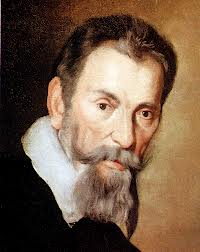 Rarely can we associate historically significant musical or esthetic developments with just one person, but Monteverdi is one of them: early in his life he wrote wonderful madrigals in the style of late Renaissance, and then transitioned to what we now call Baroque. In the process, he practically invented a new art form, the opera. You can read about him here, here and here. As a musical excerpt, we have his Lament of Arianna. We know it as a madrigal from Book Six, published in Venice in 1614, but originally it was composed or his early opera Arianna, now lost. Here it is performed by the Concerto Italiano under the direction of Rinaldo Alessandrini.
In some sense, Erik Satie, born on May 17th of 1866 in Honfleur to a French father and Scottish mother, was the opposite of Monteverdi: his musical output was slim (he’s mostly remembered for his Gymnopédies and Gnossiennes), his influence coming as much from his personality as his music. Satie was an eccentric (he ate only white-colored food, carried a hammer for protection and was involved in the occult). Still, he knew and was known to “everybody” of significance in the pre-WWI Paris. He had a long affair with Suzanne Valadon, a painter and mother of Morice Utrillo, was good friends with Ravel and Debussy and influenced Les Six. Later he got involved with the Dadaists and Surrealists. And, of course, he paved the way for the Minimalists. Here are three Gymnopédies, each about three and a half minutes long, performed by Jean-Yves Thibaudet, the Frenchman who recorded all piano works by Satie.
Otto Klemperer, one of the greatest conductors of his generation, was born on May 14th of 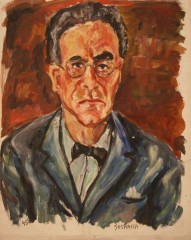 1885 in Breslau, Germany (now Wrocław, Poland). In 1905 he met Mahler, who helped Klemperer to get the conducting position at Neues Deutsches Theater in Prague, which launched Klemperer’s conducting career. He went on to conduct at several important opera houses; in 1927 he was appointed the music director of the Kroll Opera, a branch of the Berlin Staatsoper, created to promote contemporary music. There he conducted new operas by Stravinsky, Schoenberg, Hindemith and Janáček. Some of the Kroll Opera’s Wagner productions were so innovative that they affected the Bayreuth enactments half a century later. During that time, Klemperer also conducted the Kroll Concerts, where he performed significant contemporary pieces. In 1931 the Kroll Opera closed for lack of financing, but Klemperer remained at the Staatsoper. In 1933 the Nazis took over and Klemperer, who was Jewish, emigrated to the US. His first appointment was with the Los Angeles Philharmonic; his tenure there brought critical acclaim, but he wasn’t comfortable in Southern California, he preferred the East coast. He played several concerts with the New York Philharmonic, but when, in 1936, the position of Music Director opened with the departure of Arturo Toscanini, the orchestra board engaged John Barbirolli and, later, Artur Rodziński. Klemperer was hugely disappointed; he remained with the LA Phil till 1939 when a tumor was found in his brain. It was successfully removed but left Klemperer unable to conduct for several years. After the war he made several recordings with the newly created Philharmonia Orchestra in London and in 1959 was appointed its “Director for life.” He had a wonderful relationship with the musicians and made several remarkable recordings of Beethoven and Mahler’s symphonies. Klemperer died in Zurich on July 6th of 1973. Here’s the first movement of Beethoven’s Sixth Symphony, recorded in 1957. Otto Klemperer conducts the Philharmonia Orchestra.
Ludwig van Beethoven - Symphony No. 6 in F major, Op. 68 ("Pastoral"), 1st mov.
Philharmonia Orchestra (Orchestra)
Otto Klemperer (Conductor)
Erik Satie - Trois Gymnopédies
Jean-Yves Thibaudet (Piano)
Aaron Alter - For Fred (West Coast Premiere)
Batya MacAdam-Somer (Violin)
Kyle Adam Blair (Piano)
Aaron Alter - Vanilla, Chocolate and Strawberry - Big Band version - World Premiere in New York
CompCord Big Band (Ensemble)
Giovanni de Macque - Cantan gl'augelli
Gesualdo Consort Amsterdam (Ensemble)
Henry van de Kamp (Conductor)