
Jean-Philippe Rameau - Le Rappel des Oiseaux, from Suite for Keyboard in E
Samuel Deason (Piano)
Rachmaninov, 2017
April 2, 2017. Rachmaninov. Anybody who pays attention to the musical calendar could accuse us of being prejudiced against Sergei Rachmaninov. Last week we wrote about Antonio de Cabezón, a somewhat obscure Spanish composer of the 17th century with a questionable birth 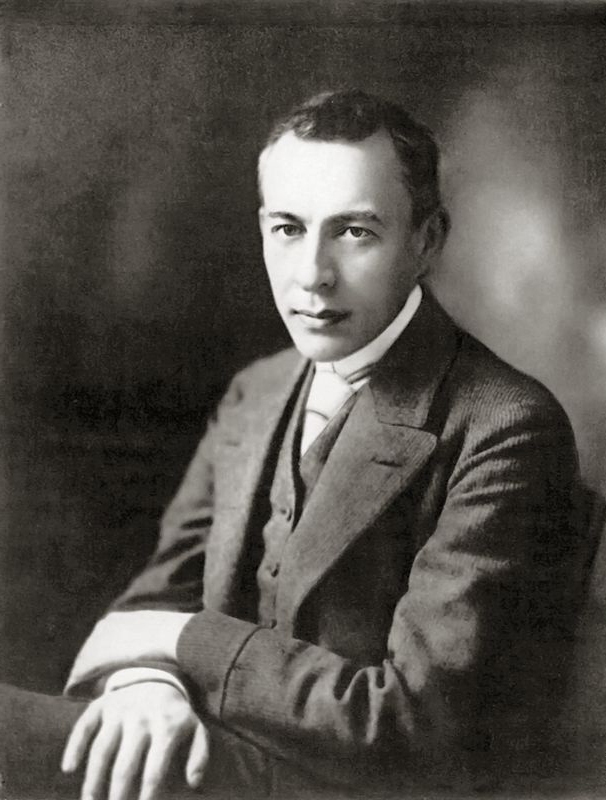 date instead of writing about Rachmaninov, one of the most popular composers of the 20th century who was definitely born on April 1st. And a year ago, we wrote about Johann Kuhnau, Bach’s predecessor as Thomaskantor in Leipzig, but again, not about Rachmaninov. Fortunately, it seems that among our listeners there are not too many sticklers for historical detail. We’re not trying to avoid Rachmaninov: he was a great composer, even if perception of his music has been changing over the years (but of course that also could be said about any composer of note). He was not a pathbreaker; his musical idiom came straight from the 19th century Russian tradition. Still, the totality of his work is original, he was a wonderful melodist and had a great sense of form. And, in additional to all that, he was one of the greatest pianist of the first half of the 20th century!
His life, as lives of so many Russian artists who lived through the Revolution, was broken in two: the Russian part and the exile. Rachmaninov was born on April 1st (or March 20th, old style) of 1873 on a family estate in the Novgorod province of northern Russia. His family was quite rich in the previous generations, but his father had squandered much of the wealth, leaving them just one estate at Oneg, and even that would be lost soon after. Rachmaninov, who received early piano lessons from his mother, was sent to the St.-Petersburg conservatory. Things did not go well there, and he transferred to Moscow to study with Nikolay Zverev. Lacking fund for his own place, he lived in his teacher’s apartment. That was providential, as that’s where he met many musicians who were influential in his development: Anton Rubinstein, Taneyev, Arensky, and, most
importantly, Tchaikovsky. Taneyev and Arensky became his teachers at the Conservatory; he also took piano classes with a cousin 10 years his elder, Alexander Siloti (Siloti, a pupil of Nikolai Rubinstein, Tchaikovsky and Liszt, a virtuoso pianist and conductor, would also emigrate to the US after the Revolution). For a while Rachmaninov continued living with Zverev, but in 1888 moved in with his relatives, the Satins. Satins had an estate, Ivanovka, near Tambov, deep in the Russian provinces. Rachmaninov fell in love with the place; that’s where he would do most of his composing (Mahler at Steinbach or Maiernigg comes to mind). That’s were, in 1891, at just 18 years old, he wrote the First Piano concerto, his first major work. Rachmaninov fell in love not just with the place, he also fell in love with one of the Satins, the young Natalia. They were first cousins (Natalia’s mother was the sister of Sergei’s father) and therefore needed special permission to marry: in the end, a petition had to be sent to the Czar and was granted. They married in 1902 and stayed together till Rachmaninov’s death in 1945.
In 1892, as a graduation work at the Conservatory, he wrote Aleko, a one-act opera based on Pushkin’s poem The Gypsies. It was premiered in the Bolshoi a year later, with Tchaikovsky attending. Some year later Chaliapin sang in it and it’s still being staged today, if not very frequently. At the conservatory, the opera was awarded the highest mark, with Rachmaninov receiving the great Gold Medal.
Here’s Rachmaninov’s Piano Concerto no. 1, op. 1 in a brilliant performance by Krystian Zimerman. Seiji Ozawa conducts the Boston Symphony Orchestra. You cannot compare it to the Second and Third concertos but Rachmaninov’s melodic gifts are obvious, as is the wonderful mix of lyricism and energy.
Read more...Sergei Rachmaninov - Piano Concerto no. 1 in F sharp minor, Op. 1
Krystian Zimerman (Piano)
Seiji Ozawa (Conductor)
Boston Symphony Orchestra (Orchestra)
Franz Liszt - Étude No. 6 in A minor, from Grandes études de Paganini
Riyad Nicolas (Piano)
György Ligeti - Fanfares, from Études for Piano
Riyad Nicolas (Piano)
Alexander Scriabin - Sonata No. 5 in F-sharp Major, Op. 53
Riyad Nicolas (Piano)
Wolfgang Amadeus Mozart - Piano Sonata No. 14 in C Minor, K. 457
Riyad Nicolas (Piano)
Cabezón and Haydn, 2017
March 27 2017. Cabezón and Haydn. Antonio de Cabezón, one of the most important keyboard composers of the Spanish Renaissance, was born on March 30th of 1510 (or at least that is traditionally assumed to be his birth date). The year 1510 makes him the exact contemporary of Flemish composers Tielman Susato and Jacob Clemens non Papa; on the Spanish music timeline,  Cristóbal de Morales was five years older and Tomás Luis de Victoria - a generation younger. Little is known about Cabezón: he was born in a small town in northern Spain not far from Burgos, and was blind from childhood. In 1526 he entered the service of Queen Isabella of Portugal, wife of Charles I, king of Spain, who as Charles V, the Holy Roman Emperor, became the most powerful ruler in Europe. At the court, Cabezón was employed as an organist and clavichord player. In 1538 he was appointed the chamber musician to Charles himself. Later, Cabezón became the music teacher to Prince Felipe, the future king of Spain, and accompanied him on his travels to Italy, the Netherlands, Germany and London. Cabezón’s music influenced many composers, especially English ones, such as Thomas Tallis and William Byrd. Here’s is a short piece by Cabezón called Pavana con su glosa, it’s performed by the ensemble Capella Virelai. And here is one of his Quatro favordones, variations that so affected his English audiences. Hamonices Mundi is conducted by Claudio Astronio.
Franz Joseph Haydn, born on March 31st of 1732, was one of the greatest, if sometimes underappreciated, composers ever. We’ve written about him many times, and will write more. Haydn was extremely prolific, writing in every musical genre known in his time. He composed 104 symphonies, more than 60 quartets, 62 piano sonatas, trios, concertos, wonderful cantatas and even operas, written for Esterházy’s enjoyment. In 1790, Prince Nikolaus Esterházy died; his successor, Prince Anton wanted to save money and wasn’t interested in music as much as his father. He formally retained Haydn at a smaller salary but allowed him to travel, something Haydn was longing to do for quite some time. Johann Peter Salomon, an impresario and a fine violinist, arranged a trip to London, where Haydn’s music was very popular. Haydn, travelling with Salomon, left Vienna on December 15th of 1790. They crossed through Germany and arrived in Calais, France. On New Year’s Day of 1791 they sailed to Dover. “I stayed on deck during the entire crossing so as to gaze my fill of that great monster, the ocean,” he wrote in a letter. Haydn had never seen the ocean before. They arriving in London on January 2nd. Haydn was welcomed with great enthusiasm. The papers printed news about him, he was invited to many noble houses, the Prince of Wales (the future King George IV) became a patron. Haydn found many pupils for his piano lessons, again mostly from amoung the nobility. His music was widely performed, and of the three latest symphonies, nos. 90 through 92, the last one became a favorite. London, the largest city in Europe, was full of musicians from different countries, from the French escaping the Revolution to the ever-migrating Italians and Germans. The orchestras were large, larger than in Vienna or in Eszterháza. At the beginning of Haydn’s employ, the orchestra at Eszterháza consisted of just 14 players, which was quite enough for the smaller halls of the palace. Later the number grew to about 25. In London, orchestras were at least 40 players strong, and sometimes consisted of 60 musicians. Even though Haydn didn’t have much time to compose, during the following year he wrote six symphonies, nos. 93-98, all of amazing quality. We know them now as his “London symphonies.” Here’s Carlos Kleiber conducting the Vienna Philharmonic in a live 1982 recording of Symphony no. 94, “Surprise.”
Read more...Franz Joseph Haydn - Symphony no. 94, "Surprise"
Vienna Philharmonic Orchestra (Orchestra)
Carlos Kleiber (Conductor)
Jean-Philippe Rameau - Musette en Rondeau, from Suite for Keyboard in E
Samuel Deason (Piano)