
George Oakley - Shakespeare Sonnet No. 111 for Soprano and Piano
Inga Kashakashvili (Piano)
Mary Mackenzie (Soprano)
George Oakley - Shakespeare Sonnet No. 56 for Piano and Soprano
Inga Kashakashvili (Piano)
Mary Mackenzie (Soprano)
George Oakley - Toccata
Inga Kashakashvili (Piano)
Sergei Rachmaninov - Suite No. 2 for Two Pianos, Op. 17
Inga Kashakashvili (Piano)
George Oakley (Piano)
George Oakley - Nocturne
Inga Kashakashvili (Piano)
George Oakley - Sonata for Cello and Piano
Inga Kashakashvili (Piano)
Jay Campbell (Cello)
An Evening of Classical and New Music
10/01/2016 20:00, Carnegie Hall
An Evening of Classical and New Music is a chamber recital for Cello and Piano that explores the traditions of classical and romantic music, represented by Beethoven and Schumann, and their influence onSonata for Cello and Piano by Oakley. The concert will premiere Stabat Mater for choir and harp, written exclusively for the Nikolai Kachanov Singers by Oakley. It is inspired by the music of the medieval period.
This concert will be the US premiere for Georgian cellist Lizi Ramishvili
Program
Beethoven - Sonata for Cello and Piano in D major, op. 102 No.2
Schumann - Fantasiestücke, op. 73
Oakley — Stabat Mater for harp and chorus
Oakley — Sonata for Cello and Piano
Artists
Inga Kashakashvili, Piano
Lizi Ramishvili, Cello
Tomina Parvanova, Harp
Nikolai Kachanov Singers
Tomaso Vitali - Ciaconna / Chaconne in g for Violin and Orchestra
Naoko Matsui alias Goryo Goryokaku (Violin)
Fernando Romano (Conductor)
Orfeo Stillo Orchestra (Orchestra)
Mahler, Symphony no. 4
July 4, 2016. Mahler, Symphony no. 4. Gustav Mahler was born on July 7th of 1860, and to celebrate his birthday we will again turn to one of his symphonies, this time the Fourth. Mahler started working on the Fourth Symphony in 1899. 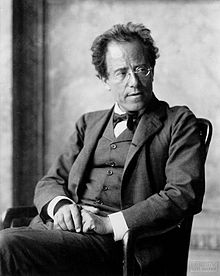 By then he had moved from Hamburg to Vienna, having received the appointment to the Vienna Hofoper (the Court opera theater) in 1897. To be even considered for the position, he had to convert to Catholicism: as liberal as the Emperor Franz Joseph was, to have a Jewish conductor of the main opera was unthinkable. Mahler, an agnostic, had no qualms: the ceremony took place on February 23, 1997. In April he started as the Kapellmeister and in September of the same year Mahler was promoted to director. He understood that his position would not be easy: much of the Viennese public and a good number of music critics were anti-Semitic, and didn’t care about Mahler’s conversion. One of the leaders of the anti-Semitic camp was the very popular mayor, Karl Lueger, who also founded the Austrian Christian Socialist party, a precursor of the German National-Socialists (Lueger was a very efficient administrator, and is credited with transforming Vienna into a modern city; still, the fact that a monument to him still stands in the center of Vienna in a square called Doktor-Karl-Lueger-Paltz is inconceivable). In financial terms, Mahler’s life became quite comfortable. He rented a large apartment on Auengruggergasse, number 2, a building next to the Belvedere Gardens (it was designed by Otto Wagner, the leading Art Nouveau architect).
For the first two years in Vienna Mahler was so involved with the Opera that there was no time for him to compose. A perfectionist, he rehearsed every production for many weeks at a time and was very demanding, overseeing all aspects of every production. That didn’t endear him to the singers and the orchestra. On the other hand, the repertory and the quality of the opera house improved dramatically. The first opera to be staged under Mahler’s direction was Wagner’s Lohengrin; Mozart‘s Die Zauberflöte followed. Both were a huge success. Mahler also took over the subscription concerts of the Philharmonic, which were previously lead by the famous conductor Hans Richter. There were days when he conducted a symphony concert during the day and an opera in the evening. The workload was enormous and stressful. He was also affected by the plight of his close friend Hugo Wolf, who, suffering from the late stages of syphilis, fell into dementia and was sent to an asylum. With a long concert and opera season fully consumed by directing and conducting, the summer months became very important to Mahler as the time to unwind and, more importantly, to compose. In the summer of 1899 Mahler rented a summer-house in Steinbach on lake Altaussee, not far from Salzburg. A fashionable resort, it was frequented by writers and journalists, such as Hugo von Hofmannsthal and Theodor Herzl. It wasn’t his first visit to Steinbach: there he composed parts of the Second and Third Symphonies. He even built a “composing hut” there, to seclude himself from the summer crowd. It was in Steinbach that Mahler started working on his Fourth Symphony. The pattern – conducting and directing during Vienna’s musical season and composing during the summer months – was firmly established the next year, when Mahler decided to go to the village of Maiernigg on lake Wörthersee in Carinthia. Eventually he would build a small hut there as well so that he could compose without being interrupted. The Fourth Symphony was completed that summer. It’s the last of the so-called Wunderhorn symphonies: every one of the first four incorporates some music from the Des Knaben Wunderhorn collection, Mahler’s setting of German folk poems. In the case of the Fourth symphony, it’s the song, "Das himmlische Leben" (“The Heavenly Life”), originally written in 1892, that Mahler re-orchestrated into the fourth movement of the symphony. Here it is, with Claudio Abbado conducting “Mahler’s own” Vienna Philharmonic Orchestra; Frederica von Stade is the mezzo soprano.
Read more... « first ‹ previous … 278 279 280 281 282 283 284 285 286 … next › last »
Richard Danielpour - There's a Ghost in My Room!
Inga Kashakashvili (Piano)