
michael moore - the great whale
michael moore (Orchestra)
Beethoven, Symphonies nos. 1 and 2
November 16, 2015. Beethoven's Symphonies nos. 1 and 2. Today we're publishing an essay on Ludwig van Beethoven's two early symphonies. To illustrate, we use the recordings made by the Orchestra of the Eighteenth Century, Frans Brüggen conducting (Symphony no. 1) and London 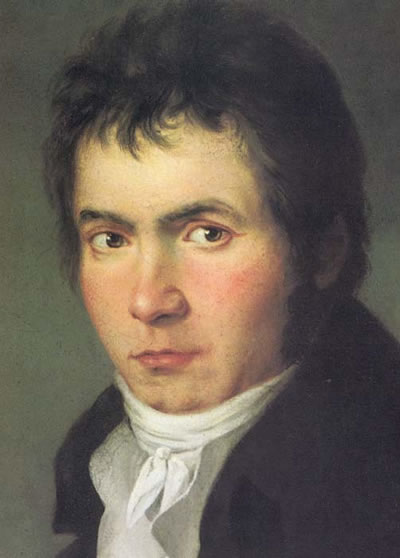 Symphony Orchestra under the baton of Josef Krips (Symphony no. 2). ♫
Beethoven and the symphony are nearly synonymous. It is impossible to speak of one without discussing the other. In short, the symphony was one of the genres of instrumental composition that was radically transformed at the mighty hands of Beethoven. Everything before him seems but a prelude; everything after, as Richard Wagner commented, an “epilogue.”
The symphony, as a musical composition, traces its roots to the waning years of the Renaissance. The term itself is far older—originating from the Greek “symphonia,” meaning “agreement or concord of sound.” The earliest pieces that bore the title of “symphony” were works by composers such as Giovanni Gabrieli, Andriano Banchieri, and Heinrich Schütz. These works were all sacred vocal compositions with or without instrumental accompaniment. As the Baroque period reached its maturity, the “symphony” or “sinfonia” was applied to a wide range of instrumental compositions from operatic overtures to keyboard pieces (Bach’s three-part inventions were called “Sinfonias”). By the 18th century, the Italian overture had developed into a well-defined form of three contrasting movements—fast, slow, fast—and is generally considered to be the immediate progenitor of the modern symphony.
As the Baroque period faded, the symphony became one of the hallmarks of the burgeoning Classical period. Pioneered by composers such as Sammartini, Wagenseil, von Dittersdorf, and Stamitz, it reached the brink of maturity in the works of Haydn and Mozart. Slowly, the four-movement form common since the 19th century replaced the inherited three-part design of the Baroque. Symphonies became an increasingly prominent fixture of public life and were thus written at a profuse rate (Haydn composed 107, and Mozart at least 47), fueled in large part by the musical establishments maintained by the aristocracy and the competition that resulted amongst them.
With Beethoven the fullest potential of the symphony was realized. Not writing for any court, Beethoven was free to develop the symphony into a vehicle for his artistic will. With the exception of Haydn and Mozart, the symphony had generally been the product of artisans throughout the Classical period. Beethoven made it the domain of artists—a blank canvas for the composer to envision the highest potential of his art. He adopted the symphonic design of his predecessors but vastly expanded the breadth and scope of each individual movement. His most well-known contribution is, of course, the transformation of the old Classical Minuet into the Scherzo, which became the dance movement of choice in virtually every multi-movement design throughout the Romantic period. The outer movements became more profound, not to mention larger, with every aspect developing out of their basic motives. In accordance with this change, coda sections also were greatly expanded, and became in essence added "developments" in which musical ideas were further explored. Lastly, within his slow movements, Beethoven plunged the depths of the human soul and soared into the heights of heaven.
Beethoven's radical transformations touched virtually every symphonist for the next century. Schubert quickly followed in his idol's footsteps, culminating his symphonic output with the severe pathos of his Unfinished Symphony and the colossal grandeur of his "Great" C major Symphony. Berlioz developed further on the programmatic elements of Beethoven's Pastoral Symphony, creating dramatic and ground-breaking works such as the Symphonie fantastique and the Roméo et Juliette Symphony. Following Schubert's death, the banner of German symphonism was carried by Mendelssohn and Schumann, and ultimately passed to Johannes Brahms. Brahms introduced his own innovations, supplanting the Scherzo with his characteristic Intermezzi in three of his four symphonies, while introducing the archaic passacaglia as an effective Finale in his Fourth. Yet, one can certainly find within them the hand Beethoven, particularly in his First Symphony. Anton Bruckner, forced to work in Brahms's shadow, created gargantuan symphonies that are certainly influenced by both Beethoven and Wagner. Mahler was a natural successor. His enormous symphonies stretch the form even further and one cannot miss his imitations of Beethoven's immortal Choral Symphony (continue here).
Read more...Ludwig van Beethoven - Symphony no. 2 in_D Major Op. 36
London Symphony Orchestra (Orchestra)
Josef Krips (Conductor)
Ludwig van Beethoven - Symphony No. 1 in C Major, Op. 21
Orchestra Of The 18th Century (Orchestra)
Frans Brüggen (Conductor)
michael moore - mercury in the underworld
michael moore (Orchestra)
michael moore - the worship of neptune
michael moore (Orchestra)
michael moore - saturnine
michael moore (Orchestra)
Sergei Rachmaninov - Prelude Op. 23, No. 2 in B-flat Major
Steven Vanhauwaert (Piano)
Sergei Rachmaninov - Prelude Op. 23, No. 1 in F-Sharp minor
Steven Vanhauwaert (Piano)
michael moore - Evolution of stars
michael moore (Orchestra)