
Dieterich Buxtehude, 2015
November 30, 2015. Dieterich Buxtehude. Throughout the Renaissance, what we know as “vital records” were kept mostly by churches, but those were not always well organized: the baptismal date of a child born into nobility would be recorded, but not necessarily that of a poor one. As very few of the composers of the period came from the nobility (Carlo 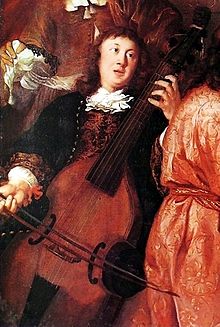 Gesualdo being a notable exception), we don’t know when such giants of early music as Guillaume Dufay, Josquin des Prez, Giovanni Pierluigi da Palestrina or Orlando di Lasso were born. Lapses occurred even much later: Jeremiah Clarke, a famous English baroque composer, was born in 1674, but exactly when we don’t know. The story is even murkier with Dietrich Buxtehude: not only don’t we know when was he born, we’re not even sure in which country. The name Buxtehude seems to suggest that the family came from the town of Buxtehude, not far from Hamburg, but at some point the Buxtehudes moved to Denmark. Most historians believe that Dietrich was born around 1637, maybe in Helsingborg, formerly Danish and now a Swedish town, or in Elsinore on the Danish side of the sound -the town famous for its castle where Shakespeare set his Hamlet. Dietrich’s father was an organist, and most likely his first music teacher. We do know that in 1668 Dietrich Buxtehude settled in Lübeck: the position of organist of Marienkirche, one of the most important in Northern Germany, became vacant, and Buxtehude applied, as did several other organists. Marienkirche, built in 1250, an imposing Gothic structure, had two organs: the great organ originally built in 1516, probably the largest gothic organ in the world, and a smaller “Dance Macabre” organ, located in the transept – it was called “Dance macabre” for a famous painting of the same name that hung in the transept. Unfortunately, both organs, as well as the painting, were destroyed in 1942 during the bombing of the city by the British air force. The bombing created a huge firestorm, which devastated a large part of the historical center; even the famous bells of Marienkirche partially melted down and fell to the floor, breaking into pieces.
Buxtehude was selected as the organist on April 11th of 1668 and two months later became a citizen of Lübeck. Buxtehude’s official duties at Marienkirche required him to compose and play music during Sunday services and major holidays. In addition to his religious duties, he directed concerts known as Abendmusic, which took place in the same church. These concerts featured mainly organ music and, after Buxtehude took over, orchestral and choral music. The concerts became very popular among Lübeck’s bourgeois and known even outside the city. Buxtehude composed several oratorios for Abendmusic, most of which were, unfortunately, lost. He lived in Lübeck for the rest of his life, an eminent citizen and “music director” for the city. In 1699, Pachelbel dedicated his Hexachordum Apollinis to Buxtehude. In 1703 the young Handel visited him, and three years later, in 1706, Bach came “in order to learn one thing and another about his art,” according to theArnstadt records. It’s very likely that Bach was present at at least two Abendmusic concerts. Buxtehude died on May 9th of 1707 and was buried in Marienkirche.
Buxtehude composed more than 100 cantatas, but his most important work was written for the organ. Here, for example, is Prelude in G minor. The influence he had on Johann Sebastian Bach seems rather obvious. The organist is Ton Coopman, who, after recording all works of Bach, embarked on the Buxtehude Project, recording the complete works of Bach’s predecessor. The project was successfully finished in 2014. The portrait of Buxtehude, above, is from a painting by the Dutchman Johannes Voorhout. It was made in 1674.
Read more...Mischa Zupko - "Rising" for violin and piano
Mathias Tacke (Violin)
Kuang-Hao Huang (Piano)
Dietrich Buxtehude - Prelude in G minor, BuxWV 149
Ton Koopman (Organ)
Johann Sebastian Bach - Suite Nr.3 for Solo Cello Bourrée
Brian Dempsey (Cello)
Nine composers, November of 2015
November 23, 2015. Nine composers of note were born this week, starting with Jean-Baptiste Lully, who was born in Florence on November 28th of 1632, to Krzysztof Penderecki, the Polish composer who, at the ripe age of 81 (he was born on November .jpg "Melozzo da Forli, Angel with Lute") 23rd of 1933) is still actively writing music and conducting. Between these two, in chronological order, we have: Anton Stamitz, a son of Johann Stamitz, the founder of the Mannheim School and the brother of Carl, another prominent composer. Anton was born on November 27th of 1750. He spent the second half of his life in France. Sometime after the French revolution he went mad and lived in an asylum for the rest of his life. It’s not known when he died. From the happier years of his life, here’s the Concerto for two flutes; Shigenori Kudo and Jean-Pierre Rampal are the flutists, Josef Schneider conducts the Salzburg Mozarteum Orchestra. Gaetano Donizetti, one of the greatest composers of the bel canto opera, was born on November 29th of 1797. Another Anton, the Russian composer Anton Rubinstein was born on November 28th of 1829. Rubinstein, one of the supreme piano virtuosos of the 19th century, was the founder of the St-Petersburg Conservatory, the first in Russia. There he taught composition, and among his students was none other than Pyotr Ilyich Tchaikovsky. Another interesting Russian composer, Sergei Taneyev , was born on November 25th of 1856. A generation younger than Anton Rubinstein, Taneyev was a friend of Anton’s brother, Nikolai; he was even closer with Tchaikovsky. Taneyev had impeccable taste and was the only one whom Tchaikovsky openly trusted and allowed to discuss his music. Here’s the Gigue from Taneyev’s Quartet no 6, written in 1905. It’s performed by one of the foremost Russian chamber ensembles, the string quartet named after the composer: The Taneyev Quartet.
23rd of 1933) is still actively writing music and conducting. Between these two, in chronological order, we have: Anton Stamitz, a son of Johann Stamitz, the founder of the Mannheim School and the brother of Carl, another prominent composer. Anton was born on November 27th of 1750. He spent the second half of his life in France. Sometime after the French revolution he went mad and lived in an asylum for the rest of his life. It’s not known when he died. From the happier years of his life, here’s the Concerto for two flutes; Shigenori Kudo and Jean-Pierre Rampal are the flutists, Josef Schneider conducts the Salzburg Mozarteum Orchestra. Gaetano Donizetti, one of the greatest composers of the bel canto opera, was born on November 29th of 1797. Another Anton, the Russian composer Anton Rubinstein was born on November 28th of 1829. Rubinstein, one of the supreme piano virtuosos of the 19th century, was the founder of the St-Petersburg Conservatory, the first in Russia. There he taught composition, and among his students was none other than Pyotr Ilyich Tchaikovsky. Another interesting Russian composer, Sergei Taneyev , was born on November 25th of 1856. A generation younger than Anton Rubinstein, Taneyev was a friend of Anton’s brother, Nikolai; he was even closer with Tchaikovsky. Taneyev had impeccable taste and was the only one whom Tchaikovsky openly trusted and allowed to discuss his music. Here’s the Gigue from Taneyev’s Quartet no 6, written in 1905. It’s performed by one of the foremost Russian chamber ensembles, the string quartet named after the composer: The Taneyev Quartet.
The path-breaking Spanish composer Manuel de Falla was born on November 23rd, 1876 in Cádiz, Spain. He wrote a lot of music for the stage: zarzuelas (traditional Spanish musical comedies), a ballet that became famous, The Three-Cornered Hat, and even a puppet opera. He also wrote some orchestral and piano music. One of his best known piano compositions is Fantasia Betica. It’s performed here by Tanya Gabrielian. The American composer Virgil Thomson was born 20 years later, on November 25th, 1896. A pupil of Nadia Boulanger and a friend of Gertrude Stein, he lived in Paris from 1925 to 1940. These days he’s better known as one of the most influential American music critics but he was a whimsical and interesting composer. His opera “Four Saints in Three Acts” on the libretto by Stein is a revolutionary piece of music.
Alfred Schnittke, who was born on November 24th of 1934 and Krzysztof Penderecki are among the most significant composers of the second half of the 20th century. We’ve written about Schnittke a number of times but haven’t had a chance to discuss Penderecki. A complex and prolific composer who during his long creative life went through a number of phases, from atonal to melodic, Penderecki requires a separate entry. In the meantime, here’s his Threnody for the Victims of Hiroshima. National Polish Radio Symphony Orchestra is conducted by Antoni Wit.
Read more...Sergei Taneyev - String Quartet No. 6 in B-Flat Major, Op. 19
The Taneyev Quartet (Quartet)
Krzysztof Penderecki - Threnody for the Victims of Hiroshima
National Polish Radio Symphony Orchestra (Orchestra)
Antoni Wit (Conductor)
Sergei Taneyev - Gigue, from String Quartet No. 6 in B-Flat Major, Op. 19
The Taneyev Quartet (Quartet)
Anton Stamitz - Concerto for 2 flutes
Shigenori Kudo (Flute)
Jean-Pierre Rampal (Flute)
Salzburg Mozarteum Orchestra (Orchestra)
Josef Schneider (Conductor)
Franz Schubert - Moment musicaux, D. 780 No. 1
Xiaohui Yang (Piano)