
Stefan Kristinkov - RJTD
Stefan Kristinkov (Ensemble)
Stefan Kristinkov - The Vault
Stefan Kristinkov (Orchestra)
Stefan Kristinkov - Etude No. 9
Stefan Kristinkov (Clarinet)
Ludwig van Beethoven, Symphonies 3 an 4
December 14, 2015. Beethoven! This week we celebrate Ludwig van Beethoven’s 245th birthday. Beethoven was baptized on December 17th of 1770, so it’s often assumed that he was born the previous day, on December 16th. We usually celebrate his birthday by focusing on different periods of his life during which he wrote some of his piano sonatas: last year, for example, we finished with the Piano sonata no. 4, which was published in 1797. This time we’ll change tracks a bit and present a longer article on his two symphonies, no 3, the famous Eroica, and no. 4. We’ll continue the traversal of Beethoven’s piano sonatas later on. You can hear 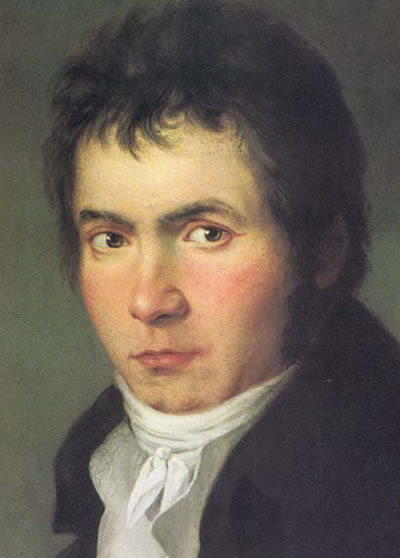 Eroica in the performance by the Berlin Philharmonic under the direction of Herbert von Karajan in the 1984 recording here, and Symphony no. 4, in the live recording made by Carlos Kleiber with the Bavarian State Orchestra in 1982, here. ♫
Symphony No. 3. With the closing measures of the Symphony No. 2 in D major, Beethoven embarked down the “new road” he announced in a letter to Krumpholz in 1802: “I am not satisfied with my works up to the present time. From today I mean to take a new road.” While this turning point—this new artistic direction—can be seen in the Violin Sonatas, op. 30 or the Piano Sonatas, op. 31, it is most striking apparent in the comparison of the Second Symphony to its successor, the Eroica. Premonitions of Beethoven’s mature style surfaced at times in the first two symphonies—most noticeably in the Minuet of the First and the Finale of the Second. However, the Third Symphony is pure Beethoven as he is so beloved today.
Beethoven began working on the Symphony No. 3 in E-flat shortly after the Second and was occupied with it until early 1804, with much of the actual composition beginning during the summer of 1803. By the spring of 1804, a fair copy of the score had been made, which was openly displayed on Beethoven’s desk. On the outside page written at the very top was the name “Buonaparte,” and at the bottom, “Luigi van Beethoven.” The first suggestion of a symphony in honor of Napoleon Buonaparte had likely been made to Beethoven as early as 1798. At this time, Napoleon was known as a great statesman and a champion of freedom, and had not yet transformed, in his fall from glory, into the tyrant that waged war across Europe. The French Revolution had certainly influenced Beethoven, quite possibly through Bonn’s proximity to France. Indeed, his very character embodied its ideals. Once in Vienna, he was a contradiction to all the expectations of musicians of that day. Besides refusing to enter the service of any of the nobility, he asserted his independence with manners that were off-putting even to his friends and a lack of etiquette or respect towards his professed superiors. He took what was his by right and refused to see them as favors. This freedom of spirit is certainly evident in the earlier symphonies but the Third is its undeniable embodiment. Napoleon had become the quintessence of the French Revolution’s ideals, and it is quite nature that Beethoven should admire him.
However, Beethoven had no knowledge of the changes taking place in Napoleon. On May 2, 1804, the Senate passed a motion asking Napoleon to take the title of Emperor. Later that month, on the 18th, he assumed the title. When the news finally reached Vienna, Ferdinand Ries delivered it to Beethoven. “After all, then, he is nothing but an ordinary mortal! He will trample all the rights of men under foot, to indulge his ambition, and become a greater tyrant than any one,” was the reply that erupted from the composer. In his fury, Beethoven grabbed the score of his new symphony, tore the title page, and threw it on the ground. For seventeen years, Beethoven never mentioned the connection between the work and Napoleon until, on hearing news of Emperor’s death, he replied, “I have already composed the proper music for that catastrophe”—an obvious reference to the Funeral March which forms the symphony’s second movement. On the copy of Beethoven’s score preserved today, one can visibly see the hatred with which Beethoven scratched out Napoleon’s name from the title page. (Continue reading here).
Read more...Ludwig van Beethoven - Symphony no. 4, op. 60
Bavarian State Orchestra (Orchestra)
Carlos Kleiber (Conductor)
Ludwig van Beethoven - Symphony no. 3 Eroica, op. 55
Berlin Philharmonic (Orchestra)
Herbert von Karajan (Conductor)
Joe Cutler - Tuesday
Nicolas Horvath (Piano)
George Gershwin - I Got Rhythm
The Grant Park Music Festival’s Apprentice Chorale (Chorale)
Robert Ehle - Viola Sonata mvt. 3
Debra Moree (Viola)
Ehle (Fortepiano)
Stefan Kristinkov - 1:31 AM
Stefan Kristinkov (Ensemble)