
Alban Berg - Lulu Suite, Part 1
City Of Birmingham Symphony Orchestra (Orchestra)
Simon Rattle (Conductor)
Alban Berg, part II, 2024
This Week in Classical Music: February 12, 2024. Alban Berg, Part II. In 1911, Arnold Schoenberg moved from Vienna to Berlin but the intense relationship between Berg and his 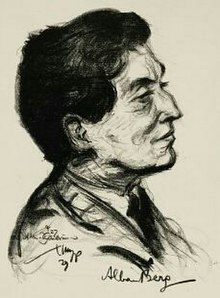 teacher continued through letters. Schoenberg’s notes often contained demands that were about more than just the music: some were domestic, some financial. Though Berg adored his teacher, Schoenberg’s demands were difficult and time-consuming, and the relationship was getting more difficult – so much so that in 1915 their correspondence broke off. WWI was in full swing; Berg was conscripted into the Austrian Army and served for three years (the 42-year-old Schoenberg, who moved back to Vienna in 1915, also served in the army, but only for a year). Things changed in 1918 after Berg was discharged: he returned to Vienna and reestablished his relationship with his teacher.
In May of 1914 Berg attended a performance of Woyzeck, a play by the German playwright Georg Büchner. He immediately decided to write an opera based on the play; it would become known as Wozzeck, a misspelling of the original play’s name that somehow stuck. Berg wrote the libretto himself, selecting 15 episodes from Woyzeck, a macabre story of a poor and desperate soldier, who, suspecting that the mother of his illegitimate child is having an affair with the Captain, murders her, and then drowns. Berg started writing sketches soon after he saw the play but had to stop in June of 1915 when he was drafted. He continued composing while on leave in 1917 and 1918, finished the first act in 1919, the second act two years later, and completed the opera in 1922. It premiered at the Berlin State Opera in December of 1925, with Erich Kleiber conducting. Wozzeck created a scandal, which is understandable, given that it was the first full-size opera written in an atonal idiom, unique not only musically but also in its emotional impact. What is more important (and somewhat surprising) is that the premier was followed by a slew of productions across Germany and Austria. Wozzeck was staged continuously in different German-speaking cities for the next eight years, but also internationally: in Prague, Philadelphia, and even in such an unlikely place as Leningrad. It all came to an end when the Nazis banned it as part of their campaign against Entartete Musik (Degenerate music) and the Austrians dutifully followed. Wozzeck’s success made Berg financially secure, brought him international recognition and some teaching jobs. We’ll listen for the first 15 minutes of Act II of Wozzeck. In Scene 1, Marie puts her son to bed, then Vozzeck arrives, gets suspicious of her earrings (they were given to her by the Captain), gives her some money and leaves. In Scene 2, the Doctor and the Captain walk the street; they see Wozzeck, make fun of him and insinuate that Marie isn’t faithful. Wozzeck runs away in despair. Claudio Abbado conducts the Orchestra and Chorus of the Vienna State Opera (we know the orchestra as the Vienna Philharmonic); Wozzeck is sung by Franz Grundheber, his common-law wife Marie is Hildegard Behrens. Heinz Zednik is the Captain, Aage Haugland is the Doctor.
Wozzeck was an atonal opera, but it wasn’t a 12-note composition, the technique which by then was being developed by Schoenberg. Berg was receptive to it and soon moved in a similar direction. He wrote two pieces, Kammerkonzert (Chamber Concerto for Piano and Violin with 13 Wind Instruments), completed in 1925, and Lyric Suite, a year later, which broadly used the 12-tone technique. In 1929 he started work on his second major opera, Lulu, a much larger and more complex composition than Wozzeck. We’ll cover it next week, in our the third and final installment on Berg.
Read more...Alban Berg - Wozzeck, Act II, Scene 2
Heinz Zednik (Tenor)
Orchestra of the Vienna State Opera (Orchestra)
Claudio Abbado (Conductor)
Alban Berg - Wozzeck, Act II, Scene 1
Hildegard Behrens (Soprano)
Orchestra of the Vienna State Opera (Orchestra)
Claudio Abbado (Conductor)
Alban Berg, Part I, Early Years, 2024
This Week in Classical Music: February 5, 2024. Berg, Part I, Early Years. Alban Berg, a seminal German composer of the first half of the 20th century, was born in Vienna on February 9th 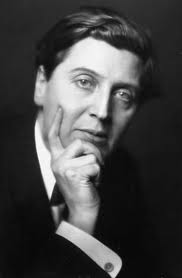 of 1885. Berg, with Anton Webern, was a favorite pupil of Arnold Schoenberg and was one of the first composers to write atonal and 12-tonal music. While Schoenberg was often cerebral, even in his more expressive works and Webern a much stricter follower of the technique in his succinct, perfectly formed pieces, Berg’s music was more lyrical and Romantic, even as he abandoned the tonal format. Berg’s background was very different from his Jewish teacher’s: his Viennese family was well-off, at least while his father was alive (he died when Alban was 15), they lived in the center of the city (Schoenbergs lived in Leopoldstadt, a poor Jewish neighborhood). Berg was a poor student: he had to repeat the 6th and the 7th grades. Even though Alban was interested in music from an early age and wrote many songs, he clearly wasn’t suited for studies in a formal environment and lacked the required qualifications, so, instead of going to a conservatory he became an unpaid civil servant trainee. In 1904, without any previous musical education, he became Schoenberg’s student. By that time Schoenberg, who was struggling financially and took students to support himself, had already written Verklärte Nacht (Transfigured Night) and a symphonic poem Pelleas und Melisande. Both had a fluid tonal canvass as Schoenberg was already researching the atonal idiom, but it would be another three years till he’d write his Quartet no. 2, his first truly atonal piece; all these developments took place while Berg was his student. Berg studied with Schoenberg till 1911, first the counterpoint and music theory, and later composition. During that time he sketched several piano sonatas and later completed one of them, published as his op. 1. That was a big departure, as before joining Schoenberg all he could write were songs.
We should note that the pre-WWI years in Vienna were a period of tremendous cultural development; despite the overall antisemitism of the Austrian society, many of the leading figures were Jewish, and sexuality was explored deeply for the first time. In music, it was Gustav Mahler, Richard Strauss, Alexander von Zemlinsky, Schoenberg, Franz Schreker, Egon Wellesz, Ernst Toch, and of course, Webern and Berg, with many younger composers to follow. Arthur Schnitzler, Hugo von Hofmannsthal, Robert Musil and Stefan Zweig were important novelists and playwrights (Frank Wedekind, their German contemporary, was the source for Berg’s opera Lulu). The painter Gustav Klimt was Berg’s friend, and so was the architect Adolf Loos. And we shouldn’t forget Sigmund Freud, who was not just a psychoanalyst famous around Vienna but a leading cultural figure.
A characteristic episode happened in March of 1913 when Schoenberg conducted what became known as the Skandalkonzert ("scandal concert") in Vienna’s Musikverein. Here’s the program: Webern: Six Pieces for Orchestra; Zemlinsky: Four Orchestral Songs on poems by Maeterlinck; Schoenberg: Chamber Symphony No. 1; Berg: Two of the Five Orchestral Songs on Picture-Postcard Texts by Peter Altenberg. Mahler's Kindertotenlieder was supposed to be performed at the end, but during the performance of Berg’s songs fighting began and the concert was cut short. The Viennese public’s response could be expected, if not necessarily in its physical form (after all, their favorite music was Strauss’s waltzes), but how many American presenters would dare to program such a concert in our time, more than 100 years later? We can listen to Berg’s songs that were performed during the concert, no. 2 of op. 4 here and no. 3 here. The soprano is Renée Flemming; Claudio Abbado leads the Lucerne Festival Orchestra.
We’ll continue with Berg and his two masterpieces, operas Wozzeck and Lulu, next week.
Read more...Alban Berg - Lieder Op. 4, no. 3
Renée Flemming (Conductor)
Lucerne Festival Orchestra (Orchestra)
Claudio Abbado (Conductor)
Alban Berg - Lieder Op. 4, no. 2
Renée Flemming (Soprano)
Lucerne Festival Orchestra (Orchestra)
Claudio Abbado (Conductor)
Franz Liszt - Mephisto Valse No. 1
Andreas Klein (Piano)
Franz Schubert - Piano in B flat major, D.960
Andreas Klein (Piano)
Alban Berg - Lulu Suite, Part 2
Arleen Auger (Soprano)
City Of Birmingham Symphony Orchestra (Orchestra)
Simon Rattle (Conductor)