
Michael moore - He was meant for that end
Michael moore (Organ)
Schubery, Mendelssohn, 2024
This Week in Classical Music: January 29, 2024. Schubert, Mendelssohn and more. What an exceptional week: Franz Schubert was born on January 31st of 1797, and February 3rd is the 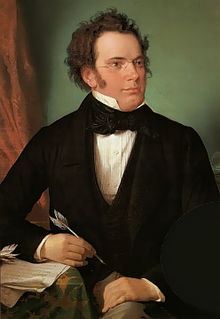 anniversary of Felix Mendelssohn, born 12 years later, in 1809. We just celebrated Mozart’s birthday; he died very young, at 35. Schubert’s life was even shorter: he was 31 when he passed away, and Mendelssohn – only 38. All three could’ve lived twice as long, and our culture would’ve been so much richer. Schubert is one of our perennial favorites (tastes and predilections change, Schubert stays) and we’ve written many entries about him (here and here, for example), including longer articles on his song cycles. There are hundreds of his pieces in our library – he remains one of the most often performed composers. His life was not eventful, his music was sublime, so here’s one of his songs: An die Musik, that is, To Music that Schubert composed in March of 1817 (he was twenty). Nothing can be simpler and more beautiful. We could not select a favorite recording, there are too many excellent ones, so we present three, all sung by the Germans: soprano Elisabeth Schwarzkopf with the great pianist, Edwin Sicher, released in 1958 (here); the 1967 recording made by the baritone Dietrich Fischer-Dieskau with Roger Moore (here); and Fritz Wunderlich, an amazing tenor who also died at 35, accompanied by Hubert Giesen in a 1967 recording (here). You can decide for yourself which one you like better.
As for Mendelssohn, his most famous “songs” were not vocal butfor piano solo:Songs without Words. Still, he also composed “real” songs – not as many as Schubert, of course, who wrote about 600 – and some of them are wonderful. Here, for example, is Gruss (Greeting), a song from his op. 19a on a poem by Henrich Heine. It’s performed by the Irish tenor Robin Tritschler, accompanied by Malcolm Martineau. When he wrote his songs op. 19a, Mendelssohn wasn’t much older than Schubert of An die Musik: he started the cycle at the age of 21.
Three Italian composers were also born this week: Alessandro Marcello, on February 1st of 1673, Luigi Dallapiccola, on February 3rd of 1904, and Luigi Nono, on January 29th of 1924. We’ve never written about Dallapiccola even though he was a very interesting composer; we’ll do it next week.
Also, yesterday was Arthur Rubinstein’s birthday (he was born in 1887, 137 years ago, but his ever-popular recordings evidence that he was one of the greatest pianists of the 20th century). Two wonderful singers were also born this week, the Italian soprano Renata Tebaldi on February 1st of 1922, and the Swedish tenor Jussi Björling, one of the few non-Italians who could sing Italian operas as well as the best of the locals, on February 5th of 1911.
Read more...Felix Mendelssohn - Gruss
Robin Tritschler (Tenor)
Malcolm Martineau (Piano)
Franz Schubert - An die Musik
Fritz Wunderlich (Tenor)
Hubert Giesen (Piano)
Franz Schubert - An die Musik
Elisabeth Schwarzkopf (Soprano)
Edwin Fischer (Piano)
Franz Schubert - An die Musik
Dietrich Fischer-Dieskau (Baritone)
Roger Moore (Piano)
Mozart, 2024
This Week in Classical Music: January 22, 2024. Mozart. The main event of this week is Mozart’s birthday, on January 27th. Wolfgang Amadeus was born in 1756 in Salzburg. One of the 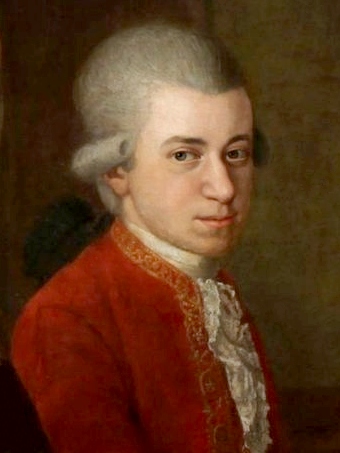 greatest composers in history, he excelled in practically every genre of classical music. His operas are of the highest order (just think of the Magic Flute, Don Giovanni, the Marriage of Figaro, or Così fan tutte, but then there are several operas, though not as popular, such as La clemenza di Tito, The Abduction from the Seraglio, or Idomeneo, that would make any other composer proud). His symphonies are the pinnacle of the orchestral music of the Classical period, and so are his piano concertos. His violin concertos were written when he was very young (the last one, no. 5, “Turkish” was completed when Mozart was 19) but were already very good. He wrote many piano sonatas that predate Beethoven’s, and wonderful violin sonatas (he was a virtuoso performer of both instruments). And then there is his chamber music: trios, quartets for all combinations of instruments, not just the strings, quintets, and much more. He did all that in just 35 years. In addition to the “standard” piano and violin concertos, Mozart wrote concertos for many different wind instruments: the horn (four of them), bassoon, flute, oboe, and clarinet. His Clarinet concerto in A major, K. 622 is marvelous. It’s a late piece, late, of course, in Mozart’s terms – he was 35 in 1791 when it was completed, less than two months before his death of still unknown causes (one thing we know for sure is that he has not been poisoned by Antonio Salieri): Mozart was already quite ill while working on the concerto. The concerto was written for Anton Stadler, a virtuoso clarinetist and a close friend of Mozart’s (they had known each other since 1781) for whom he also wrote his Clarinet Quintet. Stadler invented the so-called basset clarinet, a version of the instrument that allows the performer to reach lower notes, and that was the instrument for which Mozart wrote the concerto. We’ll hear it performed by a talented German clarinetist Sabine Meyer with the Staatskapelle Dresden under the direction of Hans Vonk.
Muzio Clementi, who competed as a keyboard player and composer with Mozart at the court of Emperor Josef II, was born on January 23rd of 1752. He, Henri Dutilleux, Witold Lutoslawski, the pianists Josef Hofmann, John Ogdon and Arthur Rubinstein, the cellist Jacqueline du Pré and Wilhelm Furtwängler, a great conductor, all of whom were born this week, will have to wait for another time.
Read more...Wolfgang Amadeus Mozart - Clarinet concerto in A Major, K. 622
Sabine Meyer (Clarinet)
Staatskapelle Dresden (Orchestra)
Hans Vonk (Conductor)
Loran Alan Davis - Prelude from Symphony #3
loran alan davis (Orchestra)
Wolfgang Amadeus Mozart - Piano Concerto no.13 in C Major, K. 415
Andreas Klein (Piano)