
Rome, again 2022
This Week in Classical Music: November 21, 2022. Rome again. Even though there are many significant anniversaries this week (composers Wilhelm Friedemann Bach, Benjamin Britten, 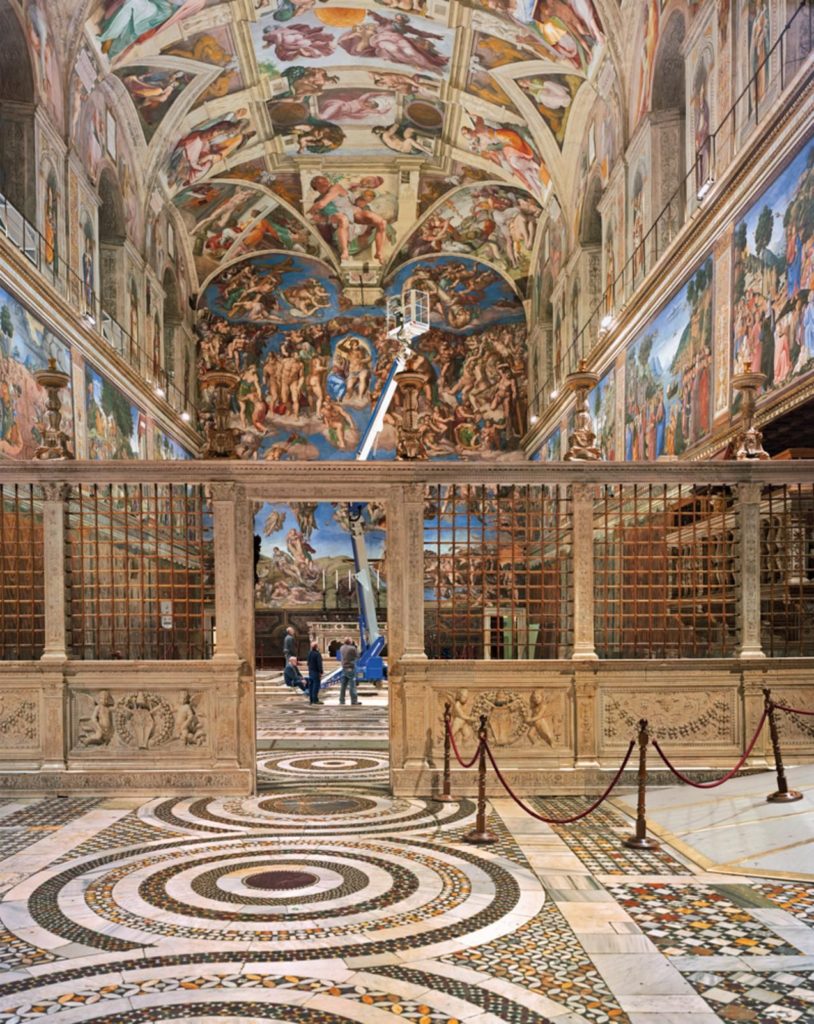 Manuel de Falla, Krzysztof Penderecki, and Alfred Schnittke, the pianists Wilhelm Kempff and Earl Wild, the violinist Hilary Hahn, the tenor Alfredo Kraus among them) we’ll return to Rome. Rome was central to the musical life of Europe for centuries, and it couldn’t have been otherwise: much of the music was written for religious services, while Rome was the place of papacy, the spiritual center of the Western world till the Reformation and to a considerable extent even later. It was especially so when polyphony was the predominant style in which church music, mass in particular, was written. Even though Rome was not the place where the first significant and identifiable European musical school had appeared – that was the Flanders and France (Belgium and Northern France now), where the Franco-Flemish school originated – many of the important composers traveled to Rome and served at the papal court. And why wouldn’t they if popes were rich patrons and the papal choir was considered the best in Europe? The choir had a long history, going back all the way to Scuola Cantorum, instituted by Pope Sylvester I in the fourth (!) century. It was reorganized by Pope Gregory I the Great (a great pope but not the inventor of the Gregorian chant which was a later creation). By the time of the
 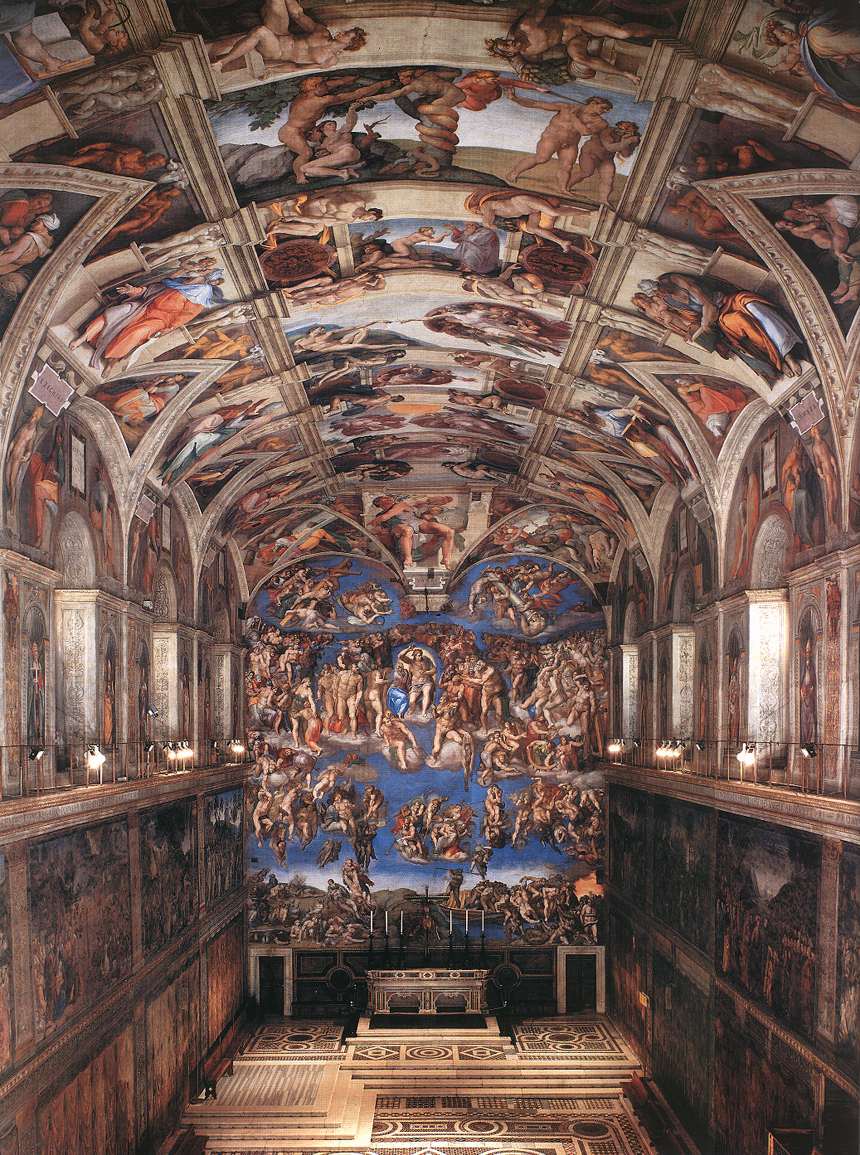 Renaissance, it was the private choir of the powerful popes and in 1470 it got a magnificent new home in the chapel built by Pope Sixtus IV, first called Capella Magna and then by the name we all know, the Sistine Chapel. Officially called Coro della Cappella Musicale Pontificia Sistina, it was acknowledged as the best musical ensemble in all of Europe.
Guillaume Dufay, born around Brussels in 1397, was one of the first and probably most influential composers of the early Renaissance. He moved to Rome in 1428, became a member of the papal choir and, while there, wrote several motets and masses. Josquin des Prez, probably the greatest composer of the next period, was born around 1450 in the French-speaking part of the Low Countries; he came to Rome in 1489 and became the composer and music director of the Capella for the next five years. Some of the greatest composers of the younger generations followed suit. Jacob Arcadelt (born in 1507 and better known for his 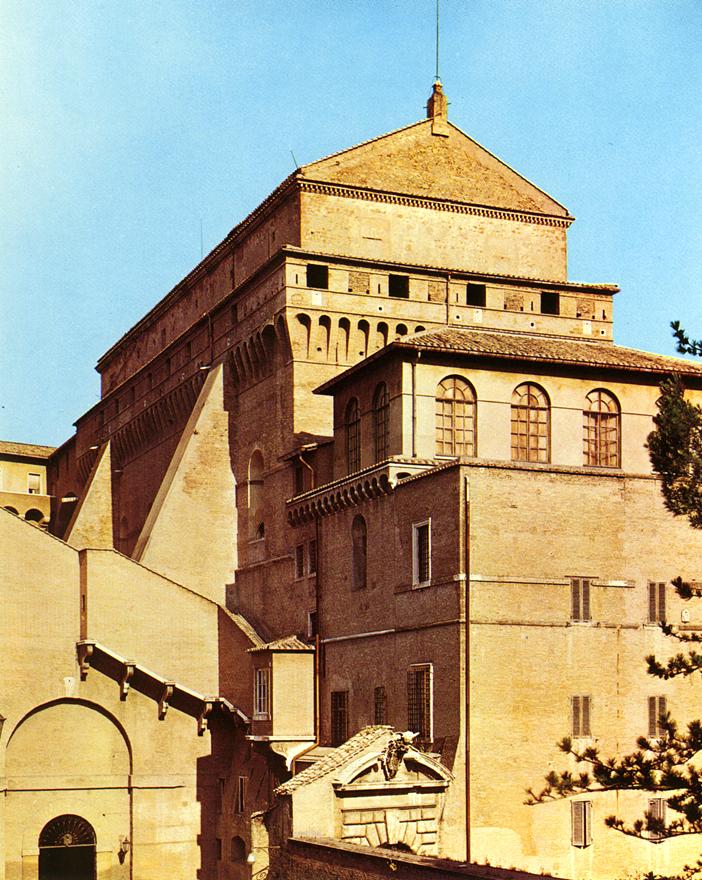 secular madrigals), moved to Rome in 1538 and sung in the Capella for several years. Orlando di Lasso, one of the geniuses of the High Renaissance (he was born in 1532), was employed as maestro di cappella at the Basilica of San Giovanni in Laterano, for centuries, till the new St. Peter’s Basilica was built, the most important church of Rome. Giaches De Wert (born in 1535), another influential composer, spent much time in Ferrara but also found work in Rome. But if there was a composer most closely associated with Rome, that would clearly be Giovanni Pierluigi da Palestrina. Palestrina, the Council of Trent and some composers that came up later – all that we’ll address in a subsequent entry. In the meantime, some music from Rome. By Guillaume Dufay, a motet Apostolo glorioso. By Josquin des Prez, also a motet, but for 24 voices Qui habitat. By Jacob Arcadelt, another motet, a beautiful Ave Maria. From Orlando di Lasso, one of the motets from Prophecies of the Sibyls. By Giaches De Wert, a madrigal Misera, che faro. And from the talented Luca Marenzio (1553-1599), who also spent most of his career in Rome, another madrigal, Madonna, sua mercé.
Josquin des Prez - Qui habitat
Huelgas Ensemble (Ensemble)
Michal Bylina - Ricercar in D Minor for Solo Bass On A Theme of Bach
P. Kellach Waddle (Double Bass)
Accademia degli Arcadi, 2022
This Week in Classical Music: November 14, 2022. Rome. On one of our recent walks in Rome, while coming down the Janiculum Hill (the Belvedere at the top offers a magnificent view 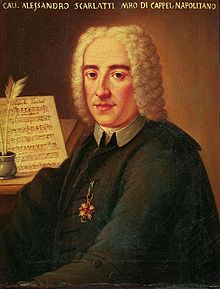 of the city), we came across a sign on a gate, Accademia degli Arcadi. The gate was closed and led, it seemed, into the gardens. That was puzzling: could it be the Academy? Wasn’t it dissolved many years ago? We had to investigate, and the answers were surprising – but first let’s look back at what Accademia degli Arcadi was about and when. The beginnings of the Academy go back to the time of Queen Christina of Sweden’s sojourn to Rome. Christina, who abdicated the Swedish throne in 1654 but kept much of her riches, converted to Catholicism, settled in Rome in the Palazzo Farnese and surrounded herself with the most illustrious Roman intellectuals – poets, composers, philosophers. She became a patron to many of them. On January 24th of 1656 she opened an Academy, providing a space in the Palazzo Farnese, and called it Accademia degli Arcadi; it was a society devoted to cultural and intellectual affairs; its member met to discuss matters they deemed important, whether in poetry, music or arts. Much of it in those days was directed against the predominant Baroque style.
After Christina’s death in 1689 the Academy had to move several times and, in 1723, thanks to the generosity of King John V of Portugal, it settled in a newly built villa in a garden on the slope of the Janiculum, called Bosco Parrasio. The gate leading to the villa was what we saw on our walk down the hill. The Academy functioned as an important cultural institution for many years but with time it became less relevant, and, by the end of the 19th century, quite conservative. It still exists to this day, but instead of being a place where new ideas are generated and new arts promoted, it became a research institution, branching into such fields as history and archeology. It also moved, and Bosco Parrasio stays mostly empty, though some concerts are being played there occasionally. The Academy’s new headquarters are located not far from Piazza Navona, in the Biblioteca Angelica on Piazza di S. Agosino.
During the Academy’s early, and most vigorous, days, many prominent composers were its members, among them Alessandro Scarlatti, Arcangelo Corelli, Giovanni Bononcini, and brothers Alessandro and Benedetto Marcello. The famous opera librettist Pietro Metastasio also was a member. The young Handel, while he lived in Rome, attended its meetings. Let’s hear some of the music created by the Arcadians. Alessandro Scarlatti was famous for his operas, but he also wrote some church music. Here’s Credo, from his Messa di Santa Cecilia. Maurice Abravanel leads the Utah Symphony Orchestra and the University of Utah Chorus. Giuseppe Valentini, another Arcadian, was born in 1681; he is not as well-known as Scarlatti but his Concerto in A minor, op. 7, no. 11 is delightful. Here it is, in the performance by the Musica Antiqua Köln.
Read more...
Giuseppe Valentini - Concerto Op. 7 No. 11 In A Minor
Musica Antiqua Köln (Ensemble)
Alessandro Scarlatti - Credo, from Messa di Santa Cecilia
Utah Symphony Orchestra (Orchestra)
University Of Utah Chorus (Chorale)
Maurice Abravanel (Conductor)
Brief Italian entry 2, 2022
This Week in Classical Music: November 7, 2022. Brief Italian entry 2. We’re still under the Italian spell, but this week it’s harder to maintain the Italian theme: we have only one Italian 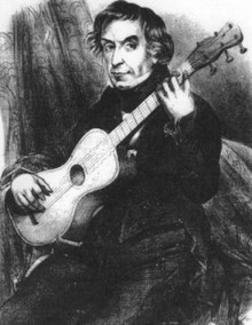 composer, and, unfortunately, rather mediocre – Luigi Legnani, born on November 7th of 1790 in Ferrara. He started as a tenor but switched to playing the guitar when he was almost 30. He turned out to be very good at that: after making a name for himself in Italy, he went to Vienna in 1822 and performed there to great acclaim. Critics calling him a worthy successor to Mauro Giuliani, another Italian, a virtuoso guitar player and composer, who spent many years in Vienna, built a highly successful career and made friends with Beethoven, Rossini and members of the Imperial court. Legnani toured many European countries and at some point, met Paganini, himself an excellent guitar player. They became friendly and even planned a concert together but at the last moment Paganini got sick. Legnani composed about 250 works, most of them for the guitar. Later in life he settled in Ravenna where he built fine guitars and violins. Here is Luigi Legnani's Capriccio no. 28, op. 20, played by the Italian guitarist Federica Canta.
Our second Italian, Giuseppe Sinopoli, was a very talented (and unorthodox) conductor and composer. Born on November 2nd of 1946 in Venice, he studied with Bruno Maderna, one of most prominent Italian modernist composers, and later with Karlheinz Stockhausen in Darmstadt. In 1975 Sinopoli formed the Bruno Maderna Ensemble to perform contemporary music; in 1978 he conducted his first opera, Aida, in Venice. During that period, he composed an opera, Lou Salomé, which was staged in Munich in 1981. He later dropped composing and devoted himself to conducting. Sinopoli’s career developed rapidly: in 1983 he became the Chief conductor of the Academy of Santa Cecilia in Rome, went on to conduct the New York Philharmonic and Philharmonia Orchestra from London, worked at the Bayreuth Festival. In 1990 he was appointed to the prestigious position of music director at the Berlin Deutsche Oper but didn’t take it, moving instead to Dresden’s Staatskapelle as their principal conductor. Sinopoli died on April 20th of 2001 of a heart attack while conducting the third act of Aida at the Deutsche Oper. Here’s Giuseppe Sinopoli conducting the Staatskapelle Dresden orchestra in the first movement of Bruckner’s Symphony no. 5.
Read more...Brief Italian entry 1, 2022
This Week in Classical Music: October 31, 2022. Brief Italian entry 1. A short hiatus with Italian flavor calls for an Italian theme for this week’s entry, and history, so rich on Italian music, 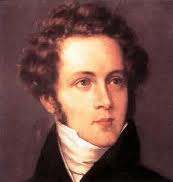 obliges. Vincenzo Bellini, the creator of La sonnambula, Norma, and I puritani, was born on November 3rd of 1801 in Catania, Sicily. Just last week we wrote about the great soprano sfogato Giuditta Pasta: she sung at the premier performances of two of these operas, as Anna in La sonnambula, in Milan’s Teatro Carcano, in March of 1831, and in December of the same year, the role of Norma, also in Milan but in Teatro alla Scala. Bellini was 33 when he died of dysentery. His first opera was written when he was 23, still a student at the Naples San Sebastiano Conservatory – Bellini had only ten creative years but still left us some of the most memorable bel canto operas.
And also this week, two historical Italian singers were born: the great castrato Senesino, on October 31st of 1686, and Tarquinia Molza on November 1st of 1542. Senesino, an Italian alto castrato, born Francesco Bernardi in Siena (thus Senesino), was one of Handel’s favorite singers. He came to London in 1720, became enormously popular and was paid equally enormous fees (after leaving London, he built a fancy house in Siena, which carried an inscription: “the folly of the English had laid the foundation of it.” Senesino sung in 20 Handel operas, of which 17 were written for his voice; his performance in Giulio Cesare was called “beyond all criticism.” Here, from a 2012 Salzburg production of Giulio is Andreas Scholl, the German countertenor, as Cesar, singing the aria Va tacito e nascosto (Silently and stealthily). This, alas, is only an approximation of Senesino’s voice. And from the same production, here’s Cleopatra’s aria E pur così in un giorno (And even so in a day) sung by Cecilia Bartoli. We suspect that she’s not worse than the famous Fancesca Cuzzoni who premiered the role in February of 1724.
Tarquinia Molza was an extraordinary woman: a brilliant singer, a virtuoso player on bass viol in a style called “viola bastarda,” and poet. She was born in Modena and around 1583, already a widow, moved to Ferrara, one of the musical centers of Italy, as a lady-in-waiting to the Duchess Margherita Gonzaga d’Este. In Ferrara she served as an advisor to the famous Concerto delle donne, of which we’ve written several times, for example, here. While at the court, she had a tryst with the composer Giaches De Wert, deemed inappropriate (she was a minor nobility while composers were considered of a serving class) and had to leave Ferrara. She moved to Rome and died there in 1617.
Read more...George Frideric Handel - Non è sì vago e bello, from Giulio Cesare
Andreas Scholl (Countertenor)
Il giardino armonico (Orchestra)
Giovanni Antonini (Conductor)
Jacob Arcadelt - Ave Maria
Ave Sol Riga (Chorale)
Imants Kokars (Conductor)