Welcome to our free classical music site

Do you write about classical music? Are you a blogger? Want to team up with Classical Connect? Send us a message, let's talk!
Do you write about classical music? Are you a blogger? Want to team up with Classical Connect? Send us a message, let's talk!




December 9, 2013. Franck, Messiaen, Berlioz. This year the birthdays of these three francophone composers again fell on the same week. César Franck was born on December 10th, 1822 in Liège, but spent most of his life in Paris. One of the greatest composers of the 20th century, Olivier Messiaen was born on the same day in 1908 in Avignon, and Hector Berlioz – on December 11th, 1803 in La Côte-Saint-André, near Grenoble. We wrote extensively about Franck last year. His violin sonata remains one of the most popular pieces both among musicians and listeners: we have 10 recordings of it with violin soloists and two arrangements, one for the cello and another for the viola. Here the sonata is played by the German violinist Augustin Hadelich with Yingdi Sun on the piano.
Olivier Messiaen’s life consisted of contradictions that produced extraordinarily creative results: deeply religious, somewhat conservative, and inspired by life of St Francis, he wrote music in an idiom all his own, absolutely modern and original. His experience during WWII was traumatic; conscripted, he was captured by the Germans at the beginning of the war and imprisoned in a camp. There he wrote Quatuor pour la fin du temps ("Quartet for the End of Time") (you can read more here). He was released in May of 1941 and soon after appointed a professor at the Conservatory of the occupied Paris. All along he was working as the organist at the church of La Trinité. In 1944, during the terrible last months of the German occupation, he composed a piano cycle called Vingt regards sur l'enfant-Jésus, which could be translated as “Twenty contemplations (or gazes) on the infant Jesus.” He dedicated it to his pupil, and later wife, the pianist Yvonne Loriod. One of his religious works, it consists of twenty episodes with titles such as "Contemplation of the Father," "Contemplation of the star," "Contemplation of the Virgin," and so on. The complete duration of this enormous piece is more than two hours. We’ll listen to the first part, Contemplation of the Father (here). It’s performed by the French pianist Pierre-Laurent Aimard, who studied with Yvonne Loriod at the Paris Conservatory.
Even though Messiaen inspired and influenced many composers (among his students were some of the most important composers of the second half of the 20th century: Pierre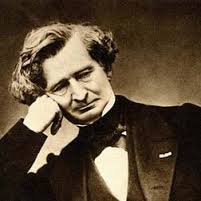 Boulez, Karlheinz Stockhausen, Iannis Xenakis) his musical style was unique. In this respect he reminds us of another Frenchman, Hector Berlioz. Born in a small town into a family of a physician, Berlioz didn’t start studying music till he was 12. His father didn’t encourage his musical studies, and at the age of 18 Hector went to Paris to study medicine, in which he had no interest. After hearing several operas (he was not a diligent student and spent much of his time looking for entertainment) he went to the library of the Paris Conservatory and studied the scores. In 1824 he abandoned his medical studies and started composing on a more regular basis. Two years later, in 1824 when he was 23, he began attending classes at the Conservatory. By then he was a fully formed composer, and winning the Prix du Rome became an important goal, not the least because it included a five-year stipend. He got it only on his forth attempt, in 1830. About the same time he also got engaged to the 20 year-old pianist Marie Moke, to whom Chopin, Liszt and Mendelssohn dedicated various compositions. At the very end of 1831 Berlioz went to Italy, as was a requirement for all Prix du Rome winners. He stayed in the Villa Medici of the French Academy and didn’t like Rome (“a stupid and prosaic city,” he called it). Moreover, he got the news from his fiancée’s mother that Marie broke their engagement and was to marry Camille Pleyel, the son of Ignaz Pleyel, the famous publisher and piano maker. He decided to kill both his former fiancée, her mother – the bearer of the news -- and Pleyel, and concocted an elaborate plan to do so. Fortunately to everybody involved, on the way from Rome to Paris it occurred to him how foolish the plan was and he returned to Rome. In 1830, while still in Paris, Berlioz wrote what was to become one of his most famous compositions, Symphony Fantastique: Épisode de la vie d'un Artiste, en cinq parties (Fantastic Symphony: An Episode in the Life of an Artist, in Five Parts). Here is the second movement Un Bal (A ball). In this 1974 recording Colin Davis is conducting the Royal Concertgebouw Orchestra (here is the first movement, Rêveries – Passions or Daydreams – Passions, with Rundfunk-Sinfonieorchester Berlin under the direction of Igor Markevitch).
PermalinkDecember 2, 2013. Soler, Geminiani and Sibelius. Francesco Geminiani was born in Lucca on December 5th, 1687. He studied music with Alessandro Scarlatti and later with Arcangelo Corelli. In 1711 he became the leader of the Opera orchestra of Naples,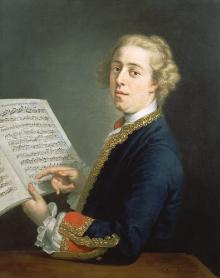 where he was also the concertmaster. His teacher Scarlatti was living (and writing operas) in Naples during that time, so they resumed their contacts. In 1714 Geminiani moved to London. By then he had a reputation as a violin virtuoso. George Frideric Handel, who also studied with Corelli, was the king of the London music scene. All things Italian were very popular in London in those days (the tradition of a young gentleman’s Grand Tour with its obligatory stops in Florence, Rome, and also Venice and Naples, was established at the end of the 17th century), and Geminiani was invited to the court of George I. There he played the violin accompanied by Handel himself. Geminiani lived in England and Ireland for the rest of his life (he died in Dublin on September 17th, 1762). He had many students and in 1751 published an influential book on violin playing, Art of Playing the Violin. Among his best-known compositions are concerti grossi, some of them based on the music of his teacher Corelli. Here, for example is Geminiani’s Concerto Grosso no. 12 in D minor "La Follia," which was based on Corelli’s Violin sonata op.5 no. 12, which in turn was based on the famous tune, La Folia. It’s performed by The English Concert, Trevor Pinnock conducting. And here is his Concerto Grosso op. 7 no. 3. It’s performed by Capella Istropolitana, Jaroslav Krcek conducting.
Antonio Soler was born on December 3rd, 1729 in a small Catalan town of Olot. There is a connection between Soler and Geminiani: the former studied with Domenico Scarlatti, while the latter – with Domenico’s father Alessandro. Soler went to the choir school of the monastery of Monserrat and soon after was made chapel master at the Lerida Cathedral. In 1752 he joined the Order of St. Jerome (therefore “Padre” or “Father” Soler, as he’s commonly called) and became the organist at the royal Monastery of El Escorial. While there he wrote more than 500 compositions, among them 150 keyboard sonatas, many of them highly original, with unexpected harmonic developments (it’s rumored, though, that some of the sonatas were actually written by his pupil, Infante Gabrile, son of the king Carlos III). Soler also wrote church music and music for plays, but it’s his keyboard sonatas that he’s famous for. Here are three sonatas by Soler, performer by the great Spanish pianist Alicia de Larrocha: F-sharp minor R 85; in D Major R86, and F-sharp major R 90.
Jean Sibelius is another composer who has his birthday this week. He was born on December 8th, 1865 in Hämeenlinna, not far from Helsinki in what was then part of the Russian Empire. The first thing that comes to mind when one compares the work of Sibelius with the baroque composers like Geminiani and Soler is not the difference in style, which of course is enormous, – it’s the intensity and seriousness of purpose. For Sibelius, a Finnish nationalist whose first language was Swedish, Finland’s independence was paramount, and while he couldn’t do much about it politically, he attempted to create it in his music; his Symphony no. 2 was dubbed “The Symphony of Independence.” As a composer he was a master, building his work as a progression of different elements and fragments. In this respect, his recollection of a conversation with Gustav Mahler, whom he met in 1907 while Mahler was touring Finland, is very telling for our understanding of both composers. “I said that I admired [the symphony's] severity of style and the profound logic that created an inner connection between all the motifs... Mahler's opinion was just the reverse. 'No, a symphony must be like the world. It must embrace everything.’” It couldn’t be said better: Mahler’s symphonies are like the world, and Sibelius’s are logical. Sibelius composed his Symphony no. 5 in 1915; the symphony was commissioned by the Finnish Government to commemorate Sibelius’s 50th birthday, and it was premiered on that date, December 8th, 1915 in Helsinki. In this recording Herbert von Karajan conducts the Berlin Philharmonic (here).Permalink
November 25, 2013. Lully and Donizetti. Just a couple of weeks ago we wrote about François Couperin and Vincenzo Bellini and here we are, celebrating yet another of the French Baroque greats and a very important Italian composer of the bel canto. In our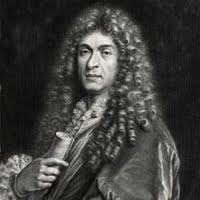 notes the French Baroque fared the best, as in the last couple of months we also wrote about Marc-Antoine Charpentier and Jean-Philippe Rameau. But at the beginning of it was the Italian, Jean-Baptiste Lully. Lully was born on November 28, 1632 in Florence and christened Giovanni Battista. He was brought to France at the age of 14 to serve at the court of Mademoiselle de Montpensier (la Grande Mademoiselle), the granddaughter of the King Henry IV and Marie do Medici. Mademoiselle, one of the richest women in France, was famous for her patronage of the arts and had many household musicians. Young Lully probably studied music with some of them. After Mademoiselle was exiled from the capital during the Fronde, Lully received her permission to return to Paris, where very soon he was hired as the violinist and composer at the court of Louis XIV. He stayed with the court for the rest of his life, although Louis’ affection cooled considerably after Lully was caught in a liaison with a male page. Highly ambitious, Lully sought titles and positions all his life. He held many royal appointments and even became a secrétaire du roi, usually reserved for the French nobility. He also bought a royal patent for operatic productions, and from 1674 no opera could be staged in France without his permission.
While engaged in the intrigue, he still managed to produce a huge volume of music. As long as the King was interested in dancing, it was mostly ballets (Lully himself was a very good dancer), but later he turned to opera or “tragedy set to music.” Lully introduced livelier dances to the ballets, got rid of “recitative secco” of the traditional Italian operas, in which declamation was accompanied only by the continuo, and adopted “accompagnato,” in which the orchestra is accompanying the singer. All these innovations made his music so much freer, both rhythmically and melodically. For a number of years Lully collaborated with Molière and wrote a number of “interludes” to his plays. He also composed some sacred music, six motets among them. The opera Alceste, ou Le triomphe d’Alcide was composed to celebrate the capture of Franche-Comté from Spain and premiered in 1674. Here is the Overture and several numbers from the first act of the opera. Jean-Claude Malgoire conducts his ensemble, La Grande Écurie et la Chambre du Roy. The mezzo-soprano Stéphanie d'Oustrac is the Nymphe of the Seine, the soprano Judith Gauthier is La Gloire.
Gaetano Donizetti was born on November 29, 1797 in Bergamo, Lombary. Born into a poor family, he received some musical education at Lezioni Caritatevoli, a school established in Bergamo by the German composer Simon Mayr. Mayr, a minor composer, authored 70 operas, which probably influenced Donizetti’s tastes in composing. The success came to Donizetti rather late: he was 33 when he wrote Anna Bolena; the opera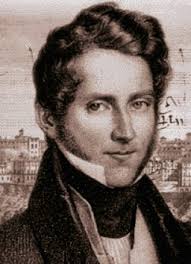 was staged in Milan and made him instantly famous (the 1957 staging of the opera in La Scala was one of Maria Callas’ greatest triumphs). Two years later, in 1832, he composed L'elisir d'amore, a two-act comic opera. In 1835 he wrote his absolute masterpiece, Lucia di Lammermoor. The opera premiered at the Teatro San Carlo in Naples on September 26, 1835, three days after the death of Vincenzo Bellini. With Rossini in retirement, Donizetti was left the reigning master of the Italian opera. Lucia became his most famous opera, performed world over. In 1838 Donizetti moved to Paris, following the steps of Rossini and Bellini. There he wrote La fille du régiment, another comic opera and also a huge success. Unfortunately, just five years later he became sick, both physically (probably syphilis) and mentally. He was moved into an institution in Paris, where he was visited by friends, Giuseppe Verdi among them, and then taken back to his native town, Bergamo. He lived there with the family of Scotti (his wife and children had died years earlier). Donizetti died on April 8, 1848 at the age 50. Here is Lucia’s famous Mad Scene with Joan Sutherland in the live 1964 performance at the Metropolitan opera, Silvio Varviso conducting (we had to cut the ovation at the end of the recording).Permalink
November 18, 2013. Wilhelm Friedemann Bach. Too many wonderful composers were born this week for us to do each of them justice. Here’s an abridged list: Carl Maria von Weber, whose operas influenced the development of the Romantic school, was born on this day in 1786; Francisco Tárrega, the Spanish composer and guitarist – on November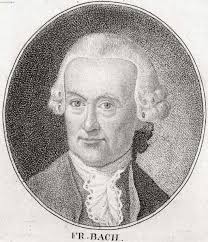 21, 1852; Wilhelm Friedemann Bach, Johann Sebastian’s eldest son, was born on November 22, 1710; November 22 is also the birthday of Joaquin Rodrigo, another Spanish composer, whose Concierto de Aranjuez is still one of the most popular music written in the 20th century; Rodrigo was born in 1901. Exactly twelve years later, in 1913, Benjamin Britten, probably the first really great English composer since Henry Purcell, was born; November 23rd is the birthday of another Spaniard, Manuel de Falla (1876), and finally, Alfred Schnittke, one of the most interesting Russian composers of the second half of the 20th century, was born on November 24, 1934. We’ve paid tribute to all of them except Wilhelm Friedemann Bach, so today is his turn.
Wilhelm Friedemann was born on November 22, 1710 in Weimar, were his father was the music director (Konzertmeister) and court organist for Prince Johann Ernst of Saxe-Weimar. Johann Sebastian was intimately involved in the music education of his eldest son; he even wrote Klavierbüchlein für Wilhelm Friedemann (Little keyboard book for Wilhelm Friedemann), many pieces of which ended up in the Well-Tempered Clavier, Inventions and Sinfonias. In 1723 Johann Sebastian took the position of cantor at St. Thomas church in Leipzig and Friedemann enrolled in St. Thomas School (many students were members of Thomanerchor or St. Thomas Choir of Leipzig, of which Bach Sr. was the director). When Friedemann was 16 and already a harpsichord and organ virtuoso, he started taking violin lessons. Music was not his only interest: after graduating from St. Thomas School, Friedemann went to the Leipzig University to study law and then moved to Halle to study mathematics. In 1733 he was appointed the organist at the Church of St. Sophia in Dresden. (The history of the church is interesting: built in 1331, it was the only gothic church in Dresden. Johann Sebastian Bach’s Kyrie and Gloria, which were later included in the Mass in B Minor, were presented in the church soon after Friedemann took the position there. The church was severely damaged during the Allied raid in 1945 but could’ve been restored, except that the GDR chief Walter Ulbricht decided that “a socialist city does not need Gothic churches,” after which it was demolished).
In 1746 Friedemann moved to Halle as the organist at Liebfrauenkirche (or the Market church). This was an important position: the church was prominent as a center of Pietism and Johann Sebastian was offered the same post years earlier. It was also the church where George Frideric Handel was baptized and later received organ lessons. Friedemann stayed there for the next eighteen, most of them unhappy, years. Many times he tried to find a different position but was never successful. He was despondent and drinking a lot. In 1764 he quit without securing a position elsewhere. For the rest of his life (he died on July 1, 1784) he couldn’t find a permanent position and earned meager income by teaching and giving recitals.
A major talent, Friedemann composed all his life. He wrote for the keyboard but also chamber pieces (many of them for flute) and orchestral works: symphonies and Harpsichord concertos. He also wrote a number of liturgical works, among them two Masses and a number of cantatas. Here’s his Fantasia for Harpsichord in C minor, F 15. It’s performed by the French harpsichordist Christophe Rousset. And here is Friedemann’s Concerto for two harpsichords in E-flat major. Harpsichordists are Andreas Staier and Robert Hill, Reinhard Goebel conducts Musica Antiqua Köln.
PermalinkNovember 11, 2013. Couperin and Copland. François Couperin was born on November 10, 1668. He was called Le Grand, the great, because for one, he was a composer of genius, but also because had to be distinguished from other member of his musically talented family. The Couperins came from the town of Brie, just east of Paris,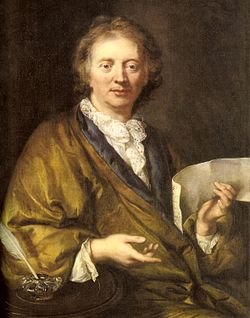 famous for its cheese. The first Couperin to come to Paris was Louis: as the story goes, the famous harpsichordist of the time, Jacques Champion de Chambonnières, was celebrating his birthday outside of Brie, and the Couperin brothers serenaded him with a song composed by Lois. The delighted Chambonnières invited him to Paris. In 1653 Louis became the organist at the church of St-Gervais in the Marais, just across the Seine from the cathedral of Notre-Dame. For several generations Couperins would occupy this position, and live in a house adjacent to the church. The last member of the family, Gervais-François, played the organ till 1826, 173 years after Lois’ arrival in Paris. Lois was a talented composer and harpsichordist; a collection of his work for the organ was discovered only in 1960, and together with his compositions for the harpsichord they represent a major body of work. Lois died at the age of 35; had he lived longer he probably would’ve developed into one of the greatest French composers of the 17th century. Two younger brothers followed Lois to Paris, both musicians but not as accomplished. Charles became the organist at St-Gervais and in 1668 had a child, François Le Grand. Charles died when François was only eleven, but church officials reserved the position of organist for François, waiting for him to turn 18. He studied music with the best teachers and assumed the position at St-Gervais before he reached the designated age. He became famous both as the organist and as a composer (his two mass settings were published in1690), and in 1693 he became an organist in the Chapelle Royale as a King Louis XIV musician. He also taught the harpsichord to the King’s children. It’s that instrument that Couperin loved and composed for the most. Four books of music for the harpsichord were published during his life, from 1713 to 1730. Instead of organizing them into suites, as was customary at the time, he set them in Orders, from five to eight to a book. He didn’t use dances, the usual components of suites (Bach’s are the supreme example), very often; instead he wrote pièces de caractère (character pieces), some with evocative names: Le rossignol-en-amour (Nightingale in Love), Le croc-en-jambe, which means to trip somebody, or Les graces incomparables, ou La Conti (in reference to a princess of Conti). In 1723 his passed the position at St-Gervais to his nephew Nicolas. Though in poor health in his later years, he continued to compose and edit his music. In 1725 he wrote Apothéose de Lully, a concert in memory of Jean-Baptiste Lully. The concert “describes” the meeting of Lully and Corelli, two founders of rival Baroques styles, the French and Italian, on Parnassus. Apollo attempts to reconcile them. (Couperin also wrote a separate concert for Corelli, Le Parnasse ou L'Apothéose de Corelli). Originally composed for two harpsichords, these days Apothéose de Lully is usually performed by chamber orchestras. Here it is, recorded in 1963 by the Toulouse chamber orchestra, Louis Auriacombe conducting. François Couperin died in Paris on September 11th, 1733.
Aaron Copland was born this week, on November 14th, in 1900. We’ll write about him later, but to celebrate, here’s his Fanfare for the Common Man as performed by the London Symphony Orchestra, also in 1963.
Permalink
November 4, 2013. Vincenzo Bellini. We missed Vincenzo Bellini’s birthday by one day (he was born on November 3rd of 1801), but did mention him in our previous post. Here’s some more about this great bel canto composer. Bellini was born in Catania, Sicily into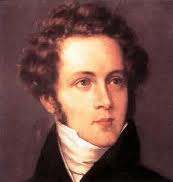 a musical family: his father was an organist and grandfather – his first music teacher. Legend has it that Vincenzo began learning music at a very young age: he took his first lessons in music theory at the age of two and started playing piano at three (considering Bellini’s talents, it all may be true). In 1819 he went to Naples to study at the conservatory; his first opera was presented at the Conservatory’s theater while Bellini was still a student. His next opera, Bianca e Gernando, was presented at Teatro di San Carlo, one of the most important (and the oldest) opera houses in Italy. In 1827 Bellini moved to Milan and that same year wrote Il Pirata, which was successfully staged at La Scala and brought Bellini international recognition. In 1830 he was commissioned to write an opera for Teatro La Fenice in Venice, the third (with La Scala and San Carlo) major opera house in Italy. The opera, I Capuleti e i Montecchi, a reworking of Shakespeare’s Romeo and Juliet, was completed in a month and a half (Bellini reused some music from his previous, and unsuccessful opera, Zaira).
The following years were tremendously productive. In 1831 Bellini wrote La sonnambula (The Sleepwalker), on the libretto by his constant collaborator, the poet Felice Romani. The main female role of this bel canto opera was written for the famous soprano Guiditta Pasta, who had a huge vocal diapason covering both the soprano and the mezzo registers; Maria Malibran, a mezzo-soprano as famous as Giuditta Pasta, sung the role of Amina the next several years. (Malibran also had an exceptional voice: she sung the roles from contralto to soprano. She died at the age of 28 on the same day as Bellini, September 23, following him by one year). In the 20th century Amina’s role was sung mostly by sopranos (last week’s sample featured Anna Netrebko). The first mezzo to record this role was Cecilia Bartoli. La sonnambula premiered in Teatro Carcano in Milan and was a huge success. That same year, 1831, Bellini followed with an opera that reached an even higher level, exceeding everything Bellini has written thus far, and probably any opera to date. Norma was written with Guiditta Pasta in mind: the main role, that of a Druid priestess, is one of the most difficult in the entire opera repertoire. In the 20th century it became a touchstone for any soprano. Maria Callas was a great Norma, and several years later Joan Sutherland created a role which, if not as dramatic, was technically probably even better. Montserrat Caballé was another famous Norma. Casta diva from Act I remains one of the most popular arias, and so is the duet Mira, o Norma from Act II (it was a specialty of Sutherland and Marilyn Horne, here, for example, from a live 1970 performance).
In 1833 Bellini moved to London and then to Paris, where Gioachino Rossini secured him a commission from the Théâtre-Italien. That resulted in I Puritani, Bellini’s last opera. Nine months after the premier he died; Bellini was just 33. Here is the aria A Te, O Cara from Act I of I Puritani. Arturo is Luciano Pavarotti. In this 1973 recording you can also hear Joan Sutherland. Richard Bonynge conducts the London Symphony Orchestra.
We planned to write about François Couperin, who was born this week on November 10th of 1668. We’ll do it in our next post.Permalink