
Antonio Soler - Keyboard Sonata No. 47 in C Minor
Mateusz Borowiak (Piano)
Francesco Geminiani - Concerto Grosso in E Minor Op. 3 No. 3
Europa Galante (Ensemble)
Fabio Biondi (Conductor)
Lully and Music Criticism, 2025
This Week in Classical Music: November 24, 2025. Lully and Music Criticism. The holidays are approaching, so we’ll try be brief. One of the composers born this week is Virgil Thomson. 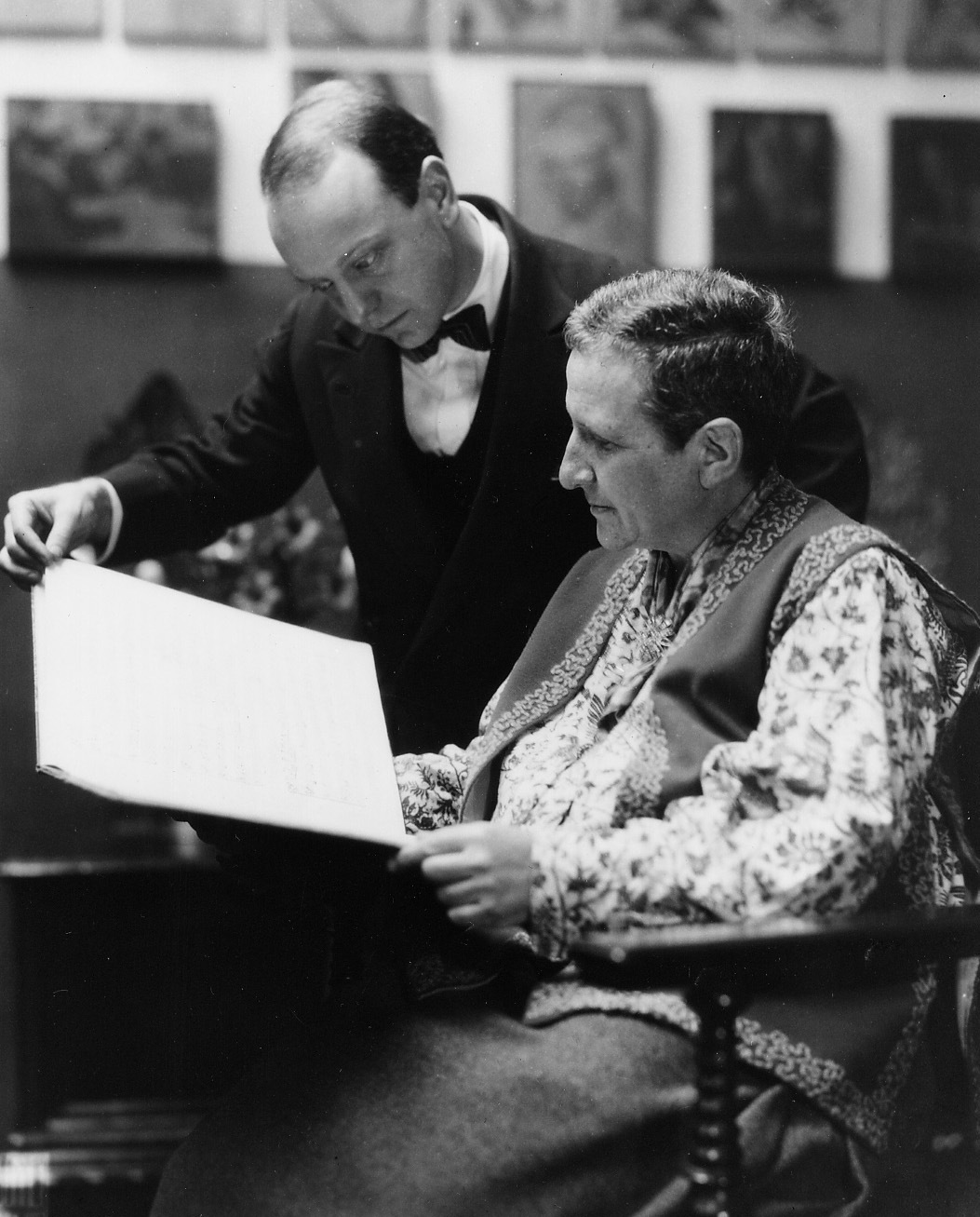 He had a very colorful life, especially during his Paris years (you can read more here, in our earlier post), and, while a relatively minor composer, he was very important as a music writer. For 15 years, from 1940 to 1954, his criticism had been published in the New York Herald Tribune; he also wrote several books. Thomson’s writings were influential and widely read; he supported American composers, and his criticism influenced musical programming in New York, resulting in more frequent performances of works by American and contemporary composers. This anniversary (Thomson was born in Kansas City, Missouri, on November 25th of 1896) reminded us of a recent article by Matthew Aucoin in the New York Review of Books. Aucoin is also a composer, young (thirty-five) and talented, and he has a wonderful way with words. What prompted him to write was the recent changes at the NY Times, which, for the time being, doesn’t have a music critic. It’s an interesting reversal of roles when a composer writes about music critics. Aucoin is not as pessimistic about the status of classical music as we are, but maybe it’s the optimism of the age. The article is worth reading, here (unfortunately, it’s behind a paywall).
Several important composers were born this week. Tarquinio Merula, an Italian composer of the early Baroque, was born in Busseto, near Cremona, on November 24th of 1595. Merula spent much of his life in Cremona, by then already a center of violin-making (surprisingly, he didn’t write much music for the violin). In many ways, Merula followed the lead of two great composers: Claudio Monteverdi and Giovanni Gabrieli. He wrote an opera, numerous madrigals and motets, and keyboard pieces. Here’s Merula’s “Madrigaletto” Mentre In Sogno, performed by the ensemble Suonare E Cantare. (And here you can read more about Merula).
Probably the most important composer born this week is Jean-Baptiste Lully, an Italian who became a founder of the French Baroque. Lully was born on November 28th (or 29th) of 1632 in Florence and brought to France as a boy by a French noble, mostly so that his niece could practice her Italian. We’ve written about Lully many times; here’s a detailed entry.
Two Russians were born this week, two Sergeis: Taneyev and Lyapunov, the former in Vladimir, on November 25th of 1856, the latter – four years later, in Yaroslavl, on November 30th of 1859. Taneyev was part of Russia’s cultural elite of the late 19th – early 20th centuries, an intellectual and cosmopolitan; he was also very close to Tchaikovsky. Tchaikovsky trusted Taneyev’s taste in and understanding of music more than any other critic’s but also often feared Taneyev’s pronouncement, as Taneyev was blunt and unsparing. Still, their friendship survived those moments; they were close till Tchaikovsky’s death. Taneyev wrote several symphonies, ten quartets, and an opera. His music is often performed in Russia.
Lyapunov studied with Taneyev in the Moscow Conservatory but turned to more “national” material. An excellent pianist, Lyapunov wrote many pieces for the piano, some of them exceptionally difficult. After the 1917 Revolution, Lyapunov emigrated to France and died in Paris in 1924. One suspects that had Taneyev lived long enough, he would have done the same (he died in 1915).
Happy Thanksgiving!
Read more...Tarquinio Merula - Mentre In Sogno
Ensemble Suonare E Cantare (Ensemble)
SIMPHONIC - FANTASY
AIVA (Orchestra)
György Cziffra, more pianists, 2025
This Week in Classical Music: November 17, 2025. Catching up on the Pianists. While we were traveling, we missed a lot of composers’ anniversaries, and last week we caught up with  most of them. In the meantime, the pianists went unattended, among whom were several outstanding masters. We’ll try to give them their dues this week.
György Cziffra, one of the greatest virtuosos of the 20th century, was born into a poor Romani (Gipsy) family in Budapest on November 5th of 1921. He learned the piano by watching his sister play; later, as a boy, he earned money in bars by improvising on the tunes customers suggested. He entered the Franz Liszt Academy at the age of nine, becoming the youngest student in the Academy’s history. Ernst von (Ernő) Dohnányi was one of his teachers. Starting in 1937, he played concerts in Hungary and other European countries. During WWII, Cziffra was conscripted and sent to the Eastern Front. There, he was captured by the Soviet partisans and held in captivity till 1947. Upon returning to Hungary, he earned his living playing jazz.
In 1950, he attempted to escape from Communist Hungary but was captured and imprisoned in a hard labor camp. The harsh treatment he experienced in the camp damaged his hands; it took him a long time to recover. Still, he went on to win the 1955 Ferenc Liszt Competition. In 1956, during the uprising against the Hungarian Stalinist regime, which would eventually be toppled by the invading Soviet army, Cziffra, his wife and son managed to escape to Austria. He gave a series of very successful concerts in Vienna, and soon after was invited to Paris. There, he was greeted by fellow musicians, among them the pianist Marguerite Long and composers Marcel Dupré and Arthur Honegger. Charles de Gaulle invited him to the Élysée Palace.
Cziffra had a very successful career in France, but in 1981, his son, György Cziffra Jr., a successful conductor, died in an apartment fire. Cziffra was severely affected by his son’s death; his concerts became infrequent (after the event, he never played with an orchestra) and he stopped recording. György Cziffra died on January 15th of 1994, in Paris. Here, in a live recording from 1959, is Cziffra’s performance of Liszt’s 1863 Concert Etude Gnomenreigen, from the opus S. 145.
145.
A wonderful French pianist Marguerite Long, whom we mentioned above, was born on November 13th of 1874 Nîmes, in the south of France. During her long life, she was friends with many of her contemporary French composers, including Fauré, Debussy, Ravel, Milhaud and others, who highly valued her interpretations of their music. For a while, Long worked as Debussy’s assistant. In 1943, Long and her friend, the violinist Jacques Thibaud, established the Concours Marguerite Long - Jacques Thibaud, which became one of the most important classical music competitions. Here, Marguerite Long plays Fauré's Nocturne no. 4. It was recorded in 1937.
Even though we don’t have the time to write about other pianists, here’s a short list. Walter Gieseking, the German pianist who had an exceptional affinity for French music, was born in France on November 15th of 1895. Ivan Moravec, a great Czech pianist and one of the best interpreters of the music of Chopin, was born in Prague on November 9th of 1930. Daniel Barenboim, a pianist, conductor, and overall musical leader, was born in Buenos Aires on November 15th of 1942. Jorge Bolet, a Cuban-American pianist who, like Cziffra, was a major virtuoso and an exceptional interpreter of the music of Liszt, was born in Havana on November 15th of 1914. Ignacy Jan Paderewski, a Polish pianist, composer, and statesman, was born in a small village of Kurilovka, then part of the Russian Empire, on November 18th of 1860. And finally, Yakov Zak was also born in the Russian Empire, in Odessa, now Odesa, Ukraine, on November 20th of 1913. He won the 1937 Chopin piano competition. Zak was a professor at the Moscow Conservatory for almost 30 years, becoming the Dean of the Piano Department in 1965.
Read more...Gabriel Fauré - Nocturne no. 4 in E Flat Major
Marguerite Long (Piano)
Franz Liszt - Gnomenreigen
György Cziffra (Piano)
Frédéric Chopin - Nocturne Op. 9 No. 2, E flat major
Jeffrey Dean Hampton (Piano)
Bernardo Pasquini - Toccata Con Lo Scherzo Del Cucco Per Lo Scozzese
Roberto Loreggian (Organ)