
Anna Leonova - I Hide Myself (in Chile)
Millaray Gonzalez (Soprano)
Analia Marigliano (Piano)
Anna Leonova - The Heart Asks
Millaray Gonzalez (Soprano)
Analia Marigliano (Piano)
From Schein to du Pré, 2020
This Week in Classical Music: January 20, 2020. From Schein to du Pré. A group of brilliant musicians (and several composers) whose lives span almost half of a millennium, were born this week. The oldest, the German composer Johann Hermann Schein, was born on this day in .jpg "Johann Hermann Schein (circa 1620)") 1586. A contemporary (and a friend) of themore famous Heinrich Schütz, Schein lived a short life of just 44 years and never traveled outside of Germany. He worked as a Kapellmeister in Weimar, later became the cantor at Thomasschule in Leipzig (a position held by Bach a century later) and lived there for the rest of his life. Even though he hadnever been to Italy, he absorbed many of the new (Baroque) music trends emanating from that country. You can hear them in this section of his Israel's Brünnlein (The Fountains of Israel), written in 1623. The section is called Die mit Tränen säen (Who sow with tears will reap with joy), and it sounds very much like a sophisticated Italian madrigal. Ensemble Vocal Européen is conducted by Philippe Herreweghe.
1586. A contemporary (and a friend) of themore famous Heinrich Schütz, Schein lived a short life of just 44 years and never traveled outside of Germany. He worked as a Kapellmeister in Weimar, later became the cantor at Thomasschule in Leipzig (a position held by Bach a century later) and lived there for the rest of his life. Even though he hadnever been to Italy, he absorbed many of the new (Baroque) music trends emanating from that country. You can hear them in this section of his Israel's Brünnlein (The Fountains of Israel), written in 1623. The section is called Die mit Tränen säen (Who sow with tears will reap with joy), and it sounds very much like a sophisticated Italian madrigal. Ensemble Vocal Européen is conducted by Philippe Herreweghe.
Farinelli, born Carlo Broschi, was probably the most famous castrato singer of all time. A soprano, he had a huge range that allowed him to sing arias written for the contraltos. He was born 215 years ago, in Andria, near the Adriatic coast of Italy on January 24th of 1705. .jpg "Farinelli, by Corrado Giaquinto") Broschi was castrated when he was about 12 years old; while a common practice for boys from poor families having fine voices, a medical pretense had to be declared for the operation to take place; in Broschi’s case it was a false report of damage he suffered after falling from a horse. Broschi studied with the famous composer and teacher Nicola Porpora and made his debut at the age of 15 in Porpora’s opera Angelica e Medoro. His fame grew swiftly; by the age of 18 he was cast in leading roles singing in major opera houses of Venice, Milan and Florence. From 1727 to 1734 he lived in Bologna; while performing in Turin he met the British ambassador who helped him negotiate a contract with London’s Opera of the Nobility, a competitor to Handel’s Royal Academy of Music. Porpora and Hasse were the major composers working for the Opera of the Nobility, with Senesino, who previously sung for Handel but ended up quarrelling with him and quitting the Academy, as their main star. With Farinelli joining, the Opera became even more popular, leading to the bankruptcy of Handel’s enterprise. Adored by the public, Farinelly was earning 5,000 pound a year, an enormous sum for the time. He stayed in London till 1737 when he quit in order to move to Spain, where he was made the Chamber musician to the King. Farinelli’s task was to sing to the King every night; he never sung in public again. In addition to his duties at the court, Farinelli was appointed the director of two Madrid theaters; there he collaborated with his friend Metastasio staging numerous lavish productions. Interestingly enough, another famous Italian, the composer Domenico Scarlatti, had a position at the court at the same time as Farinelli. After staying in Spain till 1759, Farinelli retired to his villa in Bologna. He lived there in luxury, and was visited by luminaries like Gluck, Mozart and Emperor Joseph II. He died on September 16th of 1782.
Broschi was castrated when he was about 12 years old; while a common practice for boys from poor families having fine voices, a medical pretense had to be declared for the operation to take place; in Broschi’s case it was a false report of damage he suffered after falling from a horse. Broschi studied with the famous composer and teacher Nicola Porpora and made his debut at the age of 15 in Porpora’s opera Angelica e Medoro. His fame grew swiftly; by the age of 18 he was cast in leading roles singing in major opera houses of Venice, Milan and Florence. From 1727 to 1734 he lived in Bologna; while performing in Turin he met the British ambassador who helped him negotiate a contract with London’s Opera of the Nobility, a competitor to Handel’s Royal Academy of Music. Porpora and Hasse were the major composers working for the Opera of the Nobility, with Senesino, who previously sung for Handel but ended up quarrelling with him and quitting the Academy, as their main star. With Farinelli joining, the Opera became even more popular, leading to the bankruptcy of Handel’s enterprise. Adored by the public, Farinelly was earning 5,000 pound a year, an enormous sum for the time. He stayed in London till 1737 when he quit in order to move to Spain, where he was made the Chamber musician to the King. Farinelli’s task was to sing to the King every night; he never sung in public again. In addition to his duties at the court, Farinelli was appointed the director of two Madrid theaters; there he collaborated with his friend Metastasio staging numerous lavish productions. Interestingly enough, another famous Italian, the composer Domenico Scarlatti, had a position at the court at the same time as Farinelli. After staying in Spain till 1759, Farinelli retired to his villa in Bologna. He lived there in luxury, and was visited by luminaries like Gluck, Mozart and Emperor Joseph II. He died on September 16th of 1782.
Today is also the birthday of Josef Hofmann, the famous Polish-American pianist; he was born in 1876 in Kraków, Poland. And 15 years later, also on this day, Mischa Elman, a Russian-Jewish violinist was born. Both he and Hoffman lived most of their lives in the US. And finally, the youngest of the group, the cellist Jacqueline du Pré, who was born on January 26, 1945, 75 years ago.
Read more...Johann Hermann Schein - Die mit Tränen säen
Ensemble Vocal Européen (Ensemble)
Philippe Herreweghe (Conductor)
Franz Liszt - Franz Liszt Liebestraum -Love Dream
Anahit Sevoyan (Piano)
Mariss Jansons, 2020
This Week in Classical Music: January 13, 2020. Jansons. Mariss Jansons died less than two months ago, on November 30th of 2019 (the great Wilhelm Furtwängler also died on November 30th, in 1954). This week Jansons would’ve celebrated his 77th birthday: he was born on January 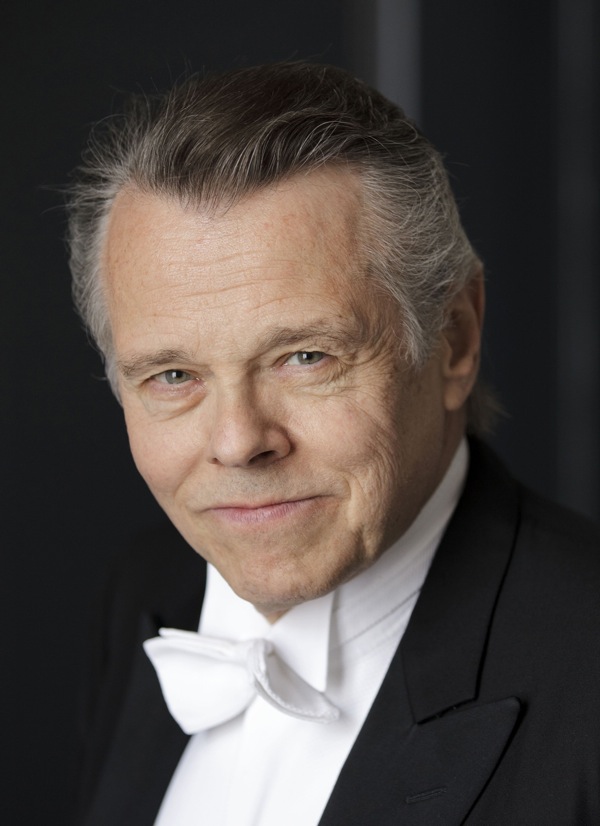 14th of 1943 in Riga, Latvia. The circumstances of his childhood were extremely difficult. Latvia was occupied by the Germans, and while his father, Arvid Jansons, was an established musician, his mother, a soprano Ida Blumenfeld, was Jewish and undermortal danger. Almost 70,000 Jews were killed in Latvia during the German occupation, only 14,000 survived. Most of the Riga Jews ended up in the ghetto, but Ida, with Arvid’s help, went into hiding. All her relatives perished during the occupation. Mariss was born while Ida was still hiding from the Nazis and local collaborators, and that’s how he spent the first year and a half of his life. After the war, with the Soviets taking over Latvia, Mariss studied the violin in Riga (Gidon Kremer was one of his fellow students) and later, when Arvid became an assistant to Yevgeny Mravinsky with the Leningrad Philharmonic, he moved to that city and continued his studies at the Leningrad Conservatory. In addition to the violin, he took conducting classes with the noted Soviet conductor Nikolai Rabinovich. Mariss was one of the first Soviet musicians to study abroad: in 1969 he went to Vienna where he studied first with the conductor Hans Swarowsky and then with Herbert von Karajan. In 1971 Jansons won the Young Conductors competition in Berlin; Karajan offered Jansons to become his assistant at the Berlin Philharmonic but the Soviet didn’t let him take the coveted position. Instead, following in the steps of his father, he became the assistant conductor at the Leningrad Philharmonic (Arvid by then was the second conductor of the orchestra). In 1979, with Mravinsky’s help, Mariss Jansons became the music director of the Oslo Philharmonic. He worked there till 2000 and made the orchestra, previously quite mediocre, into a world-class ensemble. From 1997 to 2002 he was the music director of the Pittsburgh Symphony Orchestra. He was regularly invited to Vienna to conduct the Philharmonic and from 2004 till 2016 he was the Chief Conductor of the famed Concertgebouw Orchestra.
In 1996 Mariss Jansons had a heart attack while conducting the La bohème in Oslo (his father Arvid had a heart attack and died while conducting a concert with the Hallé Orchestra). He had another heart attack five weeks later, soon after a defibrillator was implanted in his chest. Last year Jansons health deteriorated; he cancelled many concerts. He did come to the United States in November with the Bavarian Radio Symphony Orchestra but was clearly unwell: a music critic noted in a review that during one of the concerts Jansons could barely lift his arms. Mariss Jansons died at his home in Saint-Petersburg later that month. Here’s the first movement, Allegro maestoso, of Mahler’s Symphony no. 2. Mariss Jansons conducts the Bavarian Radio Symphony Orchestra. This recording was made during the Munich concerts on May 13-15, 2011.
Read more...Gustav Mahler - Symphony no. 2, 1st movement
Bavarian Radio Symphony Orchestra (Orchestra)
Mariss Jansons (Conductor)
Hans von Bülow, 2020
This Week in Classical Music: January 6, 2020. Happy New Year! We just missed a remarkable date in the history of piano playing: three great pianists were born on January 5th: Arturo Benedetti Michelangeli in 1920, Alfred Brendel in 1931 and Maurizio Pollini in 1942. Also, several interesting composers were born this week, among them one of our favorites, the Frenchman Francis Poulenc (on January 7th of 1899). But we want to celebrate the 190th birthday 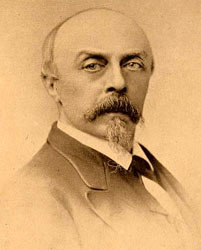 of Hans von Bülow, one of the most influential conductors of the 19th century, who was born on January 8th of 1830. Bülow was not just a conductor, he was among the finest pianists of the 19th century and one of Franz Liszt’s favorite students; he was also a composer. Born in Dresden, as a boy he studied piano with Friedrich Wieck, father of Clara Wieck and teacher of Robert Schumann, Clara’s future husband. Bülow started his conducting career in 1850, being influenced by Richard Wagner. One year later he became a student of Liszt and several years later married Liszt’z daughter Cosima; in 1860 they had a daughter. In 1864 Bülow became the Hofkapellmeister (music director) of the Munich Hofoper, and in that capacity conducted the premieres of Wagner’s Tristan und Isolde (in 1865) and Die Meistersinger von Nürnberg (in 1868). Bülow was very close to Richard Wagner; in 1862 he and Cosima stayed at the composer’s summer house. A relationship developed between Cosima and Wagner, and in 1863 they became lovers; Wagner at the time was still married to his first wife, while Cosima had another daughter from Bülow earlier that year. In 1865, while still married to Bülow, Cosima gave birth to Wagner’s daughter. The affair – an open secret in Munich – continued for a while, as Bülow refused to consent to a divorce. Two years later, in 1867, Cosima delivered another baby and then a third one with Wagner; only then did Bülow agree to let her go. Wagner and Cosima were married in Lucerne in August of 1870; Bülow, who continued to conduct Wagner’s music, never again spoke a word to the composer. Richard Wagner and Cosima stayed together for the rest of his life (Wagner died in Venice on February 13th of 1883 – she lived till 1930); on her first birthday after their marriage, on the morning of December 25th of 1870, Wagner arranged a group of musicians on the stairs of their house to play a music he called "Symphonic Birthday Greeting”; it’s known to us as the Siegfried Idyll.
Bülow, who resigned from Munich in 1869, went on a very successful piano concert tour of the United States. While in Boston, he premiered Tchaikovsky’s First Piano concerto. Altogether, he played 139 concerts in 37 cities. Upon returning to Germany, Bülow became the Hofkapellmeister in Hanover (1878-1880), then in Meiningen, where he created one of Germany’s finest orchestras, and eventually, in 1887 through 1892, he became the principal conductor of the Berlin Philharmonic. Bülow died in Cairo on February 12th of 1894.
Read more...Celebrating New Year 2020
This Week in Classical Music: December 30, 2019. New Year Celebrations. We often celebrate this season by playing parts of Bach’s Christmas Oratorio, one of the greatest creations 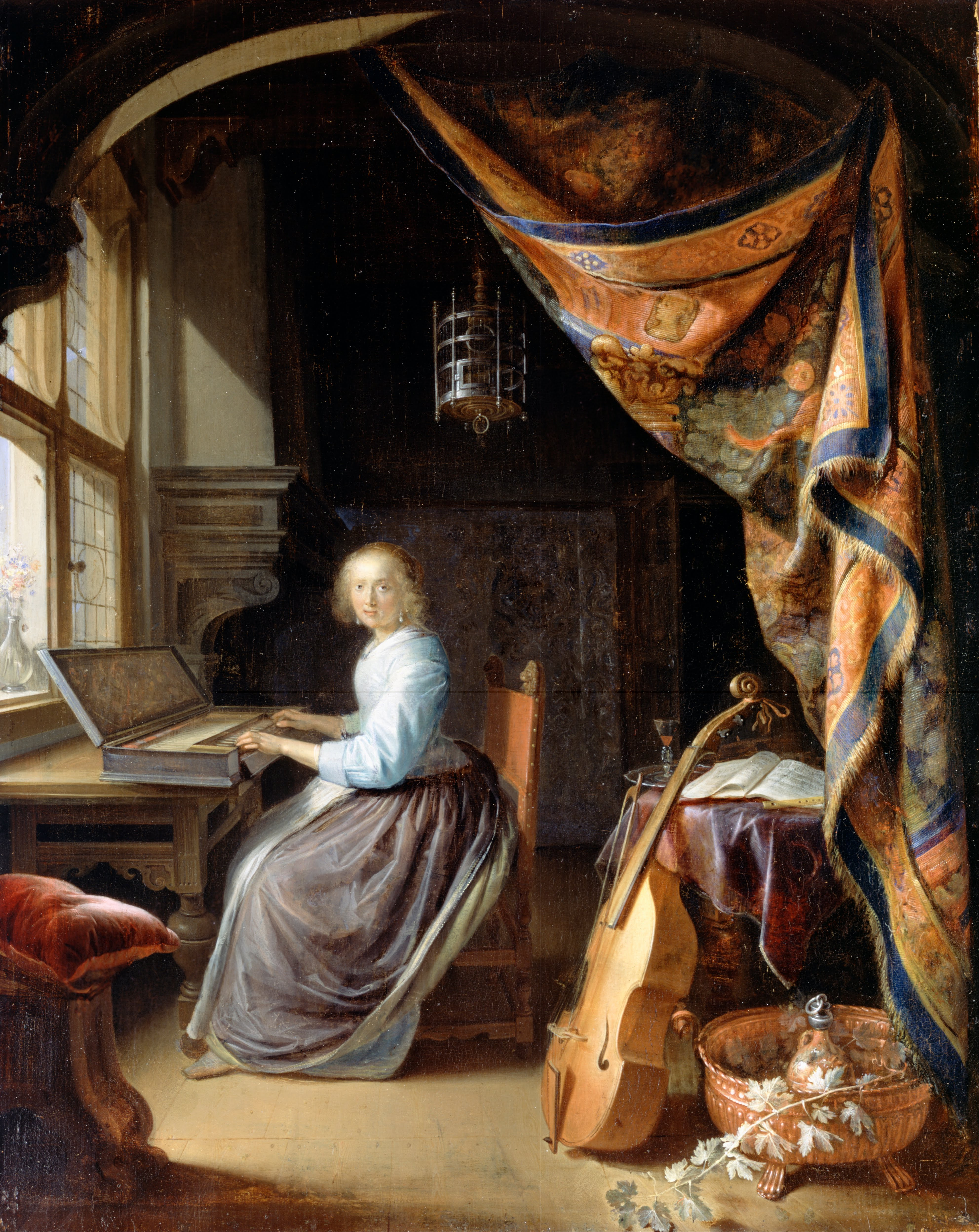 in the history of Western music. We already presented the first four parts of the Oratorio in years past, so today it’s to Part V, which is also known as Cantata Ehre sei dir, Gott, gesungen BWV 248 V (the title means “Let honor be sung to You, O God” in German, V signifies the part number in the Oratorio). This music was composed by Bach directly for the occasion, rather than recycled from his older cantatas. A calendar quirk is associated with this particular section of the Oratorio: it should be performed on the first Sunday of the New Year but before the feast day of the Epiphany, which is celebrated on January 6th; in some years – for example, 2019 – there is no such day. In 2020, though, it falls on January 5th, so it’s quite proper for us to play it this week. Here it is in the performance by the New London Consort, Philip Pickett conducting. We like this recording (it was made in 1997) but have to mention that Mr. Pickett is currently serving a 11-year sentence for rape and sexual assault of pupils at the Guildhall School of Music, where he was a teaching fellow.
The picture above is called A Woman playing a Clavichord, it was made around 1665 (70 years before Christmas Oratorio was first performed) by one of the Dutch painters of the Golden Age, Gerard Dou.
Read more... « first ‹ previous … 137 138 139 140 141 142 143 144 145 … next › last »
Anna Leonova - When Roses Cease to Bloom
Millaray Goncalez (Soprano)
Analia Marigliano (Piano)