
Johann Sebastian Bach - Fallt mit Danken, fallt mit Loben (opening chorus from Part IV), from Christmas Oratorio BWV 248
English Baroque Soloists (Orchestra)
Monteverdi Choir (Chorale)
John Eliot Gardiner (Conductor)
Christmas music of the Late Renaissance, 2019
This Week in Classical Music: December 23, 2019. Christmas music of the Late Renaissance. Last year we celebrated Christmas with the music of three giants of the High 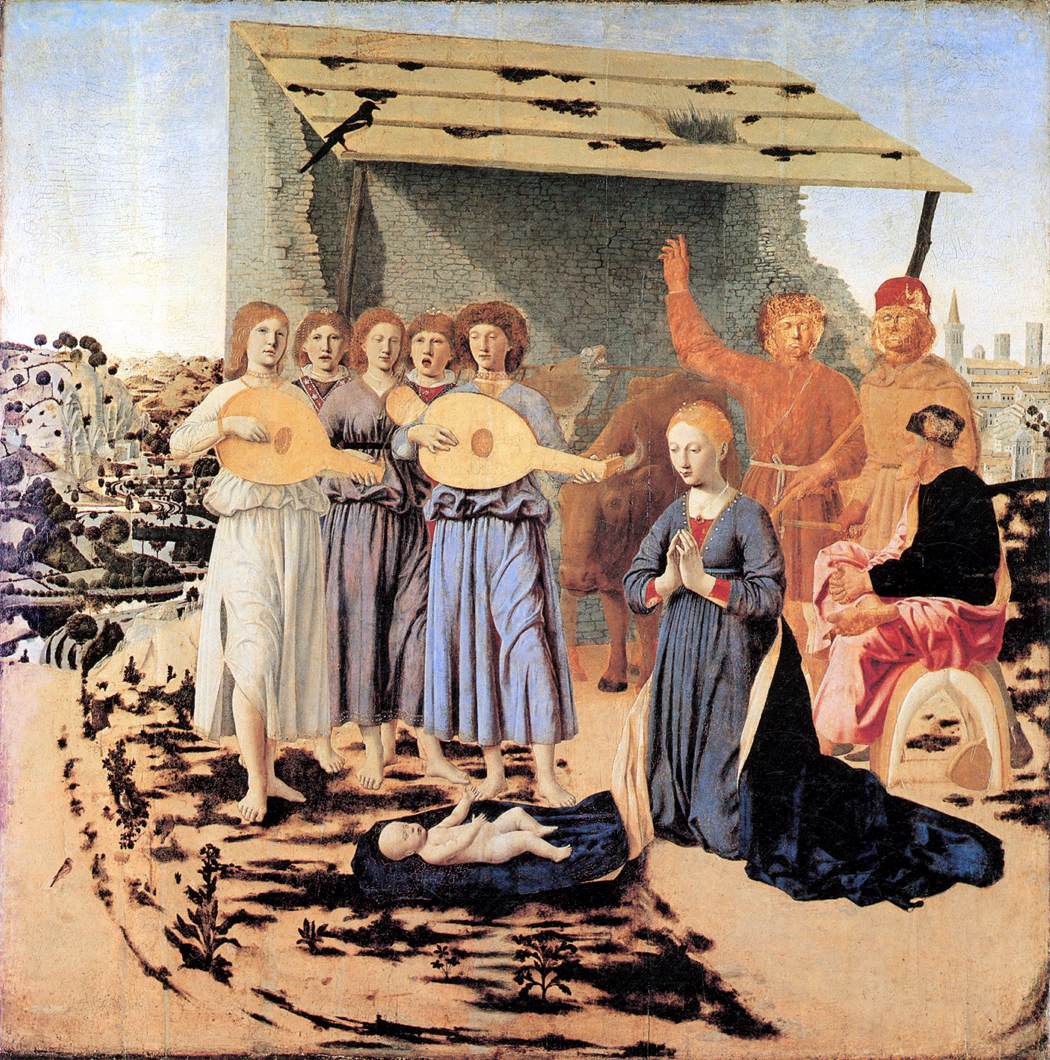 Renaissance: Orlando di Lasso, Giovanni Pierluigi da Palestrina and Tomás Luis de Victoria. This year we’re doing something similar but focusing on the composers that worked at the end of the period, with some of them forming the early phases of the Baroque. The great city of Venice is another theme that is common to our composers.
Giovanni Gabrieli, the oldest of the four, was born either in 1554 or in 1557 and lived most of his life in Venice. He only left the city to study with Orlando di Lasso who at that time was employed at the court of Duke Albrecht V in Munich. Soon after returning to Venice, Gabrieli became the chief organist at St. Mark’s basilica. Gabrieli brilliantly used the architectural and acoustical peculiarities of the basilica, writing polychoral compositions, in which two choruses, placed across the nave from each other, sing sequentially while the echo creates additional musical effects. Here’s Gabrieli’s O magnum mysterium (O great mystery) celebrating the newborn Lord. It’s performed by The Philip Jones Brass Ensemble and the Choir of King's College, Cambridge, Stephen Cleobury conducting.
One of Gabrieli’s students was a German composer Heinrich Schütz, born on October 18th of 1585 in Köstritz, Thuringia. He lived in Venice for three years, from 1609 to 1612, being sent there by Landgrave Moritz of Marburg specifically to study with Giovanni Gabrieli, since “a widely famed but rather old musician and composer, was still alive, I should not miss the chance to hear him and learn something from him.” Some years later, in 1628, when Schütz was already established in Dresden as a court composer to the Elector of Saxony, he went to Venice again. On that trip he met and studied with another of our composers, Claudio Monteverdi. In 1660 Schütz wrote Christmas Vespers for the Court chapel in Dresden. Here’s the O bone Jesu, fili Mariae section of the Vespers. It’s performed by the Gabrieli Consort, Paul McCreesh conducting.
We just mentioned Claudio Monteverdi. The great Italian is famous as a “father of the opera,” but during his long life (he was born in May of 1567 and died in 1643) he wrote many sacred pieces. One of the most important of these works was his Vespro Della Beata Vergine (Vespers for the Blessed Virgin), written around 1610, when Monteverdi was in Mantua working for the Dukes of Gonzaga. Vespers is a multi-part composition, containing several psalms and motets and ending with in a Magnificat. Here’s the psalm Dixit Dominus, it’s performed in St. Mark’s basilica by the Monteverdi Choir and the English Baroque Soloists under the direction of John Eliot Gardiner.
And finally, another German, Michael Praetorius, who was born in Eisenach (also Johann Sebastian Bach’s birthplace), probably on February 15th of 1571. Praetorius had never been to Italy, but was influenced by Italian musicians while at the court of Johann Georg I, the Elector of Saxony. It was also in Dresden that Praetorius met Heinrich Schütz. Here, from his Mass For Christmas Morning is the motet Jesaja dem Propheten das geschah. Paul McCreesh conducts the Gabrieli Consort.
Read more...Michael Praetorius - Jesaja dem Propheten das geschah, from Mass For Christmas Morning
Gabrieli Consort (Ensemble)
Paul McCreesh (Conductor)
Claudio Monteverdi - Dixit Dominus, from Vespro Della Beata Vergine
Monteverdi Choir (Chorale)
English Baroque Soloists (Ensemble)
John Eliot Gardiner (Conductor)
Heinrich Schütz - O bone Jesu, fili Mariae, from Vespers
Gabrieli Consort (Ensemble)
Paul McCreesh (Conductor)
Ludwig van Beethoven - Symphony No. 1 in C major op. 21
Chicago Symphony Orchestra (Orchestra)
Fritz Reiner (Conductor)
Ludwig van Beethoven - Violin Sonata No. 9 in A Major, ("Kreutzer") Op. 47
Bronisław Huberman (Violin)
Ignaz Friedman (Piano)
Beethoven plus Uchida, Huberman, and Reiner, 2019
This Week in Classical Music: December 16, 2019. Beethoven plus Uchida, Huberman, and Reiner. Next year we’ll be celebrating Beethoven’s 250th anniversary – he was born in Bonn on this day in 1770. We’ll have many occasions to celebrate this event in 2020, but right now we’ll focus on three interpretations of Beethoven’s work, by a pianist, a violinist, and by a conductor, all 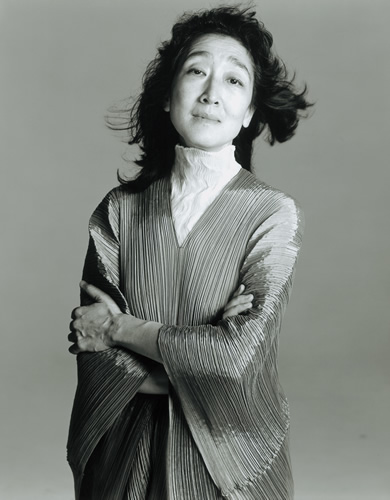 three of whom were born this week.
The marvelous Japanese pianist living in Britain, Mitzuko Uchida is known as a superb Mozartean, but she’s equally good in Beethoven. Dame Uchida, a citizen of the UK, was born near Tokyo on December 20th of 1948. Her father was a diplomat, and the family moved to Austria when Mitzuko was 12. She studied at the Vienna Academy of Music; among her teachers were Wilhelm Kempff and Maria Curcio. In 1982 she played all of the Mozart sonatas in London and Tokyo (later she repeated the program in New York). Mitzuko Uchida is also an acclaimed interpreter of Schubert, Chopin, Debussy and Schoenberg, especially his Piano Concerto. We’ll hear how Mitzuko Uchida plays Beethoven’s Sonata no. 28, Op. 101. The sonata was written in 1816; it’s the first of Beethoven’s five late sonatas, and while not as famous as the following ones, from Hammerklavier no. 29, to the three sequential opuses, 109, 110, and 111 (sonatas no. 30, 31 and 32), we think it’s very much on the same breathtaking level. Mitzuko Uchida recorded all five late sonatas; this particular recording was made in 2007.
Bronisław Huberman was a Polish-Jewish violinist, one of the most renowned musicians in the inter-war period. Huberman was born in Częstochowa, Poland, on December 19th of 1882. He studied in Berlin and Paris and became famous by the age of 12 after touring the major capitals of Europe. Huberman and Arthur Rubinstein were best friends since they were boys, when Huberman was ten and Rubinstein was six. When the Nazis came to power, Huberman helped the prosecuted Jewish musicians move to Palestine and create what was then called the Palestine Symphony Orchestra, now the Israel Philharmonic (Huberman, who lived mostly in Vienna, moved to Switzerland after the Anschluss). Huberman made numerous recordings at the "Berliner Rundfunk" but those were destroyed during WWII. Fortunately, he also recorded in London and the US. Here’s Beethoven’s Violin Sonata No. 9, “Kreutzer.” The sonata, op. 47, was written in 1803. Huberman is accompanied by the pianist Ignaz Freidman, another famous Polish-Jewish musician. The recording was made in London in 1930.
And finally, the conductor. Fritz Reiner, one of the most important conductors of the 20th century (and another famous Jewish musician from Eastern Europe), was born in Budapest on December 19th of 1888. In 1914 he was hired as one of two principal Kapellmeisters at the Hofoper in Dresden. He stayed there till 1921 and worked closely with Richard Strauss. Reiner moved to the US in 1922. He worked with the Cincinnati and Pittsburgh symphony orchestras, and then, from 1953 till his death in 1963, was the music director of the Chicago Symphony, making it, in the words of Igor Stravinsky, ”the most precise and flexible orchestra in the world.” While a consummate musician, Reiner often behaved as an ill-tempered disciplinarian. Here’s Reiner conducting the Chicago Symphony in Beethoven’s First Symphony, op. 21, written around 1795. The recording was made in 1961.
Read more...Ludwig van Beethoven - Piano Sonatas No.28, Op.101
Mitsuko Uchida (Piano)
Johann Sebastian Bach - Christmas Oratorio, Part V
New London Consort (Ensemble)
Philip Pickett (Conductor)