
Franz Joseph Haydn - Sailor's Song
Mischa Bouvier (Baritone)
Yegor Shevtsov (Piano)
Franz Joseph Haydn - She Never Told Her Love
Mischa Bouvier (Baritone)
Yegor Shevtsov (Piano)
Hans Rott, 2018
July 20, 2018. Pre-Mahlerite: the tragic story of Hans Rott. Hans Rott’s name is practically unknown these days. Usually when a composer, especially one born in modern times, is rarely performed, there’s a reason for it: it’s probably because his (and it’s almost invariably “his,” not 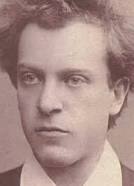 “her”) music is not very interesting (the numerous minor Italian late-Baroque composers come to mind). We think Rott is an exception, even if we don’t expect his music to join the classical cannon any time soon. Rott’s life was both short and tragic. He was born on August 1st of 1858 in a suburb of Vienna. His father’s original name was Roth, which means that Hans was most likely Jewish, although we don’t know whether he, like Mahler some time later, had later converted to Catholicism. Rott attended the Vienna Conservatory, where his organ teacher was Anton Bruckner. His composition teacher was Franz Krenn, who also taught Mahler. Mahler, two years younger, and Rott even shared a room for a while. But it was Bruckner, and also Wagner, who influenced Rott the most. In 1878 (he was 20) Rott decided to participate in a composers’ competition, submitting the first movement of his Symphony in E Major. Everybody on the jury, except for Bruckner, was highly negative. Two years later, Rott presented the complete symphony to Brahms. He should’ve known better! Brahms intensely disliked both composers whose influence he could discern in Rott’s music: Wagner and Bruckner. Brahms’s criticism was vicious: he told Rott that he had no talent and should look for a different vocation while he was still young. We can assume that at that time Rott was already mentally ill, because just several months later while traveling to Mülhausen by train (he had reluctantly applied for and received a position of the director of the Alsatian choir association) he pointed a revolver at a fellow passenger who was trying to light a cigar. The previous encounter with Brahms was probably on his mind, as in his madness he claimed that Brahms had planted dynamite on the train and he, Rott, was just trying to save his fellow travelers from being blown up. Rott was brought back to Vienna and institutionalized. He spent the rest of his short life in a lunatic asylum. Rott died of tuberculosis on June 25th of 1884, at age 25.
Here’s what Mahler said in a conversation with a friend, the violist Natalie Bauer-Lechner: “What music has lost in him is immeasurable. His first symphony, written when he was a young man of twenty, already soars to such heights of genius that it makes him – with exaggeration – the Founder of the New Symphony as I understand it. It is true that he has not yet fully realized his aims here. It is like someone taking a run for the longest possible throw and not quite hitting the mark. But I know what he is driving at. His innermost nature is so akin to mine that he and I are like two fruits from the same tree, produced by the same soil, nourished by the same air. We would have had an infinite amount in common. Perhaps we two might have gone some way together towards exhausting the possibilities of this new age that was then dawning in music.” This acknowledgement from Mahler, who started composing his own First Symphony five years after Rott completed his, is very important. Rott’s music is very Mahlerian in its sound, style, even in somewhat chaotic development. Rott stopped composing at the age of 22, consumed by insanity. In addition to his symphony, he wrote several songs, smaller orchestral pieces, a string quartet and a string quintet. We can only guess how his talents would’ve developed, but as one listens to his Symphony in E, it becomes clear that his potential was immense. Here ’s the first movement, Alla Breve; here – the second, Adagio - Sehr Langsam; here – the third, Frisch und lebhaft; and, finally, here – the fourth, Sehr langsam – Belebt. It’s performed by the Mainz State Theater Philharmonic Orchestra, Catherine Rückwardt conducting.
Read more...Hans Rott - Symphony in E Major, mov. 4, Sehr langsam - Belebt
Mainz State Theater Philharmonic Orchestra (Orchestra)
Catherine Rückwardt (Orchestra)
Hans Rott - Symphony in E Major, mov. 3, Frisch und lebhaft
Mainz State Theater Philharmonic Orchestra (Orchestra)
Catherine Rückwardt (Conductor)
Hans Rott - Symphony in E Major, mov 2, Adagio - Sehr Langsam
Mainz State Theater Philharmonic Orchestra (Orchestra)
Catherine Rückwardt (Conductor)
Hans Rott - Symphony in E Major, mov. 1, Alla Breve
Mainz State Theater Philharmonic Orchestra (Orchestra)
Catherine Rückwardt (Conductor)
Cilea, Granados, Dohnanyi, Fleisher 2018
July 23, 2018. Cilea, Granados, Dohnanyi, Fleisher. This week is full of anniversaries: composers, conductors, pianists and a singer. We’d like to mention (for the first time) Francesco  Cilea, the Italian opera composer who was born on this day in 1866. He’s remembered for his opera Adriana Lecouvreur, written in 1902. Even back then it probably sounded rather dated, and clearly sounds so these days, but the young Enrico Caruso sung at the premier to great acclaim, and some of the arias are very beautiful. All great sopranos of the last half century have sung Adriana: Montserrat Caballé, Joan Sutherland, Maria Callas. Here’s the incomparable Renata Tebaldi in the aria Io son l'umile ancella with the Orchestra of the Accademia de Santa Cecilia under the direction of Alberto Erede (Mario del Monaco and Giulietta Simionato are also in this fabulous 1962 recording).
We celebrate the Spanish composer Enrique Granados, who was born on July 27th of 1876, practically every year (here, for example is the entry from a year ago). So today we’ll just play his Los Requiebros, the first piece from Granados’s piano suite Goyescas. It’s performed by Jie Chen, a young Chinese-American pianist.
Ernst von Dohnányi was not as popular these pages as Granados. One reason is that as a composer he was not as interesting as some of his contemporaries. Dohnányi was, though, and under very difficult historical circumstances, a highly moral and principled person. Dohnányi, famous first as a pianist and conductor, was born on July 27th of 1877 in Bratislava, then called Pressburg in German and Pozsony in Hungarian. (His last name probably sounds familiar to many readers: he was the grandfather of the distinguished German conductor Christoph von Dohnányi). In the late 1890s he played piano concerts across Europe and the US. In the 1920s, he was appointed the head of the Budapest Academy of Music, and in that position he promoted Hungarian composers, Béla Bartók or Zoltán Kodály among them.
A staunch liberal, he opposed the fascist tendencies of the Horthy aurocratic government. During WWII, he did much to save Jewish musicians, for which he was later called a “forgotten hero of the Holocaust resistance.” Dohnányi was also a noted teacher; among his pupils were the conductor Georg Solti and the pianists Annie Fischer and Georges Cziffra. Here’s a live recording of Dohnányi’s Rhapsody in C Op.11 No.3. Annie Fischer is at the piano.
Several great performers were born this week, and all we can do today is just mention them by name. The pianist Leon Fleisher was born 90 years ago today in San Francisco. His mother wanted him to become a pianist and Leon started studying the instrument at the ago of four. At the ago of 16 he played with the New York Philharmonic under Pierre Monteux, who called him “a find of the century.” Fleisher later studied with Artur Schnabel. In 1952 Fleisher won the Queen Elisabeth International Music Competition; by the late1950s he was widely recording (his recording of all five Piano Concertos by Beethoven, with the Cleveland Orchestra conducted by George Szell, was highly praised) and he was generally considered the brightest start among the new generation of American pianists. Then, in 1964, disaster struck: Fleisher lost the use of his right hand due to focal dystonia. He switched to left-hand repertory, playing, for example, left-hand concertos by Ravel and Prokofiev. After a surgery and other treatments, around 1997 Fleisher returned to two-hand repertory even thought his technique, spectacular prior to the disease, did not completely recover. Here’s Leon Fleisher playing Mozart’s Piano Sonata in C major, K.330 (1960 recording).
Riccardo Muti and Giuseppe Di Stefano were also born this week. We’ll write about them soon.
Read more...Wolfgang Amadeus Mozart - Sonata in C Major, K. 330
Leon Fleisher (Piano)
Franz Joseph Haydn - The Spirit's Song
Mischa Bouvier (Baritone)
Yegor Shevtsov (Piano)