
Old picture, 2017
October 30, 2017. An old picture. Last week, as we were looking for a good photograph of Emil Gilels, we came across this picture. It was taken during the May 1 celebrations in 1940; in it are six young musicians, all of great talent, aged 17 to 27. Young, happy, Jewish (those were the last pre-Antisemitic days of the Soviet Union), they are 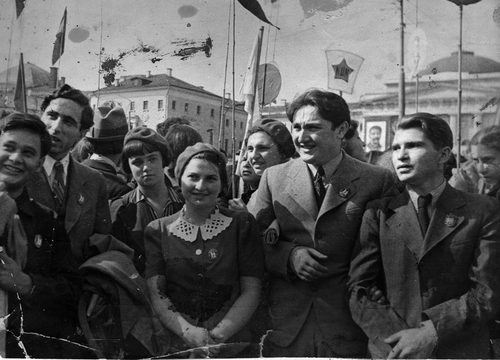 standing in a crowd on the Manezh Square, just outside of the Kremlin (behind them is Moscow University), smiling. 1940 was the year between two catastrophes, that of the Great Terror of 1937-38 and the war with Germany, which would invade the Soviet Union in a year. But in the meantime, they were living a rather privileged life: they made the young Soviet state proud, and the state responded with honors and good apartments. Who are they? Let’s start on the left and moveright. On the left is the youngest of them all, Busya (Boris) Goldshtein at 17. A violinist and a child prodigy, he was in in Odessa, and studied with Pyotr Stolyarsky. When Jascha Heifetz visited the Soviet Union in 1934, he met with many young violinists and singled Busya out. In 1935, at age 12 and a half, he won the fourth prize at the Henryk Wieniawski Violin Competition in Warsaw (Ginette Neveu was first, David Oystrakh came in second). Two years later, still not even 15, he received the fourth prize at the first Ysaye Competition in Brussels. During the war, being a student of the Moscow Conservatory, he, as many other musicians performed at the front line. This prevented him from timely passing the exam on a very important subject, “Brief History of the Communist Party.” So, despite his fame and honors, he was expelled from the Conservatory, which for all purposes was the end of his career. Goldstein emigrated to Germany in 1972 but never regained the status he held while a teenager.
Next to him stands the pianist Yakov Flier, at 27 the eldest. Flier was born on October 21st, 1912, in Orekhovo-Zuyevo, a town outside of Moscow famous for its textile production but not its culture. Not at all a wunderkind, his talent developed slowly. After attending the Central music school, he was accepted at the Conservatory and studied there with one of the best professors, Konstantin Igumnov. He reached his full potential only by the end of his studies, but once at the top, he remained at the top as long as he could play.
Starting 1935, he embarked on a series of concerts across the Soviet Union. In 1936 he won a piano competition in Vienna, ahead of his friend Emil Gilels, who took the second prize. Gilels would have his revenge two years later in Brussles, where he won the Ysaye while Flier was “only” the third. As early as in 1945 Flier noticed problems with his right hand; it was getting worse and by 1949 Flier could no longer play. He was absent from the concert scene for 10 years but returned in 1959 after a successful surgery and rehabilitation. While his earlier playing was romantic, sometimes too much so, it became deeper and more introspective. In 1960s and the 70s he toured in Europe and the US and became one of the most sought-after professors of the Moscow Conservatory.
Next to Flier, a step behind, stands the 18-year-old Rosa Tamarkina, fresh from a triumph at the Chopin competition. Why is she standing next to Flier, and not to Emil Gilels, whose wife she would become later that year? Is she still infatuated with Flier, as was rumored in Moscow? Why didn’t she marry him, one wonders – her marriage to Gilels was not very happy and brief, as, tragically, was her life. We’ll have to wait till next week to conclude our story about this remarkable group.
Read more...Emil Gilels, 2017
October 23, 2017. Emil Gilels. Last week we intended to write about the great Russian pianist, Emil Gilels but ran out of space. This week, even though we have several very interesting anniversaries, we’ll start with him. Emil Gilels was born in Odessa on October 19th of 1916. At that time, the musical Odessa was an amazing place. The whole school of violin 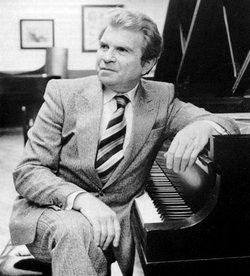 playing came out of Odessa: Pyotr Stolyarsky established it, and among his students were David Oistrakh, Nathan Milstein, Boris Goldstein, and Emil’s sister, Elizabeth Gilels. The pianists Benno Moiseiwitsch, Vladimir de Pachmann, Shura Cherkassky, Yakov Zak were all from Odessa. Sviatoslav Richter, though not born in Odessa, studied there. As most of the Odessa musicians, Emil Gilels was born into a Jewish family. His first teacher, at the age of five and a half, was Yakov Tkach (who, as Gilels acknowledged later, built the foundation of the pianist’s prodigious technique). Emil gave his first public concert at the age of 12. In 1930, not quite 14, he was accepted into the Odessa Conservatory, class of Berta Reingbald, whose other star pupil was Tatiana Goldfarb. In 1932 he met Arthur Rubinstein, who was visiting Odessa, and they became friends, even though Rubinstein was almost 30 years older. In 1933 Gilels won the first All-Union Performers’ Competition in Moscow and became famous overnight. He graduated from the Odessa Conservatory in 1935 and for the following three years studied with Heinrich Neuhaus in Moscow. He won several piano competitions, including the Concours Eugène Ysaÿe, Brussels, in 1938, and established himself as one of the most brilliant young pianists in the Soviet Union. Sergei Rachmaninov, then in the States, had heard about Gilels since his win in Moscow in 1933. After Brussels, many of Gilels’s performances were recorded, and Rachmaninov could listen to them on the radio. He decided that Gilels was his worthy successor, and sent him the Anton Rubinstein medal, which he received upon graduating from the Conservatory, and his Conservatory diploma. Gilels cherished these gifts for the rest of his life.
During WWII Gilels performed for the troops and, in 1944, premiered Prokofiev’s 8th piano sonata. In 1945, he formed a highly successful trio with Leonid Kogan (his brother in law – Kogan married his sister, the violinist Elizabeth) and the 23-year old Mstislav Rostropovich. After the war he became one of the first Soviet musicians to be allowed to travel and perform abroad (David Oistrach was another pioneer). Gilels played his American debut at the Carnegie Hall in October of 1955. Eugene Ormandy conducted the Philadelphia Orchestra. The performance of Tchaikovsky’s First Piano concerto was a triumph (both Rachmaninov and Horowitz also chose this concerto for their debuts). The rest of his US tour was equally successful. He returned to the States several times, and was always received equally well. Gilels was permitted to travel to other Western countries, a privilege not afforded to many Soviet musicians. He toured all over Europe and Japan playing with the greatest orchestras and conductors. Still, in the centralized Soviet Union, where everything had to be ranked, he was considered to be second to Sviatoslav Richter, as Kogan was considered second to Oistrakh, or Danill Shafran – to Rostropovich. These comparisons of course are nonsense, Gilels was second to no one, he was one of the greatest pianists of the 20th century. In 1981, after a concert at the Concertgebouw in Amsterdam Gilels suffered a heart attack. He never fully recovered and died on October 14th of 1985 in Moscow.
Gilels’s repertoire was phenomenally broad. He played “everything.” He was considered one of the greatest interpreters of Prokofiev’s piano sonatas. He recorded all of Beethoven’s piano concertos seven times. His Mozart was incomparable. Out of this treasure trove we’ll play just two sonatas of Domenico Scarlatti – and that’s because Scarlatti was also born this week, on October 26th of 1685. Here’s his sonata Sonata K.141, and here – Sonata K.533. Both were recorded live in London in 1957.
Read more...Domenico Scarlatti - Sonata in A major, K. 533
Emil Gilels (Piano)
Domenico Scarlatti - Sonata in C-sharp minor, K. 247
Emil Gilels (Piano)
Domenico Scarlatti - Sonata in G major, K. 125
Emil Gilels (Piano)
Domenico Scarlatti - Sonata in D minor K. 141
Emil Gilels (Piano)
Franz Liszt - Après une Lecture de Dante (Fantasia quasi Sonata)
Aristo Sham (Piano)
Wolfgang Amadeus Mozart - Sonata in F Major, K 533/494
Aristo Sham (Piano)
Johann Sebastian Bach - Jesu, Joy of Man’s Desiring (from Cantata No. 147)
Aristo Sham (Piano)
Clara Schumann - Drei Romanzen, Op. 22 for Clarinet and Piano, I
Shtrykov-Tanaka Duo (Duo)