
Frédéric Chopin - Nocturne op. 55, no. 1
Arthur Rubinstein (Piano)
Frédéric Chopin - Nocturne op. 48, no. 2
Arthur Rubinstein (Piano)
Frédéric Chopin - Nocturne op. 37, no. 1
Maurizio Pollini (Piano)
Frédéric Chopin - Nocturne op. 37, no. 2
Maurizio Pollini (Piano)
Chopin’s Nocturnes, part II, 2015
September 7, 2015. Chopin’s Nocturnes, part II. On this holiday weekend we’ll skip several important anniversaries (Antonin Dvořák; one of our all-time favorites Henry Purcell; William Boyce, another wonderful English composer; and Arvo Pärt – we’ll write about them at another time) and turn to the nocturnes by Frédéric Chopin. This is the second part of an article, which 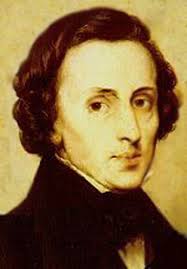 we started on July 13th. It is a testament to the changing musical tastes that we’ll have to compliment the performances by the young pianists from our library (Krystian Tkaczewski and Gabriel Escudero) with those of the masters (Pollini, Rubinstein, Richter, Barenboim, and Horowitz), borrowed from YouTube. Not that long ago Chopin’s nocturnes were among the most often played pieces in all of the piano repertory. Not that anybody today doubts that these are works of genius – they’re just not performed as often. In some sense it’s even better, as they sound fresher that way. ♫
2 Nocturnes, op. 37
The two nocturnes published as op. 37 form a marvelous pair of contrasting major/minor key pieces. Published in 1840, they were also composed around that time. The latter of the two, that in G major, with its barcarolle rhythms, is believed to have been composed the previous year when Chopin accompanied George Sand to the island of Majorca. At one time, these two works were highly praised. Robert Schumann considered them the finest nocturnes Chopin composed describing them as “of that nobler kind under which poetic ideality gleams more transparently (than the earlier Nocturnes).” However, since the twentieth century, this praise has somewhat waned.
The first of the op. 37 nocturnes is in G minor (here). Its lugubrious melody is modestly ornamented and unfolds expressively over a chordal accompaniment in steady quarter notes. It is immediately restated, with some further ornamentation, but greatly intensified as the dynamic is raised from piano to forte, and even reaches fortissimo. Yet, Chopin reigns in the melody’s emotional outpouring with a softer dynamic at the start of its second strain, leaving it to carry on in hushed torment until its conclusion. From a closing cadence in the tonic key, Chopin modulates with ease into the key of E-flat major for the consoling middle portion. This entire episode takes on the character of a simple, pious choral, which some commentators interpret as an expression of Chopin’s faith in religion. With the exception of a few grace notes, the quarter note rhythm is undisturbed, carrying the music along with unshakeable surety. Indeed, there is an effortless serenity here in Chopin’s music. During its last measures, the chorale is broken up by pauses, and subtle changes in harmony lead to reestablishment of the key of G minor. The opening melody is then reprised and is virtually unchanged, albeit shortened, and its final measures are altered to bring about an effective close on the tonic major chord. (Continue reading here).
Read more...Aaron Alter - Homage to Josquin
Linda Marianiello (Flute)
Susan Levitin (Flute)
Jacquelyn Helin (Piano)
Aaron Alter (Conductor)
Anna Leonova - Lyrical Duet for Violin and Violoncello
Sofia Grabovska (Violin)
Ivan Kucher (Cello)
Franz Schubert - Piano Sonata in G Major, D. 894
Weiyin Chen (Piano)
Johannes Brahms - Intermezzo No. 2 in A Major, from Six Piano Pieces, Op. 118
Weiyin Chen (Piano)
Frédéric Chopin - Nocturne op. 62, no. 1
Daniel Barenboim (Piano)