
Frédéric Chopin - Berceuse Op.57
Solomon (Piano)
Short takes, August 2021
This Week in Classical Music: August 2, 2021. Short takes. We’ll follow the lead of the musicologist Alejandro Planchart who, after sorting out all kind of information, had determined 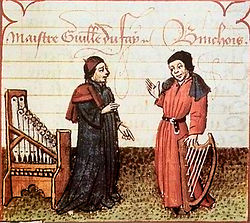 that Guillaume Dufay was born on August 5th of 1397. Dufay (his name was also spelled as Du Fay and Du Fayt) was the most famous composer of his time, that being the early Renaissance of European music. (The picture to the left indirectly attests to his fame: depicted on the left is Guillaume Dufay, on the right – Gilles Binchois, three years younger but also a famous composer; the script above the figures calls Dufay, and only him, “maître,” or master– Binchois is identified just by his name). We’ve written about Dufay a number of times, the last time just a year ago when we analyzed his peregrinations around Europe, here, which are absolutely fascinating, considering the distances he traveled and the general lack of any transportation infrastructure. Getting back to music: what we also find interesting is the use of certain technical devices, which changed as music forms were being developed. For example, early in his career, Dufay wrote what is called “isorhythmic” music. Isorhythm is just a way of using a fixed rhythmic pattern, called talea, which repeats, without change, in one of the voices, usually in the tenor. The use of talea was invented in the Middle Ages, was used by composers like Guillaume de Machaut, and was supposed to give certain structure to the musical piece. That’s how Dufay wrote his motets and masses early on. He dropped this device to write freer and more melodic music later in his career. Here’s Dufay’s early isorhythmic motet, Vasilissa ergo gaude (Therefore rejoice, princess) from about 1420. It’s performed by the Huelgas Ensemble, Paul Van Nevel conducting. And here’s the section Gloria in excelsis Deo from Dufay’s mass Missa ave regina, which was written later in his life, after 1463 (Dufay died in 1474). Ensemble Cantus Figuratus is led by Dominique Vellard.
Several composers from the modern era were also born this week: the Frenchman André Jolivet on August 8th of 1905 in Montmartre, Paris, and the American, William Schuman, on August 4th of 1910, in Manhattan, New York. Another French composer, Cécile Chaminade, was born on August 8th of 1857, also in Paris. With recent changes in cultural attitudes, Chaminade has enjoyed more popularity than any time since her death in 1944. We’ll have a guest post about Chaminade coming soon. Also, Erich Kleiber, the great Austrian conductor, was born on August 5th of 1890, in Vienna. He moved to Berlin in 1923 to assume the directorship of the Berlin State Opera. Kleiber, who was neither Jewish nor politically active and therefore could have continued to live and conduct safely in Germany, left the country in protest to the Nazi regime’s policies and emigrated to Argentina. Erich Kleiber was the father of Carlos Kleiber, also a celebrated conductor.
Read more...P. Kellach Waddle - Op. 696 No Darker Saturday Than Tenebrae: Holy Saturday Impression For Solo Bass
P. Kellach Waddle (Double Bass)
Guillaume Dufay - Gloria in excelsis Deo , from Missa Ave Regina Caelorum
Cantus Figuratus (Ensemble)
Dominique Vellard (Conductor)
Guillaume Dufay - Vasilissa ergo gaude
Huelgas Ensemble (Ensemble)
Paul Van Nevel (Conductor)
P. Kellach Waddle - Op.372a :Of Vinegar, Blood, Tears, and Faith: Good Friday Impression For Solo Bass
P. Kellach Waddle (Double Bass)
Giuseppe Di Stefano, 2021
This Week in Classical Music: July 26, 2021. Di Stefano. We missed a big date, Giuseppe Di Stefano’s 100th anniversary, by two days: he was born in a small village of Motta Sant’Anastasia, 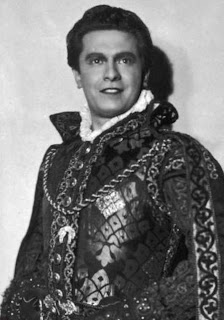 near Catania in Sicily on July 24th of 1921. His family moved all the way north to Milan when Giuseppe was six. At the age of 20 he began voice studies with Luigi Montesanto, a fine baritone and teacher. The war interrupted his career as Di Stefano was conscripted. The regiment’s doctor, having heard him singing, gave him a medical dispensation, saying that he would better serve Italy as singer than a soldier. The regiment was sent to the Russian front where most of the soldiers, including the doctor, were killed. In 1943 Di Stefano fled to Switzerland, was interned there but then released. In Lausanne he made his first recordings. He returned to Italy in 1946 and soon after made his début at the Teatro Municipale, Reggio nell’Emilia, as Massenet’s Des Grieux. A year later, in 1947, he sang at La Scala. In 1948 he made his Metropolitan debut as the Duke in Rigoletto. He was noticed almost immediately, with a critic comparing the 27-year-old tenor with Beniamino Gigli and praising his warm, sensual timbre. A lyric tenor, in his early career he sang mostly lighter roles. By 1957 he moved to heavier “spinto” and even dramatic tenor roles, such as Don José in Carmen, Canio in Pagliacci, Turiddu in Cavalleria rusticana, and Radames in Aida. With this, his voice lost some of its shine and got rougher; still, it was spectacular. Rudolf Bing, the General Manager of the Metropolitan Opera, who knew his singers, said: “The most spectacular single moment in my observation year had come when I heard his diminuendo on the high C in "Salut! demeure" in Faust: I shall never as long as I live forget the beauty of that sound." You can listen to it here, and while the whole aria is sung beautifully, it’s literally breathtaking at around 5’05”. This was a live recording made in 1950 in San Francisco during the War Memorial Opera House Concerts which were then broadcast on NBC. Gaetano Merola conducts the (substandard) San Francisco Opera Association Orchestra.
Walter Legge, the famous record producer, put Di Stefano and Maria Callas together to record many popular Italian operas. One of them, the 1953 recording of Tosca, with Titto Gobbi as Scarpia, is considered one of the best opera recordings ever made. Here’s a 12-minute excerpt from Act I, starting with “Mario! Mario! Quale occhi" from that legendary recording. Di Stefano and Callas are accompanied by the Orchestra del Teatro alla Scala under the direction of Victor de Sabata.
Di Stefano was a bon-vivant, he smoked and partied, had many lovers (he had an affair with his singing partner, Maria Callas), and sometimes – too often, as far as Rudolf Bing was concerned – failed to show up for rehearsals: Bing banned him from the Met for three years. All of that probably affected his career, which at its height was brief: his voice was already in decline in the late 1950s; Di Stefano himself blamed allergies. He rarely performed after a disastrous Otello in Pasadena in 1966. Di Stefano had a house in Kenia. On December 3rd of 2004 he was robbed and beaten there; perpetrators were never found. He never fully recovered from his injuries. Giuseppe Di Stefano died in his home in Lecco on Lake Como, on March 3rd of 2008 at the age of 86.
Riccardo Muti, a wonderful Italian conductor and the Music Director of the Chicago Symphony, will turn 80 on July 28th. He deserves a full entry, which is forthcoming.
Read more...Giacomo Puccini - Mario! Mario! Quale occhi, from Act I of Tosca
Maria Callas (Soprano)
Giuseppe Di Stefano (Tenor)
Orchestra del Teatro alla Scala (Orchestra)
Victor de Sabata (Conductor)
Charles Gounod - Salut, demeure chaste et pure, from Faust
Giuseppe Di Stefano (Tenor)
San Francisco Opera Association Orchestra (Orchestra)
Gaetano Merola (Conductor)
Johannes Brahms - Intermezzo in C Major, Op. 119, No. 3
Solomon (Piano)