
David Bruehwiler - A Journey of Love
David Bruehwiler (Piano)
David Bruehwiler - Fantasy for Barbara
David Bruehwiler (Piano)
David Bruehwiler - Dédié à Claude
David Bruehwiler (Piano)
David Bruehwiler - Moments of Joy
David Bruehwiler (Piano)
Neveu and Stockhausen, 2021
This Week in Classical Music: August 16, 2021. Ginette Neveu and Karlheinz Stockhausen. Last week we promised to write about the violinist Ginette Neveu. The reason Neveu is not 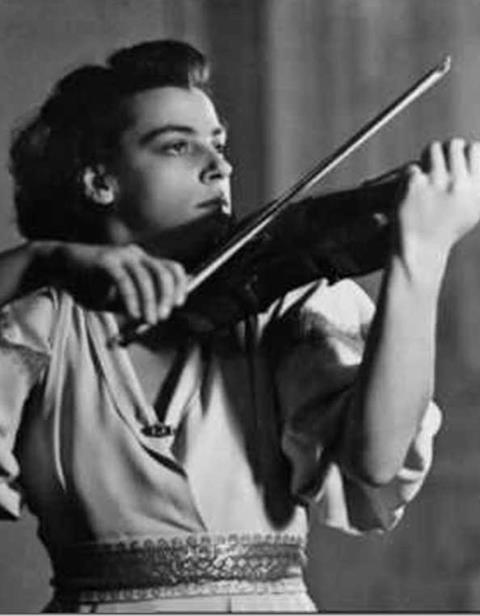 better known is because her life was tragically short. Neveu was born in Paris on August 11th of 1919. Her mother was Ginette’s first violin teacher. Ginette made her first public appearance at the age of seven playing Bruch's Violin Concerto no. 1 and later that same year performing Mendelssohn’s Violin Concerto with the Colonne Orchestra under the direction of Gabriel Pierné. She studied at the Paris Conservatory, receiving a premier prix at the age of 11, and then continued with George Enescu and the Hungarian teacher and violinist Carl Flesch (among Flesch’s pupils were Ivry Gitlis, Ida Haendel, Josef Hassid and Henryk Szeryng). In 1935, aged 15, Neveu won the International Wieniawski Competition; David Oistrakh, who was 11 years her older, took the second place and another Flesch’s pupil, Henri Temianka, took the third prize. Boris Goldstein, then 12 years old, came in the fourth. The Wieniawski win opened all major concert halls for Neveu: after the competition she toured Poland and Germany, then went to the Soviet Union, in 1937 she performed in the United States and Canada. During WWII, Neveu performed very few concerts, all of them in the occupied France (she refused to perform in Germany). In 1946 she played her debut concert in London and a year later – in South and North America. After hearing her perform Beethoven’s Violin Concerto in the first half of a concerts at the Royal Albert Hall, Queen Elizabeth invited Neveu to the royal box for the second half. But it was not just the royal fans who admired her: music critics all over the world praised her playing. Sibelius called Neveu’s performance of his Violin Concerto “extremely sensitive” and “unforgettable.”
On October 27th of 1949 she and her brother, a pianist who accompanied her in many concerts, were on their way from Paris to New York when their plane crashed near the Azores. Everybody on board was killed; her Stradivari was destroyed. Ginette Neveu was thirty when she died. Here’s a recording of Sibelius’s Violin Concerto that so impressed the composer. It was made on November 21st of 1945. Walter Süsskind leads the Philharmonia Orchestra.
Karlheinz Stockhausen was born on August 22nd of 1928 in Burg Mödrath,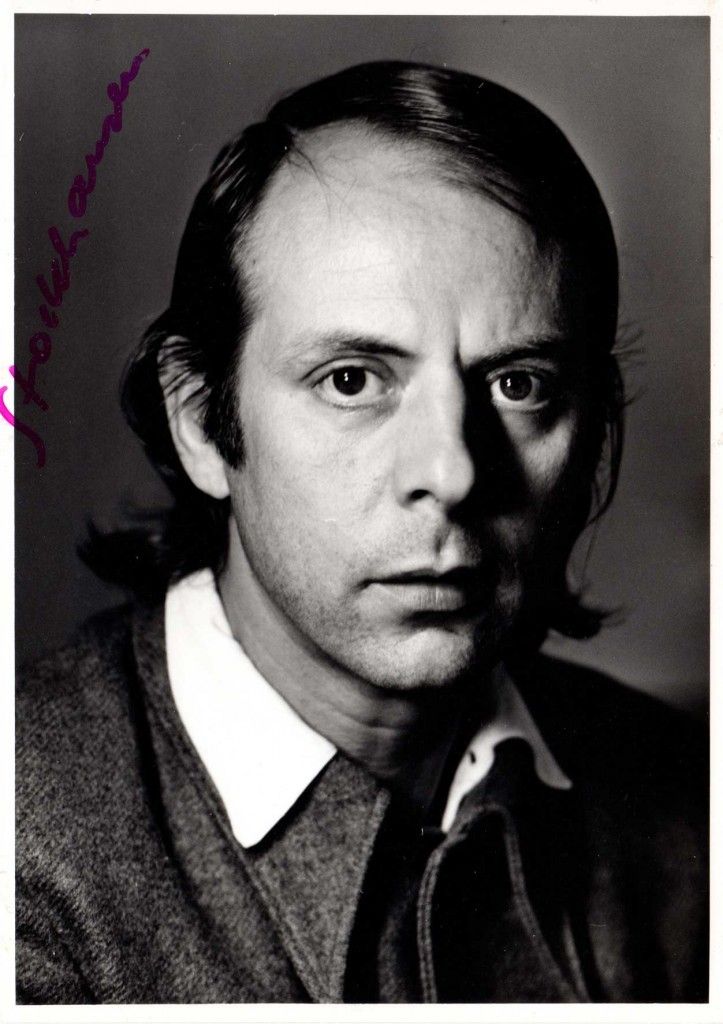 near Cologne. We often mention his name, and always somewhat anxiously: Stockhausen’s music is often very difficult. He was one of the most important composers of the second half of the 20th century, expanding serial composition technique with aleatory, or chance, elements. In the 1950s he was (along with Pierre Boulez and Luigi Nono) one of the most influential figures in the Darmstadt Summer Courses. What is interesting (and, by today’s standards, quite incredible) is that in the 1960s he was the second most recorded composer of the 20th century, after Stravinsky. In the 1970s Stockhausen was appointed professor of composition at the Cologne Musikhochschule. Also in the 1970s Stockhausen started working on his magnum opus. a cycle of seven operas Licht (Light), subtitled "Die sieben Tage der Woche" (The Seven Days of the Week). It was completed in 2003 and consists of 29 hours of music.
Of the three Stockhausen’s pieces in our library, two received “one note,” the lowest rating. Still, we’d like to offer our more adventuresome listeners an early piece called Kreuzspiel (here). It’s not very complicated and, we think, is a lot of fun. Kreuzspiel is performed by the Netherland-based Ives Ensemble.
Read more...Karlheinz Stockhausen - Kreuzspiel
Ives Ensemble (Ensemble)
Jean Sibelius - Violin Concerto
Ginette Neveu (Violin)
Philharmonia Orchestra (Orchestra)
Walter Süsskind (Conductor)
Alexander Borodin - Au Couvent
Nico De Napoli (Piano)
composers and Solomon, 2021
This Week in Classical Music: August 9, 2021. Many composers and one Solomon. We’d like to acknowledge several composers, none of them great, all very interesting: a Venezuelan-born Frenchman Reynaldo Hahn (born August 9th of 1874): it’s not clear if these days he’s better known for his wonderful songs or the friendship with Marcel Proust. Alexander Glazunov, a Russian composer, was also born on August 9th, in 1865. He was a prolific composer of rather old-fashioned music. Glazunov led the St-Petersburg Conservatory during a very difficult time after the revolution; Dmitry Shostakovich was his pupil. Heinrich Ignaz Biber, an Austrian composer, was born in Bohemia on August 12th of 1644, he’s known for his violin music. Maurice Greene (born August 12th of 1696) was an English composer who wrote several popular “anthems.” Another English composer, Kaikhosru Shapurji Sorabji, one of the most unusual composers of all time, was born on August 14th of 1892 (we wrote a brief on him here). His father was a Parsi. Samuel Coleridge-Taylor, yet another English composer, was born on August 15th of 1875. Coleridge-Taylor was highly regarded during his lifetime but then his fame faded rapidly. Coleridge-Taylor’s father was from the African country of Sierra-Leone, which may explain why his music was played more often throughout the last year than during the previous 30. This is not all: the delightful French composer, Jacques Ibert, was born on August 15th of .jpg "Solomon") 1890. August 15th is also the birthday of the American Lucas Foss (b. 1922).
1890. August 15th is also the birthday of the American Lucas Foss (b. 1922).
Now, to the performers. The British pianist known professionally as Solomon was born Solomon Cutner on August 9th of 1902. He had a most unusual career: a child prodigy, he made his public debut at the age of eight, playing Tchaikovsky’s First Piano Concerto at the Queen’s Hall. Just a couple years later he stopped performing and disappeared for about 10 years. In 1924 he returned to the stage, his technique intact. He toured across Europe and in the US, played for the troops during WWII and later formed a famed trio with the violinist Zino Francescatti and cellist Pierre Fournier. Solomon brilliantly played a broad repertoire, including Brahms, Liszt and Tchaikovsky. He was a great interpreter of such disparate composers as Beethoven and Chopin. Here is Chopin’s Berceuse, recorded in 1946. Solomon loved to play Brahms’s Intermezzo in C Major Op. 119 No. 3, both during the main program or as an encore. Here’s a recording from 1952.
The wonderful Italian pianist Aldo Ciccolini was born on August 15th of 1925. Also this week: the brilliant violinist Ginette Neveu, born on the 11th of August of 1919, who tragically died in a place crash at the age of 30.
Read more... « first ‹ previous … 95 96 97 98 99 100 101 102 103 … next › last »
David Bruehwiler - Riders at Sunset
David Bruehwiler (Piano)